





































































































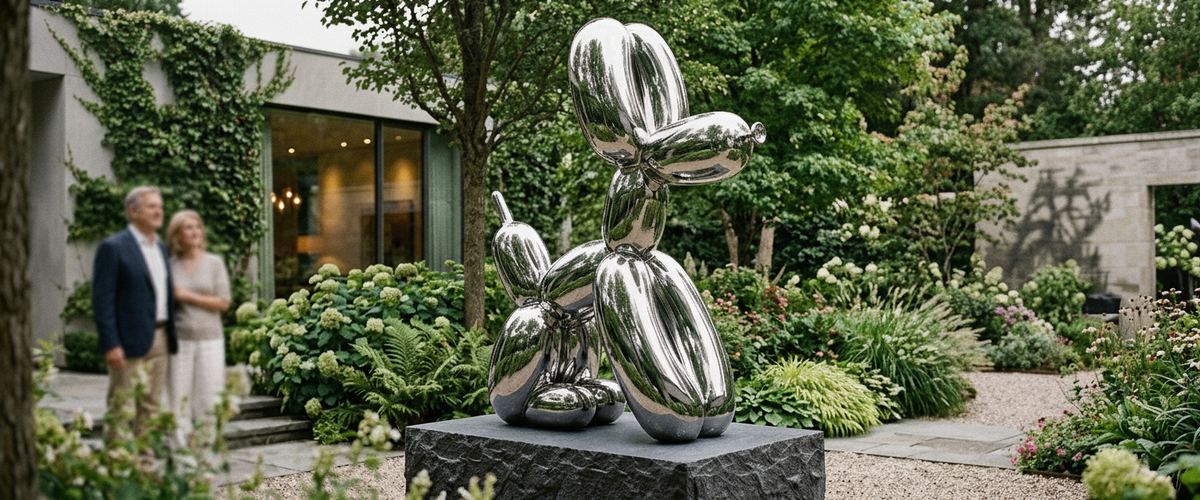

A giant sculpture dog fails in one predictable way. It gets pushed tight against a wall, or dropped in a lobby corner where nobody can step back, and suddenly a piece designed to raise a smile just reads as a large object taking up room. The joke needs air. Get the viewing distance right and the same piece becomes the thing people photograph before they reach reception.

Quick Answer: What Decides Whether a Giant Sculpture Dog Works
Viewing distance beats height. Allow roughly 20 paces of clear approach; the form should resolve before the visitor is standing under it.
Site type matters more than style. Forecourts, enclosed courtyards and double-height atriums flatter big animal forms. Low-ceilinged rooms fight them.
Plinths are a sightline tool, not a status symbol. Raising a playful giant sculpture dog can strand it above the eyeline that makes it funny.
Finish sets the light behavior. Mirror gloss throws the sky and the parking lot back at you. A matte naturalistic coat holds shadow and reads at closer range.
Wind load and fixings narrow the material list before taste gets a say: fiberglass, stainless steel or bronze.
Assume contact. Anything at hand height will be touched daily, so specify the finish accordingly.
Twenty Paces, Not Two
A giant sculpture dog earns its wit through recognition at a distance. You see a familiar silhouette at the wrong size and the brain does a double take. That reaction needs travel: a walk-up, a driveway curve, a mezzanine view across an atrium void. Two paces gives you surface texture and a weld line, which is a different and much smaller pleasure.
Before we quote on scale, we ask clients to walk their site and mark the first point at which the sculpture will be visible. If that point is under 15 feet (about 4.5 m) away, the piece is usually too big for the position rather than too big in itself. A Napa client wanted a 9 foot form at the end of a short entry path; we moved it to the far side of the turning circle instead and kept the height. Same sculpture, completely different effect, because a giant sculpture dog is really a piece of choreography as much as a piece of casting.
A long arrival axis gives the double take somewhere to happen.
Three Sites That Flatter the Size
For wider placement ideas on a giant sculpture dog, Balloon Dog Sculpture: Get the Twist Right and the Rest Follows is useful companion reading before finalizing the setting and sightlines.
Forecourts and turning circles. Cars arrive slowly, the approach is long, and a giant sculpture dog gets seen from several angles in sequence. Center it on the arrival axis, not on the building's structural grid.
Enclosed courtyards. Walls give scale a reference. A giant balloon dog sculpture in a 40 by 40 foot (12 by 12 m) courtyard reads as confident; the same piece loose in an open field looks stranded.
Double-height atriums. The best atrium placements let a giant sculpture dog be seen twice, once from the floor and once from the balcony above. Check the overhead view early. Balloon forms in particular have a strong plan silhouette that most people never think to test.

When a Plinth Kills the Punchline
A plinth does two jobs: it lifts a piece above visual clutter, and it signals formality. A playful giant sculpture of a dog as a balloon animal usually wants to sit on the ground, at dog height, as if it wandered in. Lift it three feet and the humor curdles into monument.
There are exceptions worth respecting when a giant sculpture dog lands in a busy public space. In retail, a low plinth stops trolleys, strollers and cleaning machines from chipping the base. Outdoors, a shallow pad keeps the piece clear of standing water and mulch. In both cases, keep the plinth low and visually quiet so it reads as ground rather than pedestal. Naturalistic and figurative work behaves differently. Where the subject is sincere rather than sly, a modest stone base earns its keep: a piece such as the Traditional Boy and Dog Bronze Sculpture - 150cm at 150cm sits better lifted slightly clear of planting than set flat on gravel, because the raised base reads as garden architecture rather than ceremony.
Balloon Gloss or Naturalistic Coat
Mirror-polished and high-gloss surfaces are daylight machines. They collect sky, foliage, headlights and passing people, which is why a glossy giant sculpture dog photographs so well and why the same finish looks flat under a gray overcast sky or dim indoor lighting. If your site is a shaded courtyard in the Pacific Northwest, gloss loses half its argument.
On a bright site gloss earns its keep; under flat cloud it can look oddly empty.
Matte and coat-textured finishes work the opposite way. They hold shadow, describe muscle and fur, and reward closer viewing. Smaller studio pieces make the contrast easy to test in person before you commit at scale: the mirror-bright Bramhall Silver Balloon Dog Sculpture - 54cm takes its character from whatever surrounds it, whereas the deeper, lower-sheen surface of the Cranford Brown Balloon Dog Sculpture - 71cm keeps its own volume legible in flat light. Scale that difference up to a giant sculpture dog of 8 or 10 feet and it becomes the single biggest decision on the spec sheet.
Wind Load and Anchoring Decide the Material
An exterior giant sculpture dog above roughly 6 feet (1.8 m) is a wind sail with a base plate. US structural wind design follows ASCE 7 loading criteria, and engineers use it to size fixings for exposed sites; coastal gardens and wide open plazas both push the numbers hard. Work through the ASCE 7 standard with your structural engineer rather than guessing.
What that means practically: cast bronze brings mass and needs a dowelled, grouted connection into a concrete pad. Fabricated stainless steel gives strength with lower weight and suits taller, more slender balloon geometry. Fiberglass and composite forms are light, which is an advantage for indoor and rooftop work but makes secure anchoring non-negotiable outdoors. Interior retail installations often use a hidden steel sub-frame instead, tied into the floor slab. On the giant balloon dog sculptures we ship most often for commercial sites, the fixing method is agreed before anyone chooses a finish color.
People Will Touch It, So Plan the Wear
Hands land between 30 and 48 inches (75 to 120 cm) off the ground. On a giant sculpture dog that means the muzzle, the ears and the front leg join, and after a year of public traffic you can see exactly where. Bronze polishes to a bright patch there, which many owners like. Regular inspection and waxing is the baseline for any public bronze, and the Smithsonian's Save Outdoor Sculpture survey is a useful reminder of how unevenly an outdoor surface ages across a single piece.
Gloss coatings behave less forgivingly. Fingerprints, sunscreen and ring scratches show, so plan a wipe-down schedule and specify a repairable topcoat. Also think about the selfie line. If the piece is popular, people will queue at one angle; leave 6 feet of clear standing room on that side and keep planting or seating off it.

Placement Mistakes We Keep Fixing
Backing the piece against glass. A reflective giant sculpture dog plus curtain wall creates a confused double image and glare complaints from staff.
Ignoring the service route. A courtyard reached only through a 30 inch doorway limits you to bolt-together fabrication or a crane lift.
Uplighting a glossy form from below. It blows out as a hotspot. Cross-light from two low angles instead.
Buying color before seeing the site. Bright hues that sing in a white gallery can clash badly with red brick or terracotta paving. Test with a printed panel on site.
Under-sizing to be safe. A 4 foot piece in a 30 foot atrium looks like a mistake. Scale it up, or move it to a smaller room it can actually hold.
Skipping drainage. Hollow forms need a drain point; trapped water freezes and splits seams over a hard winter.
Commissioning Checklist for a Giant Sculpture Dog
Photograph the site from the first visible point and from any balcony above.
Confirm ceiling height, door widths, crane access and floor loading.
Decide gloss or matte based on the site's real light, not on a studio photo.
Get the anchoring design engineered for local wind and seismic conditions.
Agree the maintenance regime and who owns it.
Ask for a scale mock-up or dimensioned overlay before fabrication starts.
Budget for a giant sculpture dog depends on material, finished height, surface complexity, engineering, transport and installation, so the sensible next step is a tailored quote rather than a guess. If you are still narrowing the look, the balloon dog sculptures range is the quickest way to compare form and finish, and the bronze dog statues collection covers the naturalistic route for buyers who want something that will outlast the building. Giant Sculptures builds bespoke work at architectural scale, and the earlier we see your site plan, the better your giant sculpture dog will sit in it.