





































































































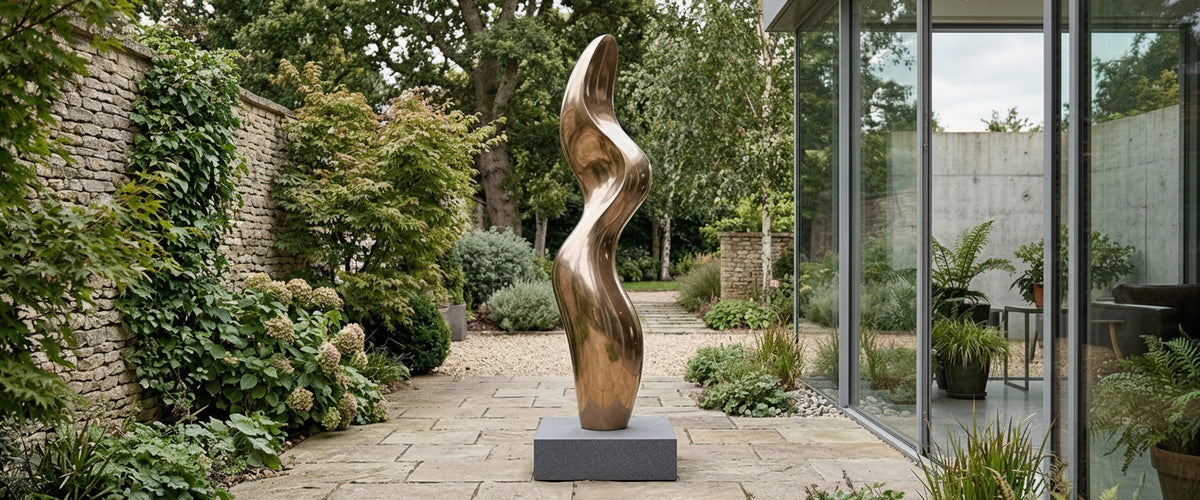

Most large creative products fail for one reason, and it is rarely the piece itself. It is placement. A six-foot bronze that looked commanding in the studio can shrink against a double-height wall, or crowd a hallway until people sidestep it on their way to the kitchen. Scale is a relationship, not a number, and getting that relationship right is what separates a piece that anchors a room from one that just occupies it.
Looking for the full range in this category? Browse our Fiberglass Sculptures collection for every available finish, size, and configuration.
We ship large-scale sculpture worldwide from our UK studio, and the questions that come up most about large creative products are never about the object in isolation. They are about the space around it. So this is a placement guide, written from the buyer's chair: where big work wins, where it stumbles, and the decisions that quietly control how a piece reads.

Key Takeaways for Placing Large Creative Products
- Sightline first: decide where the piece is seen from before you decide its size.
- Pedestal height changes everything: a few inches up or down shifts a sculpture from grounded to floating.
- Outdoors forgives scale, indoors punishes it: open sky absorbs mass that a ceiling cannot.
- Contrast decides impact: a dark bronze needs a light backdrop, a stainless steel piece needs something to reflect.
- Budget depends on material, scale, engineering, finishing, and installation. Ask for a tailored quote rather than guessing from a range.

What Large Creative Products Actually Look Like in Real Spaces
The phrase covers a lot of ground, so let us be concrete. In one entrance hall we have seen a polished bronze figure work as the single thing you notice from the front door, framed by a plain plaster wall. In a courtyard, a Corten steel abstract earned its keep by rusting into a warm ochre that played against green planting. In a lobby, a tall stainless steel form did the opposite job, throwing light and movement into a space that was otherwise flat and gray. That is the reach of large creative products in practice.
These big, imaginative pieces behave differently depending on whether they are read up close or from across a room. A textured stone work rewards proximity; you want people near it, touching the surface. A mirror-finish steel sculpture wants distance and a clear approach so the reflections have room to shift as you walk. Deciding which experience you are buying is the first real choice with large creative products, and it should come before you fall for a particular shape.

Scale, Sightlines and Pedestal Height
Here is the rule we repeat most in commissions: size the piece to the sightline, not the room. A sculpture seen from twenty feet away across an open-plan living space needs more mass than one you meet at arm's length in a reading nook. If the main view is from a sofa, kneel at seated height and check what the eye lands on. That is the framing that matters for large creative products, not the plan view an architect hands you.
Pedestal height is the lever most people ignore. Raise a figure so its center of gravity sits near standing eye level and it reads as present and dignified. Drop it low and it becomes something you look down on, which can be intimate or can just feel neglected. For abstract and metal work, a low plinth often reads as more confident than a tall one, because it lets the form own the floor. We usually mock this up with blocks before anything is fabricated, and clients are routinely surprised how much three or four inches (roughly 8 to 10 cm) changes the feeling.
Weight and engineering ride along with height. A tall pedestal under a heavy bronze needs a base rated for the load and, outdoors, for wind. This is where a bespoke supplier earns the fee: matching the mount to the piece so it is safe for decades, not just for the photo shoot on delivery day. Large creative products live or die on that engineering.

Indoor Versus Outdoor: When Each Wins
Open sky is generous. A piece that would dominate a living room can look modest in a garden because there is no ceiling to compress it and no wall to measure it against. That is why outdoor buyers almost always underestimate the size they need. If a lawn or terrace is the setting, go bigger than instinct suggests, then check it against the nearest architecture so it holds its own next to the house.
Material choice follows the setting. Outdoors we lean toward bronze, stainless steel, Corten, and stone because they take weather and time well. Bronze develops a patina that conservation bodies at the Getty Conservation Institute have documented in detail, and that surface change is a feature to plan for, not a fault to fight. Corten is meant to rust to a stable, protective skin; site it where the run-off will not stain pale paving. Stainless steel stays bright but shows fingerprints and water spotting, so it suits places where someone will wipe it down.
Indoors, the calculus flips. You gain control of light and lose forgiveness on scale. Large creative products in marble or bronze want breathing room on at least two sides and a clear approach. If you are drawn to metal, a stainless steel sculpture can carry a modern interior, but only if there is something for it to reflect: a window, a lamp, a colored wall. Put a mirror finish against flat white in shadow and you have muted the one thing it does best.

Light, Backdrop and Contrast
Contrast is the quiet engine of impact for large creative products. A dark patinated bronze reads best against a light, plain backdrop; a pale stone figure needs a darker or textured wall behind it or it dissolves. Before committing, hold a sample or a printed silhouette against the intended spot at the times of day the room is actually used. Morning and evening light behave very differently, and a piece that sings at noon can vanish at dusk.
Directional light gives sculpture its form. Flat, even lighting flattens it. Outdoors, watch how the sun rakes across the surface through the day; a piece with strong texture wants low-angle light to bring out the modeling. Indoors, a single well-aimed spot usually beats three soft sources. For metal, aim light so the reflections point toward where people stand, not away.
Backdrop clutter is the enemy. A statement piece needs negative space to register as a single object. If the wall behind it is busy with art, shelving, or a patterned finish, the eye cannot separate the sculpture from the noise. Clear the zone. This is the cheapest improvement available and the one buyers resist most when placing large creative products.

Common Placement Mistakes We See in Commissions
For wider placement ideas, Large 3d Wall Art: How Scale, Light, and Placement Decide Its Impact is useful companion reading before finalising the setting and sightlines.
The same errors recur with large creative products, so here is a short checklist to test your plan against.
- Buying to the room, not the sightline. Measure from where people will stand or sit, and size up if the main view is distant.
- Underscaling outdoors. Sky and planting swallow mass. Mock up the footprint with stakes and string before ordering.
- Ignoring the approach. A piece meant to be walked around needs clearance on all sides, not just a nice front.
- Wrong pedestal height. Test with blocks. Eye-level placement suits figures; low plinths often suit abstracts.
- Backdrop competition. A patterned or crowded wall kills a large piece. Give it plain negative space.
- Forgetting run-off and staining. Corten and some bronzes can mark pale stone. Site accordingly and seal the paving if needed.
- No load or wind engineering. Heavy or tall outdoor work needs a base rated for the site, not a decorative plinth.
One more, aimed at anyone treating these big commissions as pure decor: matching a metal sculpture to soft furnishings usually goes wrong. Buyers ask us to coordinate a piece with a sofa or a neutral florals canvas wall art scheme, and the safer approach is to let the sculpture contrast rather than blend. A large canvas wall art panel can carry a color story; a bronze or steel piece should hold its own weight against it, not disappear into a coordinated palette. If the room already leans toward large canvas wall art, treat the sculpture as the punctuation, sited where it breaks the pattern rather than continues it.
Commissioning a Piece Sized to Your Space
When a room or garden has an awkward scale, off-the-shelf rarely fits. A bespoke commission lets you set the exact height, footprint, finish, and mount for the sightline you actually have. Large creative products are the bulk of what we do at Giant Sculptures: durable work engineered for a specific place and built to last outdoors for decades. We work from your measurements, light conditions, and material preferences, then prototype the placement before anything is cast or fabricated. If you are early in the process, browsing the latest large creative products in the range is a useful way to calibrate scale and material against your space.
Cost depends on the variables that always drive it: material, size, complexity, engineering, finishing, and installation. Rather than quote a band that would not fit your project, we prepare a tailored quote once we understand the site. That is the honest answer for large creative products, and it saves the disappointment of a number that assumed the wrong thing.