





































































































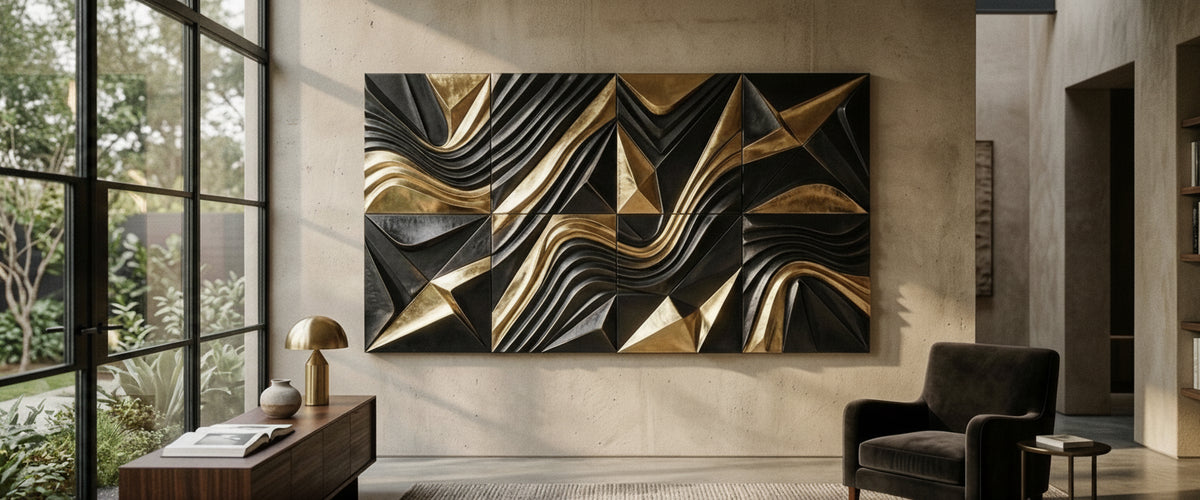

A flat canvas fills a wall. A large 3D wall piece changes how the whole room feels the moment you walk in. That difference comes down to relief, shadow, and mass; a raised bronze or metal form catches light from the side and throws its own shadow, so the wall stops being a backdrop and starts doing work. Get the scale and placement right and a large 3D wall installation becomes the thing people notice first and remember longest. Get it wrong and even a beautiful piece looks stranded, like a good painting hung six inches too high.
Looking for the full range in this category? Browse our Wall Art and Wall Decor collection for every available finish, size, and configuration.
We have shipped wall commissions into double-height entryways, restaurant feature walls, and great rooms where the ceiling runs past 20 feet (6 m). The pattern is always the same: the buyers who plan for sightlines and light are thrilled; the ones who buy on the product photo alone tend to call us back about mounting. This guide is built to keep you in the first group.

Large 3D Wall Art at a Glance
- Relief is everything. The depth of the piece off the wall is what creates the shadow and movement flat art can't match.
- Scale to the wall, not the furniture. A large 3D wall piece should read from across the room, not just up close.
- Center on the sightline, not the wall. Where the eye lands matters more than geometric center.
- Material decides the setting. Interior metal and gloss finishes for living rooms; bronze, stainless, and Corten for anything outdoors.
- Light is the co-author. Side light reveals depth; flat front light kills it.
- Weight and fixing are not afterthoughts. A large relief needs the right substrate and anchors, not a picture hook.

What Large 3D Wall Art Actually Looks Like in Different Rooms
In a living room, a large 3D wall piece is usually the anchor above a sofa, console, or fireplace. Think of a circular metal burst or a rippled geometric panel two to four feet (0.6 to 1.2 m) across, sitting where a mirror or print would normally go but reading with far more presence because it holds actual depth. For a neutral wall that needs a point of heat and dimension without a full gallery treatment, a textured metal orb such as Luminosa Orange Orb Textured Metal 3D Wall Art sits comfortably in exactly this role.
Move into a stairwell, a double-height foyer, or a commercial lobby and the calculus changes. Here you are filling vertical space that flat art can't hold. A cluster of relief forms, or a single oversized figural piece, earns its keep because the viewer sees it from multiple floors and angles. Where a period interior or study calls for sculpture proper rather than decor, a cast bronze relief such as Traditional Horse Head Bronze Relief - 80cm projects far enough off the wall to throw a real shadow line.
Outdoors, large 3D wall art becomes architectural. A Corten or bronze relief mounted on a garden wall, a pool house, or a courtyard elevation gives a hard surface something to say. The rules shift toward weather, fixing, and material, which we get to below.

Scale, Sightlines, and Mounting Height: The Choices That Change How a Piece Reads
The most common instinct is to match a piece to the furniture beneath it. Resist that. A large 3D wall composition should be scaled to the wall and the viewing distance, then checked against the furniture second. As a working rule, a feature piece above a sofa or console usually wants to span roughly two-thirds of the furniture width, but on a tall bare wall you scale up hard; a small piece on a big wall looks apologetic.
Mounting height is where good intentions go wrong. Gallery convention centers art at about 57 to 60 inches (145 to 152 cm) to the visual center, but that assumes a standing viewer in a gallery. In a living room where people are seated, and above furniture, you drop the whole thing so the piece relates to the seated sightline and doesn't float in a gap of blank wall above the sofa back. In a foyer or stairwell, you raise it and let the ascending eye do the work.
For freestanding figural work on a plinth the same thinking applies to pedestal height, but wall art has its own version of this: the depth of relief and the angle at which people approach. A piece with 4 inches (10 cm) of projection looks dramatic head-on and even better from a raking angle down a hallway. Plan the approach, not just the wall.

Indoor Versus Outdoor Placement: When Each Wins
For wider placement ideas, Large Abstract 3d Metal Wall Art: How to Place It so It Actually Reads is useful companion reading before finalising the setting and sightlines.
Indoors, you have controlled light and no weather, so finish and color can carry the piece. Gloss metal, painted steel, gilded accents, and fine surface texture all survive happily inside and read beautifully under warm interior lighting. This is the home of the decorative large 3D wall panel, and it is where most searches for large 3d wall art for living room actually end up.
Outdoors is a different discipline. Sun, rain, salt air, and freeze-thaw cycles will find any weakness in a material or a fixing. This is why we steer exterior wall commissions toward bronze, marine-grade stainless steel, and Corten weathering steel. Bronze develops a patina that many owners come to prefer to the original finish; the process is a natural surface reaction that conservation bodies document in detail, and it is stable rather than destructive when the alloy and finish are specified properly (see the American Institute for Conservation for the underlying material science). Corten forms a stable oxide layer that protects the steel beneath, which is exactly why it suits garden and courtyard walls in climates that have to live through real winters.
If you love the look of a decorative interior panel but want it outside, tell us at the briefing stage. We would rather engineer the same visual language in a weatherproof material than watch an indoor finish fail on a south-facing wall.
Light, Backdrop, and Contrast: What Really Decides Visual Impact
A 3D wall piece is a shadow machine. Its entire advantage over flat art is that it sculpts light, so the lighting plan matters as much as the piece itself. Side light and grazing light reveal every ridge and hollow; flat, straight-on light flattens the whole thing back into something that might as well be printed. If you are commissioning a large relief, aim an adjustable spot or a wall washer from one side and watch how the shadows lengthen.
Backdrop contrast is the second lever. A dark, high-contrast piece such as Onda Black & Gold Rippled Geometric Metal 3D Wall Art needs a lighter or mid-tone wall behind it, or its depth disappears into the background. A pale or reflective piece wants a deeper wall color to push it forward. We ask clients to send a photo of the actual wall color before we finalize finish, because the same piece reads completely differently on warm gray versus off-white versus deep green.
Reflection matters too. Gloss and polished metal will pick up windows, lamps, and movement, which is lively in a living room and distracting in a north-lit hallway. Textured and matte finishes are calmer and hide fingerprints and dust; think about who cleans the wall and how often before you fall for a mirror-bright surface.
Common Placement Mistakes We See in Commissions
A handful of errors come up again and again, and every one is avoidable.
- Buying too small. On camera, a piece looks bigger than it will in a 14-foot (4.3 m) room. Measure the wall, mark the outline in painter's tape, and live with it for a day before committing.
- Ignoring the fixing. A large metal or bronze relief has real weight. It needs anchors into studs, masonry, or a proper backing board, not drywall plugs. Ask us for the mounting spec with the commission.
- Flat lighting. Overhead downlights pointed straight at the piece erase the relief. Angle the light.
- Wrong material outside. An interior-finished panel on an exposed wall is a callback waiting to happen. Match material to weather.
- Centering on the wall instead of the room. A piece should be centered on where people stand and sit, not on a tape measure.
- Clashing the backdrop. Tone-on-tone kills depth. Give the piece contrast to work against.
Commissioning a Large 3D Wall Piece with Giant Sculptures
As a bespoke sculpture supplier working at large scale, we treat wall commissions the same way we treat freestanding work: material first, engineering second, finish third. If you want an existing design at a different size, or a piece designed around a specific wall and light plan, that starts with the wall dimensions, a photo, the wall color, and how the piece will be viewed and approached. Budget depends on material, scale, depth of relief, engineering, finishing, and installation, so we quote each commission individually rather than quoting a band that would mislead you.
Browse the full 3D Wall Art range to see how relief and depth read across different styles, or the wider Metal Wall Art collection if you are leaning toward contemporary metalwork. When something is close but not quite the size or finish you need, that is usually the moment a bespoke commission makes the most sense.