





































































































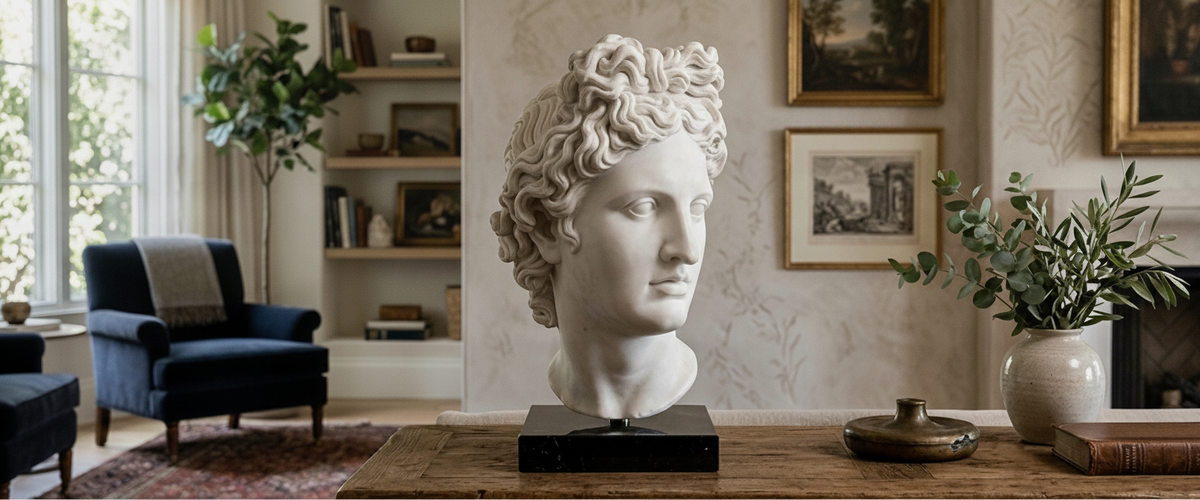

Nine times out of ten the problem is not the carving. It is the plinth. A bust Apollo marble sculpture sitting on a console table at 30 inches (76 cm) reads like a decorative object; the same head on a correctly proportioned column reads like a collected piece. The difference costs nothing but thought, and most buyers only discover it after the crate is open and the piece is standing in the wrong place.

Key Takeaways
Eye height rules everything. Aim to land the carved gaze between roughly 4 ft 9 in and 5 ft 1 in (1.45 to 1.55 m) off the floor.
Dark backgrounds flatter white marble. A white wall quietly erases the profile.
Turn the head. A three-quarter angle to the approach beats a square-on stare every time.
Uplight carves, downlight flattens. Light from below and to the side to keep the cheekbone and brow alive.
Outdoors is a commitment. Freeze-thaw cycles are unforgiving on a polished forehead. Plan the plinth, drainage and winter cover before you buy.
Pedestal Math: Why a Bust Apollo Marble Sculpture Wants Eye Level
Classical busts were carved to be met, not looked down on. The sculptor cut the jawline, the hollow under the cheek and the shadow beneath the brow assuming a viewer standing more or less level with the face. Drop it to coffee-table height and the underside of the chin dominates. Raise it above 6 ft (1.83 m) and the eyes disappear into shadow while the nostrils take over.
The math is simple. Measure from the base of the bust to the pupils, then subtract that figure from your target of about 4 ft 11 in (1.5 m). That is your plinth height. A 30 in (75 cm) bust Apollo marble sculpture such as the Apollo Marble Bust Sculpture at 75cm carries most of its face in the upper third, so it typically wants a shorter column than people assume. Where the room is tighter and the column can afford more height, the 20 in (50 cm) Apollo is the easier proportion to work with, because the extra plinth does the lifting instead of the stone. Order the plinth after you have chosen the scale, never at the same time.
Hallway, Alcove or Open Gallery: Three Sightlines, Three Plinths
A narrow hallway gives you one approach and one exit. Here a slim square column works, set tight to the wall so nobody clips it with a shoulder, and the bust should face along the corridor rather than across it. An alcove is the easiest win in the house: the recess already frames the silhouette, so a plain block plinth in a darker stone is enough.
Open gallery space is the hard one. When a piece can be circled, the back of the neck and the shoulder cut matter as much as the face, and a wide plinth base starts to look clumsy from behind. We usually specify a narrower shaft with a slightly heavier foot for stability. Where the setting wants the pedestal to carry part of the composition rather than disappear under it, a column such as the Gold Mirror Molten Drip Marble Pedestal Sculpture - 110cm is closer to the right design language for a contemporary interior than a plain classical shaft.

A Dark Recess Flatters White Italian Marble
White on white is the most common mistake we see in photographs clients send us. An Italian marble bust sculpture in Bianco Carrara has soft translucency at the edges, and against a gallery-white wall that edge dissolves. The profile stops reading from more than a few feet away.
Put the same head against charcoal, deep green, oxblood or a dark oiled walnut panel and the outline snaps into focus. One client repainted a single entry alcove in a near-black matte finish for a bust Apollo marble sculpture we shipped, then told us it looked like a completely different carving. The stone did not change. The background did. Black marble pieces work the opposite way, and need pale plaster or limestone behind them to hold their silhouette.
The Three-Quarter Turn: Never Face the Door Square-On
A bust Apollo marble sculpture facing the entrance dead-on looks like security. Rotate it 20 to 30 degrees off the approach line and two things happen: the viewer catches the profile first and the full face second, and the shadow across the far cheek gives the carving depth. Apollo in particular was conceived with a turned head. The Apollo Belvedere, the marble in the Vatican Museums' Museo Pio Clementino that most modern versions descend from, is built entirely around that torsion. Squaring it up fights the original design.
Pairing Apollo with a Hermes Marble Sculpture Bust
Two busts on matched plinths flanking a doorway can look decisive or it can look like a corridor of severed heads. The fix is asymmetry. Vary the plinth heights by 4 to 6 inches (10 to 15 cm), turn the two faces slightly toward each other rather than both toward the viewer, and leave one wall behind them plain. A Hermes marble sculpture bust next to Apollo works because the two profiles differ in attitude and attribute, so the eye has something to compare; two near-identical heads on identical columns just look like stock. If you want more range across finishes, our marble busts and torsos and bronze busts and heads sit together comfortably in the same room when the plinths are unified.
Lighting: Uplight Carves the Cheekbone, Downlight Flattens the Brow
A recessed downlight directly above a bust is the fastest way to kill it. Light falls straight into the eye sockets, the brow flattens and the nose throws a hard vertical shadow. Move the source off-axis by about 30 degrees, then add a low uplight on the opposite side at gentle output, and the modeling comes back.
Keep the color temperature warm, around 2700K to 3000K. Cool white makes marble look like plaster. And avoid raking a single hot spot across a polished surface; the shine will bounce and the surface texture that makes an aesthetic marble sculpture bust worth owning gets washed out.
Outdoors: Frost Is the Real Enemy
Marble is crystalline calcite, and it is porous enough for water to get in, freeze, expand and lift microscopic grains. Two hard winters in Aspen, upstate New York or the Cotswolds will take the gloss off a polished forehead and leave a chalky bloom, a process conservators call sugaring. The Smithsonian's Museum Conservation Institute researches exactly this kind of deterioration in outdoor stone, from freeze-thaw damage to acid rainfall.
If you want a bust Apollo marble sculpture outside in a cold climate, raise it on a plinth with a drip edge so meltwater does not wick up into the base, avoid siting it under a tree that drips tannins, and cover or bring it in for the worst months. In genuinely brutal winters we usually steer clients toward bronze or Corten for permanent exterior work and keep marble for sheltered loggias, courtyards and interiors.

Buyer's Checklist Before You Commit
Measure the floor-to-pupil height you want and calculate plinth height from it.
Check the wall color behind the piece; sample a darker tone before ordering.
Confirm the approach angle and plan a three-quarter turn.
Check floor loading and whether the plinth needs a spreader plate on timber joists.
Confirm door widths, stair turns and whether the crate needs a two-person carry.
Decide lighting position before the electrician is finished, not after.
For outdoor sites, plan drainage, fixing and winter protection up front.
Commissioning Something Larger
Not every room wants a stock size. We regularly scale busts up or down, change the shoulder cut, alter the truncation to suit a specific plinth, or carve a portrait head from photographs and a 3D scan. Budget on a bespoke bust Apollo marble sculpture depends on scale, stone selection, carving complexity, finishing and installation, so we quote each commission individually rather than publishing a figure. If you are still comparing formats, browse the wider marble sculptures and statues range, then send us the room dimensions and a photograph of the wall. Most placement problems get solved before anything is carved.
For wider placement ideas, What a Marble Bust Sculpture Tells You Before You Ever See the Face is useful companion reading before finalising the setting and sightlines.