

























































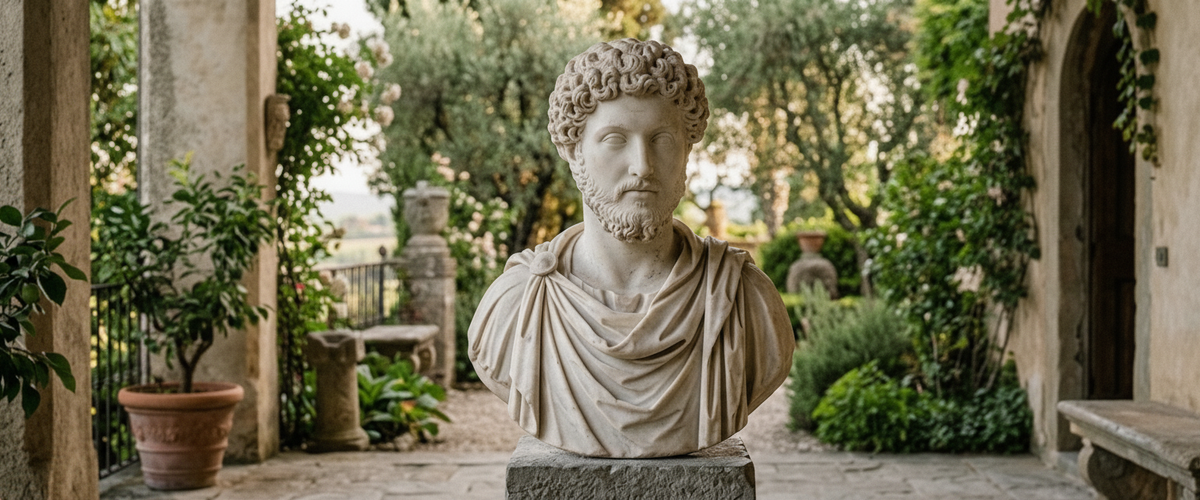

Most people judge a marble bust sculpture by the face. Carvers judge it by the shoulders. That cut across the chest is where the maker either commits to a decision or hides behind a shortcut, and once you know what to look for you will never buy a bust the same way again. Faces are flattering. Terminations are honest.

At a Glance
Shoulder termination is the fastest quality read: crisp, intentional cuts beat vague rounded stumps.
Drill work in hair and drapery separates true carving from molded composite.
Carrara, Calacatta and bonded marble are three different purchases, not three price points of the same thing.
Flat, undrilled pupils often mean a mold taken from another mold.
Plinth height decides whether the piece reads as portraiture or as a shelf ornament.
Indoors nearly always wins on longevity; marble outdoors needs a plan.
What Is a Marble Bust Sculpture?
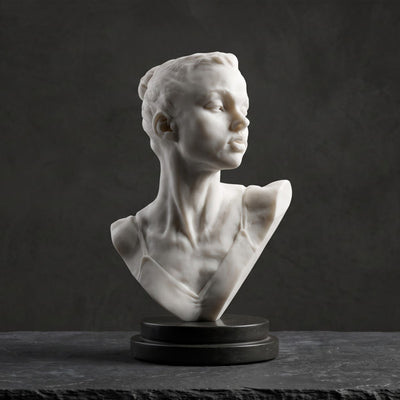
A marble bust sculpture is a portrait carved from stone that stops somewhere between the collarbone and the mid-chest, usually mounted on a socle or plinth. The form is Roman in origin, and Roman workshops treated heads and bodies as separate problems, which is why so many surviving portraits sit on later supports. The tradition ran through the Renaissance, expanded sharply with eighteenth-century Grand Tour collecting, and still drives the two most requested subjects we quote on: a Hermes marble sculpture bust after the Praxiteles type, and Michelangelo's David.
Scale matters more than the catalog photo suggests. A bust of around 55cm (22 inches) reads as a serious object on a console; the same subject at half that height reads as a souvenir. If you are choosing between sizes, choose for the wall behind it, not the tabletop under it.

The Shoulder Termination Tells You the Carver's Confidence
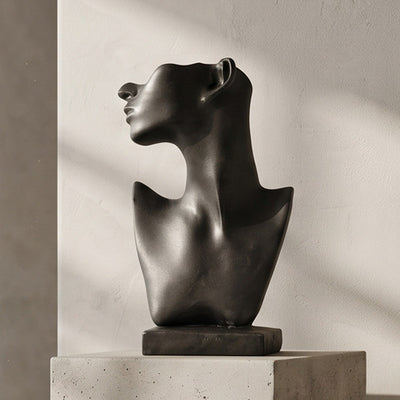
Look at where the chest ends. A confident carver gives you a clean geometric cut, a deliberate curve, or drapery that folds and tucks with a visible logic. A nervous one gives you a soft blob that fades away, because sharp edges in stone are unforgiving and blobs forgive everything. Run your eye along the back too. Many low-effort busts are fully modeled at the front and near-flat behind, which limits you to one viewing angle forever.
A deliberate cut across the chest, seen from the side, where shortcuts show up first.
Hair and Drapery: Where Drill Work Shows Up
Hair is the tell. Carved curls have undercuts, deep channels and shadow that changes as you walk past, because the carver used drills and rasps to go behind the form. Molded pieces reproduce the surface but lose the depth; the shadows sit still. Reach a finger into a curl. If you feel a defined channel with a slightly rough interior, you are in carved territory. If you feel a shallow scoop with a glossy skin, you are looking at a cast.
Drapery follows the same rule. Real folds have thin edges that catch light, and you can see the stone thinning without cracking. Cast drapery tends to keep an even wall thickness, which is exactly what a mold needs and exactly what a carver never bothers with.

Carrara, Calacatta and Bonded Marble: What You Are Paying For
Carrara from the Apuan Alps is the classic white with soft gray veining, and it is the stone most people picture when they search for an Italian marble bust sculpture. Calacatta is bolder, warmer and more dramatically veined, which is glorious in a slab and risky in a portrait, since a heavy vein running across a cheekbone can fight the modeling. Bonded marble, sometimes sold as marble composite, is crushed stone in a resin binder. It is a legitimate material for certain decorative pieces, but it is a casting, not a carving, and it should be priced and described as one.
Marble is calcite based and comparatively soft, which is why it takes a warm polish rather than a glassy one, absorbs oil and etches on contact with acids; the Natural Stone Institute publishes clear technical guidance on how calcareous stones behave in service. Budget for a bust depends on stone selection, block size, carving complexity, hand finishing, plinth work and freight, so the sensible route is a tailored quote rather than a guessed figure.
Eyes, Pupils and the Flat Stare of a Copy of a Copy
Take a phone photo of the eyes and zoom in. Good carving gives you a drilled or deeply shaped pupil, a defined tear duct, and an upper lid that casts a shadow onto the iris. That shadow is what makes a face look alive from ten feet away. When a mold is taken from a cast which was itself taken from a cast, those small deep details fill in first. The result is the flat stare: technically a portrait, emotionally a mannequin.
Antique Original, Workshop Copy or Honest Reproduction
The base usually settles the argument. An antique marble bust sculpture typically shows a socle in different stone from the head, old mounting hardware, iron staining around a pin, and wear concentrated where hands and cloths have touched it for a century. Nineteenth-century Italian workshop copies often carry a chiseled signature or a studio mark on the reverse of the socle. Modern reproductions frequently have a bonded seam, a perfectly flat machine-sawn underside, or a cast-in cavity. None of the three is dishonest. Being sold one while paying for another is.
Plinth Height and the Eye-Line Most Hallways Get Wrong
The most common placement mistake is setting a bust roughly 8 inches (20 cm) too low, so the viewer looks down onto the crown of the head and the carved chin disappears. Aim to put the sculpted eyes near the standing viewer's eye level, or slightly above for heroic subjects. Where a hallway or console needs a recognizable subject at genuine portrait scale rather than a shelf-sized head, a piece such as Michelangelo's David Marble Bust Sculpture at 55cm arrives close enough to eye level that the plinth only has to make up the last few inches. Work the number out before the piece lands: stand where you will actually stand, mark your eye height on the wall, then subtract the height of the bust from that mark. What is left is your plinth. Miss it by a few inches and a commanding face turns decorative. Browse our marble busts and torsos with the plinth in mind, not as an afterthought.
Set the carved eyes at the viewer's eye line and the chin, jaw and throat all come back.

Why the Indoor Bust Outlives the One on Your Terrace
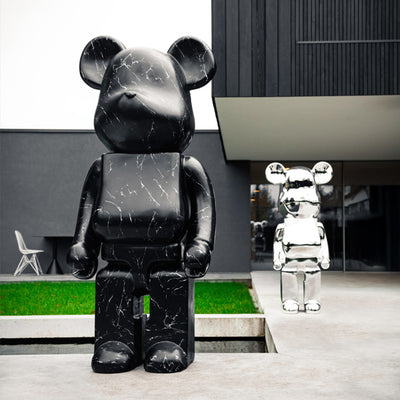
Indoors, marble is close to permanent. Outdoors, rain slowly dissolves calcite and the surface eventually goes granular, a decay conservators call sugaring; the US National Park Service preservation briefs document the same pattern on historic marble monuments. Add the freeze-thaw cycles of a climate like Colorado's high country and hairline pores become real problems. If a carved stone portrait is going outside, pick denser, tighter-grained stone, seal it appropriately, avoid pooling water on the shoulders, and expect the crisp details to soften over decades. A robustly massed subject copes better than a delicate one, which is why a heavy-formed head like the Mighty Gorilla Bust Marble Outdoor Sculpture survives a terrace where a fine-carved classical head with deeply drilled curls would slowly lose its detail. Clients who want a portrait outdoors permanently are usually better served by a bronze bust.
Buyer's Checklist
Ask for a photo of the back and underside, not just the three-quarter hero shot.
Zoom in on pupils, nostrils and hair channels for depth.
Confirm the exact material: quarried marble, which quarry family, or bonded composite.
Get the weight as well as the height; it decides floor loading, plinth choice and handling.
Decide the final eye-line before ordering the plinth.
Indoors or outdoors? Confirm sealing and freeze-thaw suitability for your climate.
For a bespoke portrait, agree on reference photos or a 3D scan, clay maquette approval, and finish samples.
Commissioning Your Own
Portrait commissions are the quietest part of our stone work and the most personal. The studio route usually starts with photographs from several angles or a 3D scan, moves to a clay or digital maquette for approval, then goes to carving and hand finishing. Clients often pair a commissioned head with something abstract elsewhere in the room, so the portrait is not competing with another face, and most now ask for a honed, matte surface rather than a high polish, which suits the quieter marble aesthetic interiors are after. Either way, the decision to make is scale first, subject second. Giant Sculptures quotes bespoke stone portraiture alongside our wider marble sculptures and statues, and we would rather talk you into the right height than sell you the wrong one twice.
For wider placement ideas, Marble Garden Statues: What Winter Really Does to White Stone is useful companion reading before finalising the setting and sightlines.