





































































































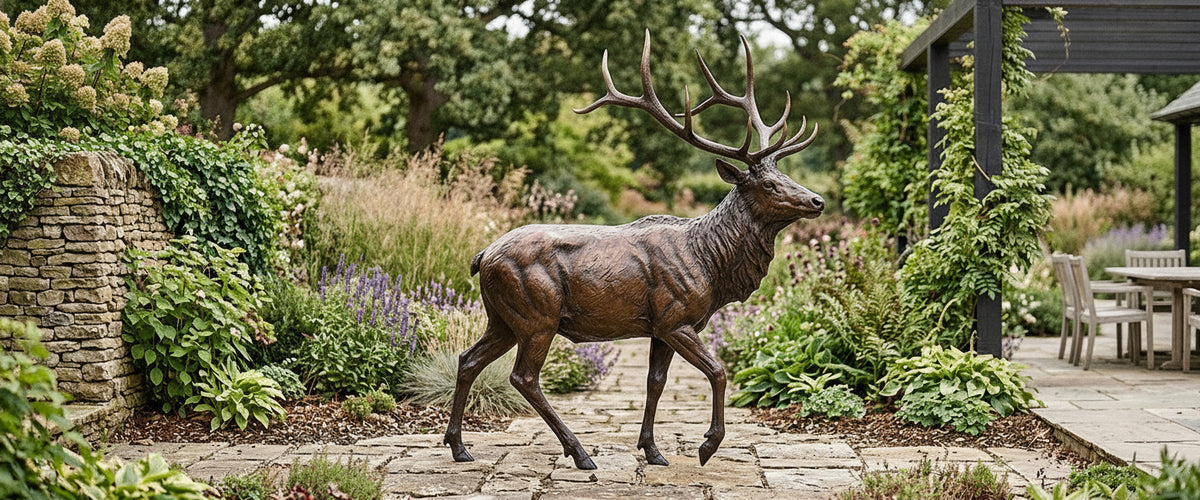

A life size bronze elk in the wrong corner looks like furniture. The same piece set at the end of a lawn, catching low afternoon light, stops people mid-conversation. Buyers tend to obsess over which animal to choose and how much it costs, then give almost no thought to the one variable that decides everything: placement. Animal statues life size are unforgiving that way. They are large enough to command a space or large enough to crowd it, with very little middle ground.
Looking for the full range in this category? Browse our Large Astronaut Sculptures collection for every available finish, size, and configuration.
We have shipped these life size animal statues to vineyards, mountain-resort entrances, ranches, and more than one city lobby, and the pattern holds. The commissions that land are the ones where placement was decided before the wax was ever poured.

Key Takeaways Before You Commission
Scale reads relative to its surroundings. A life size lion looks bigger on a bare lawn than in a planted border.
Pedestal height changes the pose. Raise a striding animal and it gains authority; raise a resting one and it looks stranded.
Outdoor usually wins for large animal statues life size, but only with the right approach distance and backdrop.
Backdrop and contrast matter more than the finish. A dark bronze against dark foliage disappears.
Budget depends on material, scale, engineering, and installation. Ask for a tailored quote rather than assuming.

What Animal Statues Life Size Actually Look Like in a Room or Garden
Life size is a slippery term. A life size fox is knee height; a life size moose stands taller than most doorways. A piece such as the Life-Size Bull Moose Bronze Sculpture - 290cm runs to around 9 feet 6 inches (290 cm) at the antler tips. Drop that into a standard living room and it dominates the ceiling line before it does anything else. Put it at the head of a long gravel drive and it finally has room to breathe. That is the tension with animal statues life size: the scale that thrills outdoors overwhelms indoors.
The rule we give clients: the piece needs negative space around it equal to at least its own footprint on every visible side. A charging bull with three feet of clearance looks trapped. Give it a clear approach and the pose starts to read as motion rather than obstruction. Where a forward-weighted subject is on the table, the Life-Size Charging Bull Bronze Statue - 220cm only makes sense if the eye can travel in the direction the lowered head is heading.
Indoors, animal statues life size work best where sightlines are long. An entrance hall you walk toward, a double-height atrium, a gallery-style corridor. Cramped rooms fight the sculpture instead of framing it.

Scale, Sightlines, and Pedestal Height
Three settings change how a life size animal statue reads, and none of them involve the sculpture. The first is viewing distance. A piece designed to be seen from 30 feet needs a bold silhouette and simplified surface; the same piece at arm's length can carry fine detail in the coat or muscle. Decide your primary viewing distance first, then choose or commission accordingly.
The second is eye line. A seated lion at ground level meets you as an equal. Lift it onto a low plinth and it presides over the space, which is why a subject like the Life-Size Classical Seated Lion Bronze Sculpture - 260cm reads as a guardian at a gatepost rather than a garden ornament. As a rough starting point, a resting animal wants a low pedestal (6 to 18 inches, roughly 15 to 45 cm); a standing or striding animal often reads best close to grade so it appears to inhabit the ground it stands on. This is where life size animal statues live or die.
The third is approach. People rarely see a sculpture head-on first. They come at it from an angle, along a path or across a lawn. Walk your intended route before you commit. The pose that looks strongest in the catalog photo may present its least interesting profile from where your visitors actually arrive.

Indoor Versus Outdoor: When Each Wins
Outdoor placement suits most large animal statues life size, and bronze is built for it. A patinated bronze surface, correctly waxed, weathers slowly and predictably; the Smithsonian American Art Museum's guidance on caring for outdoor bronze is a useful primer on why maintenance matters more than most buyers expect. Set across an open meadow, a striding subject like the Life-Size Bull Elk Striding Bronze Sculpture - 280cm gets the distance it needs, and the changing light does half the work for you.
Indoor wins in three cases. When the piece carries fine surface detail you want people to study up close. When the animal is smaller and would look lost outside. And when the setting is architectural, a lobby or stairwell where the sculpture and the building are meant to be read together. A painted finish, such as the Contemporary Life-Size Painted Cow Bronze Sculpture - 170cm, also holds its color better under cover than in relentless UV, so interiors and covered courtyards suit it well.
If you are torn, think about how the piece will be lived with. Outdoor life size animal statues become part of the seasons; they look different in frost, rain, and August haze. Indoor sculpture is more controlled and more constant. Neither is better. They are different relationships.
Light, Backdrop, and Contrast
The single most common reason a good sculpture underperforms is a backdrop that swallows it. Dark bronze against dark evergreens or a slate wall loses its silhouette entirely. You want tonal separation. Set a dark patina against pale gravel, a rendered wall, ornamental grasses, or open sky, and the outline reads cleanly from a distance.
Light direction decides the drama. Side light rakes across muscle and coat and pulls out every modeled plane; flat front light flattens the whole thing. For outdoor life size animal statues, note where the sun sits at the times you are most likely to be looking, early evening for a terrace, mid-morning for an entrance, and orient the animal so that key light crosses the form rather than hitting it head-on.
Indoors, avoid a single ceiling downlight directly overhead. It casts hard shadows into the eye sockets and under the belly and makes even a warm bronze look severe. Two crossing sources, or one strong raking light plus soft fill, treat the surface far more kindly.
Placement Mistakes We See in Commissions
For wider placement ideas, Life Size Animal Statue Placement: How Scale and Sightlines Decide the Room is useful companion reading before finalising the setting and sightlines.
A few recurring errors with animal statues life size, and how to sidestep them.
Buying for the empty space, not the finished one. Planting grows. A lion set among young shrubs is engulfed in three seasons. Plan for the mature garden.
Ignoring the base and groundwork. A large bronze needs a proper footing. Soft lawn or loose gravel lets a heavy piece settle and lean over time. Get the foundation specified early.
Facing the animal the wrong way. A striding or charging pose should lead the eye into the space, not off the edge of the property. Turn it to invite people in.
Pedestal overkill. Lifting a resting animal too high breaks the illusion that it belongs there. When in doubt, lower the plinth.
Forgetting the winter view. Northern gardens are bare for months. Make sure the piece still holds the composition when the borders die back.
A Quick Word on Anime and Character Statues
Buyers searching for an anime life size statue or a life sized anime statue are chasing something related but distinct: a life size figure whose whole point is faithful likeness and finish rather than weathering and longevity. Those are usually resin or composite show pieces built for interiors, not weatherproof animal statues life size. Our focus at Giant Sculptures is durable, large-scale metal and stone work, so if you want a character piece engineered to live outdoors in bronze or stainless steel, that becomes a bespoke commission rather than an off-the-shelf collectible. The placement principles above still apply; the material conversation is different.
Commissioning Through Giant Sculptures
Most of our life size animal statues are bespoke, which means placement feeds directly into the design. Tell us the site, the approach, the backdrop, and the viewing distance, and we size the pose and surface to suit. As a bespoke sculpture supplier working in bronze, stainless steel, and stone, we would rather solve the placement question on paper than watch a beautiful casting arrive at the wrong scale for its home. Browse the Life Size Bronze Statues range to gauge scale, then talk to us about adapting a piece or starting from scratch. Placed well, animal statues life size earn their keep for decades.