






































































































The lettering fails first. Not the stone, not the base, not the foundation. A memorial can stand upright for a century and still look neglected at year twenty because the inscription has gone soft and faint against a pale face. That single detail is the fastest way to separate serious custom headstone makers from firms that sell a catalog page and quietly subcontract the cutting to whoever is cheapest that month.

Key Takeaways Before You Approve Anything
Hand-cut V-carving reads by shadow and holds its legibility for decades; sandblasted lettering relies on surface frosting that softens.
Choose stone for how it behaves in your climate, not for how the polished sample looks under showroom lights.
Relief carving needs more stone thickness than a flat drawing ever suggests. Ask for the depth in inches.
Judge custom headstone makers on the back of the stone and the proof sheet, not on the showroom face.
Insist on a full-size lettering proof and read it on a wall, not on a screen.
Get the cemetery's written regulations before design work starts, not after you fall for a shape.
Sandblasted Lettering Softens, Hand-Cut V-Carving Keeps Its Shadow Line
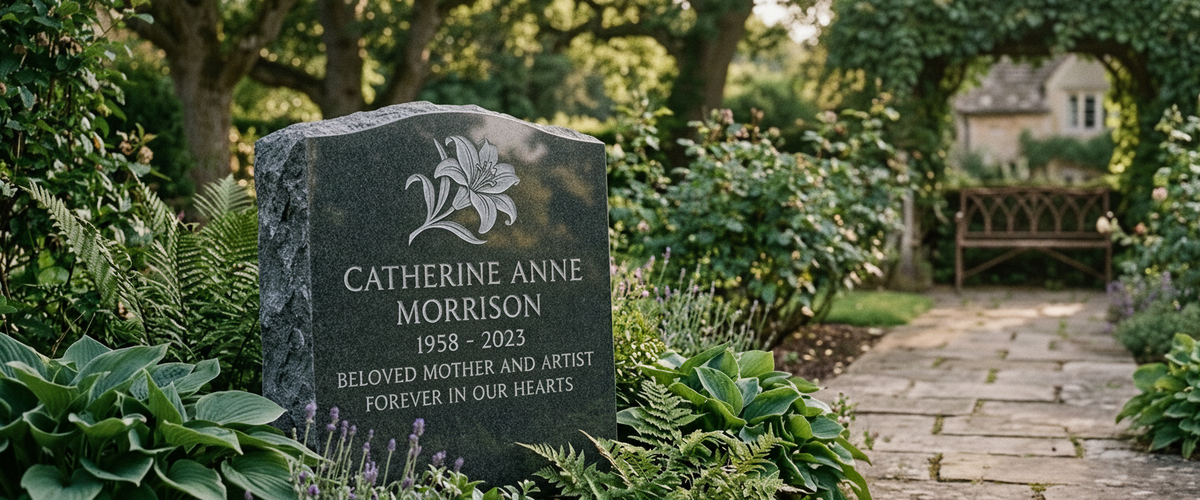
Sandblasting works by masking the face with a rubber stencil and eroding the exposed letters. It is fast, consistent, and perfectly respectable for straightforward inscriptions. The trough it leaves is shallow and rounded, and on a light gray granite the letter only reads because the blasted surface is frosted lighter than the polished ground. Weathering, algae and airborne grime all attack that contrast.
A hand-cut V-carved letter is a different object entirely. Two angled planes meet at a clean point below the surface, so the letter reads as a shadow rather than as a color change. Move around the stone and the inscription shifts with the light. Rain darkens it instead of erasing it. Conservation guidance on historic graveyard monuments ties long-term legibility to cut depth and letterform quality rather than to the hardness of the stone alone, which is why carved memorials from the 1700s often out-read markers from the 1970s. Custom headstone makers who cut by hand will tell you the letter height they recommend and why; resellers will send you a font menu.
A V-cut letter reads by shadow, so it survives the weathering that flattens frosted sandblast work.
Granite, Slate and Limestone Judged on Weathering, Not on the Sample Swatch
Granite is the workhorse for good reason. It is dense, low in porosity, holds a polish, and tolerates freeze-thaw cycling in Vermont as happily as it tolerates a Texas August. Dark granites give the strongest contrast for frosted lettering, which is why so much of our granite headstone work uses a black or deep gray face with a lighter surround. Custom headstone makers who buy their own blocks will talk about quarry behavior before they talk about price.
Slate takes exceptionally fine lettering and rewards a skilled hand-carver, but quality varies sharply by quarry and poor slate delaminates along its bedding. Limestone and marble are calcite-based, which makes them beautiful to carve in relief and vulnerable to acid rain and salt. Where a family wants drapery, hands or a face rendered with real softness, a marble figure such as the Weeping Angel Marble Headstone - 150cm at roughly 5 ft (150 cm) holds modeling that granite will never quite surrender, and the trade is real: more expressive carving, more attentive long-term care. Compare the marble memorials against granite before deciding, and ask what the same design would cost and weigh in each.
Relief Carving Needs More Stone Depth Than the Drawing Ever Suggests
Every rendering flattens. A lily, a rose, a pair of hands or a set of wings looks perfectly achievable on paper and then arrives at the workshop needing an inch or more of stock above the ground plane before it stops looking like a scratch. Undercut elements need more again, plus enough slab thickness behind them that the panel is not compromised.
Artistic memorial designs are specified from the block outward, with relief depth agreed before cutting starts.
This is where thin imported blanks give themselves away. Custom headstone makers who cut their own stone will quote slab thickness and intended relief depth as two separate numbers. A shallow etched or lightly carved motif can be exactly right when the family wants restraint, and something on the scale of the Butterfly Black Granite Headstone - 130cm at about 4 ft 3 in (130 cm) is drawn around that shallow depth rather than squeezed into it. When the subject is the point of the memorial rather than a decorative note, the stone has to be specified around it: a profile-cut piece on the scale of the Horse Head Grey Granite Memorial Headstone at close to 6 ft (180 cm) is a sculpture with an inscription, not a tablet with a picture on it, and the block is chosen accordingly.

The Full-Size Lettering Proof Is the Last Moment Anything Can Change
Print the layout at 1:1, tape it to a wall, and stand back about 10 ft (3 m). Everything wrong will show itself: cramped line spacing, dates that fight the name, a middle initial someone assumed. One family caught a missing accent on a Spanish surname at proof stage, three days before cutting. Nobody had seen it on a screen.
Use the same proof to plan ahead. If a spouse's inscription will be added later, the space, margin and letter style all need reserving now, and you want written confirmation that the studio can match the cut and the depth years from now. Custom headstone makers who do their own lettering can promise that. Brokers usually cannot.
Polished Faces, Pitched Edges and Why the Back of the Stone Tells You the Most
Finish vocabulary matters when you are comparing quotes. Polished gives maximum contrast and sheds water. Honed reads softer and hides scratching. Sawn is flat and matte. Pitched or rock-faced edges leave a hand-worked border that frames a polished panel beautifully and disguises minor edge variation.
Then walk behind the stone. The reverse is where corners get cut: rough saw marks, an obviously thinner section, dowel holes drilled off-center, a base that was clearly cut from a different batch. Custom headstone makers who finish the back to the same standard as the front are telling you something about everything you cannot see, including how the piece is doweled and bedded onto its foundation.
Cemetery Regulations That Quietly Veto Half the Designs People Fall For
Nothing derails a commission faster than a rule nobody checked. Lawn sections frequently permit only flush markers. Many cemeteries cap upright height, dictate base width, restrict polished black granite, ban figurative sculpture outright, or require their own crews to pour the foundation. National cemeteries operate to their own published specifications for government-furnished markers, and a privately purchased memorial has to conform to the standards set for the section it stands in.
Ask the cemetery office for the regulations in writing, dated, before artwork begins. Custom headstone makers worth commissioning will read them with you and flag conflicts early rather than sending an invoice and letting you discover the problem at installation.
Questions That Separate a Memorial Studio from a Catalog Reseller
Put these to every studio on your shortlist and listen for specifics rather than reassurance.
Who cuts the lettering, and is it hand-carved or stencil-blasted?
Can I see a full-size proof and a physical letter sample in the chosen stone?
Which quarry and stone name, and how does it perform in my climate?
What is the slab thickness, and how deep will the relief stand?
How is the reverse face finished?
Who pours the foundation and who obtains the cemetery permit?
What is the lead time from approved artwork to setting?
Can you re-letter and match this stone in ten or twenty years?

Commissioning Artistic Memorial Designs Without Regret
Giant Sculptures works in the same materials for memorials as we do for large-scale garden and civic commissions, which means stone selection, carving depth, fixing and long-term weathering are handled by people who think in decades. Families come to us for the work that defines genuine custom headstone makers, artistic memorial designs a standard product line cannot deliver: a portrait relief, an animal subject, a niche figure, or an inscription in a script the local yard will not cut. Explore the full range of headstones and memorials to see what is possible in granite and marble, then send us the cemetery regulations and a rough idea of the subject.
Cost follows material, scale, carving complexity, engineering, foundation work and finishing, so we quote each commission individually rather than publishing bands that would mislead you. Send the details and you will get a straight answer from custom headstone makers who cut the stone themselves, including where a simpler solution will serve the family better.
For wider placement ideas, What Nobody Tells You About Commissioning Custom Bronze Animal Sculptures is useful companion reading before finalizing the setting and sightlines.