





































































































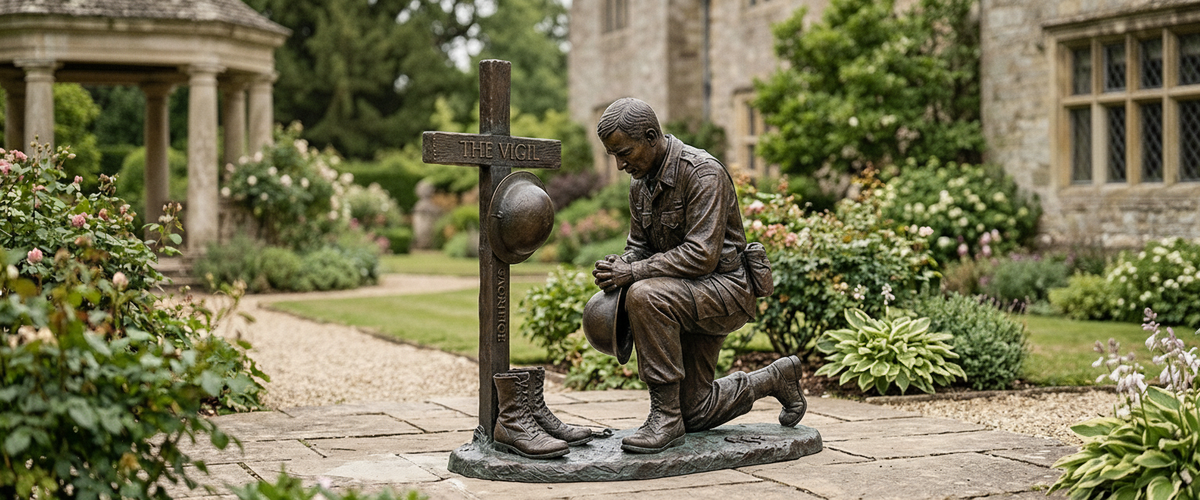

Twenty studio portraits of the same smile will not give you a likeness. Families commissioning a custom bronze memorial sculpture usually arrive with a phone full of photographs shot from one flattering angle, which is almost nothing a sculptor can build from. What our modelers actually need is stranger and simpler: the shape of the back of the head, how the shoulders sat when the person was tired, one unguarded frame where the face was doing something real.
Key takeaways
Reference photography matters more than budget when a custom bronze memorial sculpture starts. Three clean angles plus one candid beat a folder of posed shots.
The clay stage is the only point where big changes are cheap. Say the difficult thing there.
Wax approval locks surface, texture and detail. After casting, revisions get expensive and sometimes impossible.
Patina is a long-term decision, not a color swatch. It has to still read as the same person after ten winters.
Inscription legibility is decided by letter depth and shadow, not font choice alone.
Footing, fixings and handover paperwork are part of the commission, not an afterthought.

The Photo Brief: Three Angles and One Candid
Ask any foundry sculptor what ruins a portrait and they will say flat lighting. A phone flash erases the cheekbone shadow, softens the jaw and turns a distinctive nose into a smudge. For a custom bronze memorial sculpture we ask for front, three-quarter and full profile, taken in daylight, ideally without glasses in at least one frame. Then the candid: someone laughing at a kitchen table, hands mid-gesture, head tilted the way only that person tilted it.
Height and build references help just as much. A photograph of the person standing next to a doorway or a car gives us proportion we can measure against, and proportion is what makes a custom bronze memorial sculpture read as that individual from thirty feet away. If clothing matters, and with service memorials it almost always does, send images of the actual uniform, boots, insignia and badge placement. Families are often surprised that a collar detail takes longer to resolve than the face.
Clay Stage Honesty: The Sitting Where Families Should Say the Hard Thing
Clay is forgiving. Bronze is not. When we send clay photographs of a custom bronze memorial sculpture or host a studio review, the polite response is usually "that's lovely." The useful response is "his mouth was thinner" or "she never stood that squarely." On one firehouse memorial, the widow said nothing for ten minutes, then pointed at the hands and told us he always held his helmet by the brim, never the crown. That single note changed the pose, and the whole piece landed.
Clay is the cheap moment for honesty: a jawline reworked here costs an afternoon, not a re-weld.
Bring more than one family member to this review if you can. Siblings notice different things than spouses. Children remember posture. The sculptor can rework a jawline in an afternoon at this stage; the same correction to a cast custom bronze memorial sculpture means cutting and re-welding metal.
What Wax Approval Actually Decides
After clay comes the mold and the wax, and for any custom bronze memorial sculpture this is the real gate. The wax carries every surface decision into the metal: hair texture, fabric folds, the sharpness of an eyelid, the tooling marks on a boot sole. Sign off the wax and you are signing off the finished surface. With custom memorial sculptures, that is the last easy decision you get to make.
What can still change after casting: patina color, mounting method, inscription plaques, base material. What generally cannot: proportion, pose, facial structure, the depth of a fold. Chasing and welding can fix a flaw, but rebuilding a likeness in solid metal is effectively a second custom bronze memorial sculpture. Multi-figure work raises the stakes again. In a composition like the Contemporary Kneeling Woman and Battlefield Cross Memorial Bronze Sculpture - 120cm at around 3 ft 11 in (120 cm), the relationship between the bowed figure and the cross carries the emotion, and that spacing has to be settled in wax rather than hoped for later.

Patina as a Promise
Patina is chemistry applied with heat, and it keeps working after a custom bronze memorial sculpture leaves the studio. A dark chocolate brown with a lightly rubbed highlight is the most reliable choice for portrait memorials because it holds facial shadow without going muddy. Verdigris greens look beautiful in a planted garden setting and can flatten a face under overcast light. Lighter golden patinas show water streaking faster on vertical surfaces.
A dark brown finish with rubbed highlights keeps facial shadow readable under flat, overcast light.
Durability is the easy part. Copper alloys form a stable protective layer over time, which is why outdoor bronzes survive centuries when the surface is maintained with a wax coat rather than stripped and polished; the Copper Development Association has good technical background on alloy behavior and finishes. Ask your supplier which patina they would specify for coastal salt air versus a dry inland site, and whether the piece ships with a maintenance wax and instructions. Height changes the answer too: at about 4 ft 7 in (140 cm), a custom bronze memorial sculpture such as the contemporary battle cross memorial in bronze stands where visitors instinctively reach out and touch it, and hand oils will lighten a patina over the years in a way nobody warns families about.
Inscription Proofs: Depth, Serifs and Flat Gray Skies
Lettering on a custom bronze memorial sculpture is read by shadow. Under a flat gray sky with no directional sun, shallow letters vanish. We proof inscriptions at full size on paper and then again in wax, checking depth relative to letter height, because a 1 inch (25 mm) name cut too shallow disappears at the exact moment most visitors read it.
Serifs hold shadow better than thin geometric sans faces, which is why classical memorial lettering has survived so long. Keep line count low, check every date twice, and decide early whether the inscription is cast into the bronze, applied as separate cast letters, or set on a stone base. Cast-in text is permanent and part of the custom bronze memorial sculpture itself. Applied letters can be replaced if a family later adds a name.
Sign-Off, Footing and Handover
A custom bronze memorial sculpture becomes permanent the moment it is bolted down, so the last stage deserves the same attention as the first. Before shipping, we confirm anchor layout, plinth dimensions, stainless fixings and drainage, because water pooling at a base is the fastest way to stain the metal. For public sites, the National Park Service's historic preservation guidance is a useful reference on siting and long-term stewardship expectations.
Larger figures need engineering input. Once a group reaches the scale of the Life-Size Traditional Nurse and Soldiers Bronze Sculpture - 220cm at roughly 7 ft 3 in (220 cm), wind load and weight become structural questions for the custom bronze memorial sculpture, and the footing has to be designed for the piece rather than assumed from the last one.

Commissioning Checklist for Custom Memorial Sculptures
Gather three lit angles plus one candid, and a scale reference photograph.
Agree pose, height and viewing direction before modeling starts.
Book a clay review with more than one family member present.
Give written wax approval, with photographs of the details you checked.
Choose patina for the site climate, not for a studio photograph.
Proof the inscription at full size and confirm letter depth.
Confirm footing design, fixings, drainage and access for installation.
Ask for care instructions and a rewaxing schedule at handover.
Budget for a custom bronze memorial sculpture depends on scale, figure count, engineering, base and plinth work, patina complexity and installation, so the only honest number is a tailored quote. Giant Sculptures works with families, veterans' groups, parishes and civic clients on bespoke bronze commissions, and you can look through existing bronze figures and statues or bronze garden statues to see finishes and poses in the metal before starting a brief. Bring the photographs. Bring the hard opinions. That is what makes the finished piece look like the person.
For wider placement ideas, Antlers Break First: An Insider's Guide to Bronze Deer Garden Statues is useful companion reading before finalizing the setting and sightlines.