






































































































A wall panel that photographs beautifully can still die on a real wall. That is the uncomfortable truth behind a lot of extra large wall art: the design was resolved on a screen, scaled up by a factor of five, and only then met a room with an 18 ft (5.5 m) ceiling, a west-facing window and a sofa parked 9 ft (2.7 m) away. Sculptors think about the room first and the image second. If you understand the order of those decisions, you buy better, brief better, and stop paying for surface area you will never actually see.

At a Glance: What Really Drives an Extra Large Wall Art Commission
Viewing distance sets relief depth. Extra large wall art read from 30 ft (9 m) needs deeper modeling and bolder shadow than a panel read from 8 ft (2.4 m).
Weight drives engineering, not the other way around. Substrate, hanging system and wall build decide what is possible before anyone discusses style.
Material dictates aging. Bronze patinates slowly and predictably; stainless steel holds a mirror or brushed finish; Corten keeps moving for years.
Segmentation is a craft decision. Where a large panel splits changes both the installation and the composition.
Budget follows scale, complexity, finishing, engineering and install. Ask for a tailored quote rather than assuming price scales with square footage.
What Sculptors Actually Think About Before Taking On a Large-Scale Wall Commission
Extra large wall art begins with a building question, not a drawing. The first question in our studio is never "what should it look like." It is "what is the wall made of, and who is looking at it from where." Drywall on metal studs, poured concrete, brick veneer and a timber-framed pool house all behave differently under a heavy cantilevered load. A relief that projects 6 in (15 cm) from the wall face puts a very different bending moment on its fixings than a flat cut panel of the same weight, and that changes the mounting strategy on day one.
Sightlines come next, because a big panel is rarely viewed from a single spot. In a double-height Texas entry hall we worked on, the client wanted a single tall vertical composition. From the front door it read well. From the mezzanine landing, where guests spent most of their time, they were looking straight down at the top third of the piece and seeing nothing but foreshortened edge. We rebalanced the design so the visual weight sat higher and the modeling angled slightly forward. Same footprint, completely different experience.
Light is the third input, and it is the one buyers underestimate most. Relief sculpture is a shadow instrument. Flat, even ceiling light kills it. Raking light from one side, natural or fitted, is what makes the modeling readable. Before quoting on any extra large wall art commission, we ask where the windows are and whether the client is willing to add a wall washer or a track head at an angle. If the answer is no, we design more contrast into the surface itself with deeper undercuts and a two-tone patina.

Craft Decisions That Change the Final Result and the Price
Once the wall and the sightlines are known, a handful of technical choices do most of the work on any extra large wall art commission.
Relief Depth and Undercut
High relief, where forms project sharply and parts of the shape lift free of the background, costs more to model, mold and cast than low relief. It also survives distance far better, which is why deep modeling dominates serious extra large wall art. The tradition runs deep: the Assyrian palace reliefs held in major collections, including the Metropolitan Museum of Art, still read across a gallery because the carvers cut real depth rather than scratched detail. The same rule applies to a 10 ft (3 m) bronze panel in a Napa tasting room. Depth is also what allows a comparatively small piece to hold a large wall: a deeply modeled bronze such as the Classical Bull Head Bronze Relief - 70cm works at 70 cm (28 in) because the shadow line does the job that extra width would otherwise have to do.
Depth of modeling only pays off when the light hits the panel from an angle.
Material Choice
Bronze gives the widest patina range and ages with grace, which is why so much of our bronze wall art suits interiors where the piece is meant to outlive the decor scheme. Stainless steel suits crisp geometry, mirror faces and coastal exposure, and it is often the answer for extra large wall art in humid or salt-air rooms. Corten weathering steel gives a warm oxide surface outdoors, but it releases staining runoff during the first years while the patina stabilizes, so it needs detailing away from pale stone and stucco; the American Institute of Steel Construction guidance on weathering steel is worth reading before you specify it above a pale terrace.
Finish and Patina
A single flat patina is quicker and reads cleanly at distance, which suits extra large wall art hung high. Layered patinas with burnished highlights take longer, cost more and reward close viewing. On a piece that people walk past at 3 ft (1 m), the extra hand-finishing is money well spent. On a piece 25 ft (7.6 m) up an atrium wall, it is invisible.
Segmentation and Joints
Extra large wall art usually ships in sections. Where those joints fall is a design question, not just a logistics one. Good segmentation hides seams inside a natural line in the composition. Poor segmentation runs a straight cut across a face or a horse's neck and you will never stop seeing it.

Why Some Oversized Panels Read Right at 10 Ft and Wrong at 30
Detail density is the culprit. Extra large wall art tuned for close viewing carries fine texture, thin lines and subtle tonal shifts. Step back to 30 ft (9 m) and all of that averages into gray mush, because the eye can no longer resolve it. Meanwhile the silhouette, which is doing all the long-distance work, may be too fussy to hold.
The reverse failure is just as common. A bold, simple form scaled for a lobby can look crude on a living room wall where guests stand 6 ft (1.8 m) away with a glass in hand and nothing else to look at. Extra large wall art for living room settings usually needs both registers: a strong outline you can read from the doorway, plus surface interest that rewards a closer look.
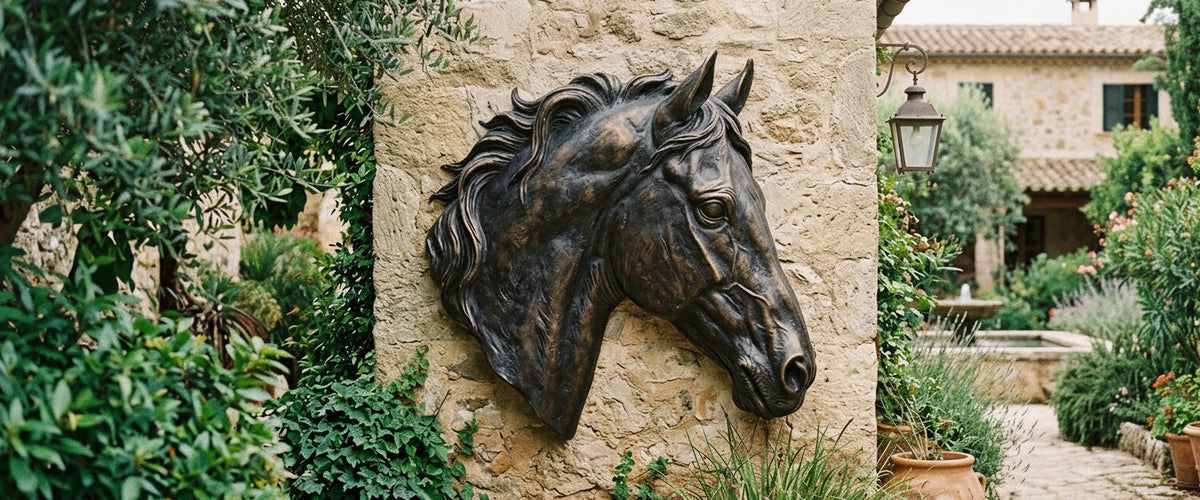
Animal heads and figural reliefs manage this dual read particularly well, because the profile is instantly legible while the modeling holds up close. A piece built along the lines of the Traditional Horse Head Bronze Relief - 80cm gives you a decisive silhouette from the doorway and mane texture at conversational range, which is the balance a single-panel extra large wall art commission has to strike when the room is used at both distances.
Studio Process: Maquette, Sample, Fabrication, Install
A scaled maquette, checked against the real viewing angles before any metal is committed.
Brief and site data. Wall construction, dimensions, sightlines, light sources, ceiling height, and what the extra large wall art has to hold its own against.
Concept and maquette. A scaled model, physical or digital, tested against the real viewing angles. This is the cheapest place to change your mind, and the stage most buyers rush.
Material and finish samples. Small test plates in the proposed patina or finish, viewed in the actual room light if possible. Bronze patina looks different under warm 2700K lighting than it does in a photograph.
Fabrication. Modeling, molding and casting, or cutting and forming for metalwork. Structural backing and fixing points are engineered as part of the piece, not bolted on afterward.
Trial assembly. Multi-section extra large wall art is dry-assembled in the studio so joints and alignment are proven before anything is crated.
Delivery and installation. Crating, access survey, and installation with the right anchors for that wall. Access is the step that derails schedules: a 9 ft (2.7 m) crate that will not turn a stairwell corner is a real problem, and we have solved it more than once by re-planning segmentation.
How to Choose Living Room Wall Art at This Scale
Practical decision criteria for extra large wall art, in the order we recommend working through them:
Measure the real wall, not the room. Subtract switch plates, vents, door swings and furniture backs. The usable field is always smaller than it feels.
Aim for roughly two-thirds to three-quarters of the sofa or console width for a single piece. Anything much smaller looks stranded.
Set the center at seated eye level in a lounge, closer to standing eye level in a hall or gallery corridor.
Confirm wall construction and load path before you fall in love with a heavy bronze. If it is drywall over studs, the fixing plan has to find structure.
Choose finish against your light temperature. Warm patinas glow under warm light; brushed stainless can go flat and cold unless you give it something to reflect.
Decide the read you want. Sculptural and tactile, or graphic and flat? Compare pieces in our wall art collection against a metal wall art option before committing.
Mock it up. Kraft paper cut to the exact size of the extra large wall art, taped up, lived with for a week. Free, and it has saved clients from expensive misjudgments more than once.
Not every wall wants a wide panel, and extra large wall art does not have to mean extra wide. Chimney breast returns, flanking positions either side of a fireplace and narrow corridor runs are better served by a tall, projecting vertical than by a shrunken version of a broad relief, and a form such as the Classical Figural Torso Wall Sconce Bronze Sculpture - 90cm throws its own shadow rather than depending on the room's lighting to reveal the modeling.

Honest Red Flags to Ask About Before You Commit
Ask these questions of any maker quoting on extra large wall art, including us.
"What is the finished weight and what fixings does it need?" A vague answer means the structural side has not been thought through.
"Will I see a maquette or sample before fabrication?" Large commissions without an approval stage are a gamble.
"Where will the seams fall?" If the answer is "wherever it splits," push back.
"Is this cast, fabricated, or a coated composite?" Some sellers describe a coated resin panel in bronze-adjacent language. Ask directly.
"How does the finish age, and what maintenance does it need?" Indoor bronze wants little more than dusting and occasional waxing. Outdoor work needs a real care plan.
"Who handles installation and access?" Delivery to the curb is not installation.
Scale is unforgiving. A piece that lands well under size for its wall is a permanent, low-level irritation; one that is engineered casually is a safety issue. Giant Sculptures builds extra large wall art as bespoke commissions precisely because the wall, the light and the sightlines vary so much from one project to the next. Send us the room, the dimensions and a photo taken from where people actually stand, and we will tell you honestly what will work on that wall and what will not.
For wider placement ideas beyond extra large wall art, Extra Large Outdoor Sculpture: How Scale, Sightlines and Placement Decide the Whole Effect is useful companion reading before finalising the setting and sightlines.