

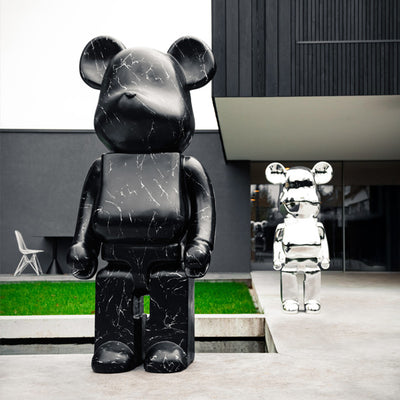







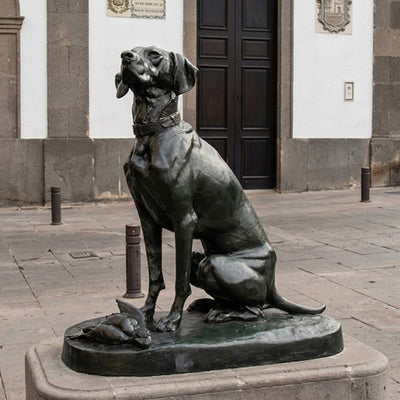














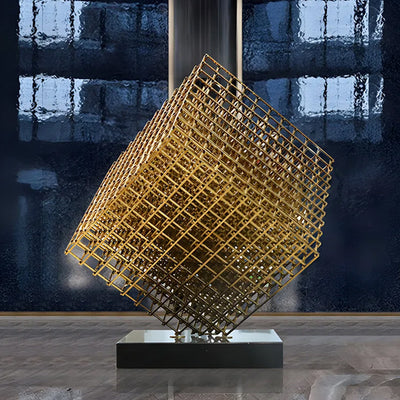
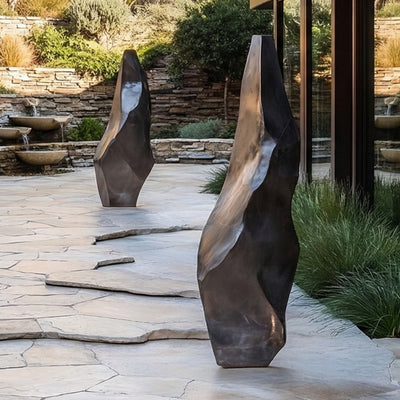






















Most custom large steel sculpture projects that go wrong do so before anyone picks up a pencil. The form is rarely the problem. The trouble comes from a 14-foot (4.3 m) piece designed without a wind calculation, polished to a mirror for a site that faces the afternoon sun, and drawn as one unbroken object that no truck on an American interstate can legally carry. At Giant Sculptures we quote on bespoke steel work regularly, and the commissions that run smoothly all settle the same few practical questions first.

Key Takeaways
Engineering first: wind load and a structural engineer's sign-off shape the form, not the other way around.
Grade by geography: coastal or de-iced sites call for 316 stainless; sheltered inland gardens can often use 304.
Finish by sun path: mirror, brushed and bead-blasted surfaces behave very differently in direct light.
Seams by logistics: truck width and crane reach decide where a large piece splits.
Budget the ground: footings and anchors belong in the scope from day one.
Wind Load Comes Before the First Sketch
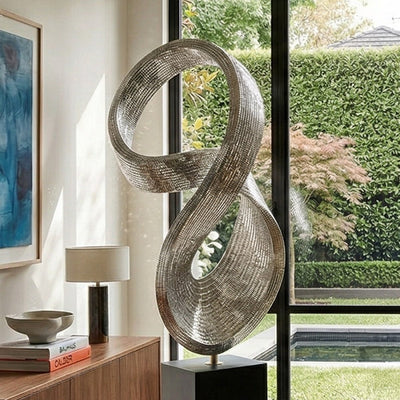
A tall stainless form behaves like a sail. A broad ribbon or disc catches far more wind than its weight suggests, and above roughly 10 feet (3 m) the load at the base usually becomes the governing design factor. In the US, engineers work from the wind speed maps in ASCE 7, and the figures differ sharply between a sheltered Napa vineyard and an exposed Gulf Coast lot.
Above about 10 feet, wind load sets the wall thickness and internal spine of a custom large steel sculpture.
That number feeds directly into wall thickness, internal armature and base plate size. We ask clients to accept early that an engineer may thicken a section or add an internal spine. Pushing back after the design is approved costs time and, occasionally, the form itself. Many municipalities and HOAs also want stamped drawings before they permit a large outdoor structure, so the sign-off does double duty.
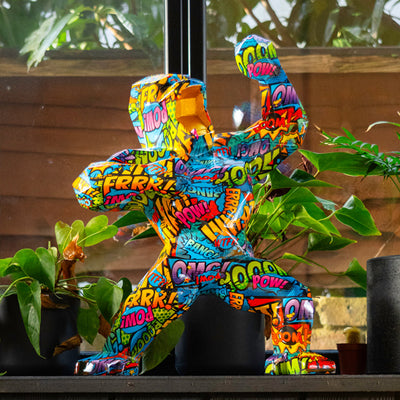
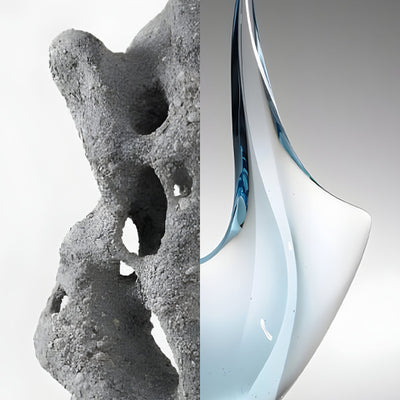
Below about 6.5 feet (2 m), particularly in a lobby or under a covered terrace, wind barely enters the calculation. At that height, a sculptural form set on a steel cube, such as Clear Tall Arm Splash on Steel Cube Resin Sculpture (193cm), is chosen for proportion and sightline rather than engineering. In that range, a bespoke commission is often unnecessary.

316 or 304: Let the Salt Air Decide
Both are austenitic stainless steels, and in a dry inland garden 304 performs well for decades. Near the ocean the picture changes. Airborne chlorides settle on the surface and attack 304, producing the brown "tea staining" owners often mistake for rust. Grade 316 adds molybdenum, which the International Molybdenum Association identifies as the key to its better chloride resistance.
Our working rule for any custom large outdoor stainless steel sculpture: if the site sits within a few miles of salt water, beside a saltwater pool, or near roads salted in winter, specify 316. Do not trust appearances. A lawn set well back from a bay can look sheltered, but if the prevailing wind comes straight off the water, chlorides arrive anyway. Built in 316, a piece in that setting should need little beyond a seasonal rinse.
Choosing a Stainless Steel Outdoor Sculpture Finish by Sun Path
Finish is often treated as taste. On a stainless steel outdoor sculpture it is closer to a site decision. Walk the location at morning, noon and late afternoon, or ask your architect for a sun-path diagram.
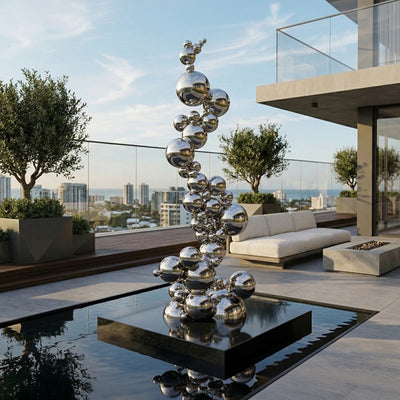
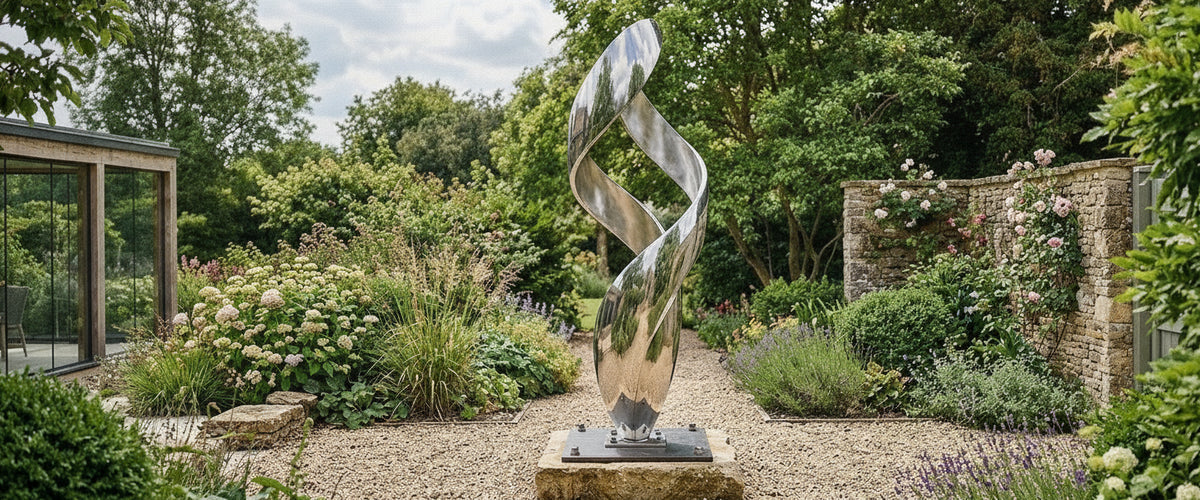
Mirror polish on a custom large steel sculpture changes character as the sun moves across the site.
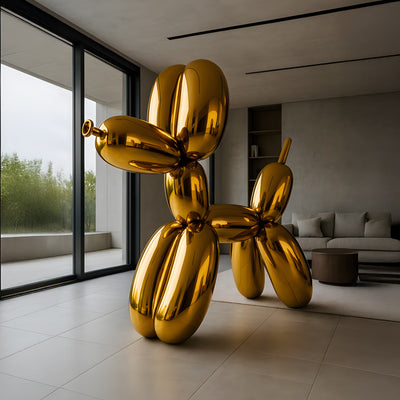
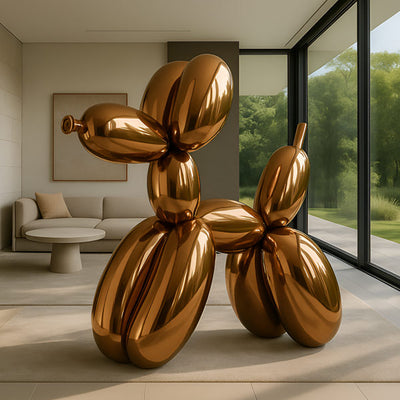
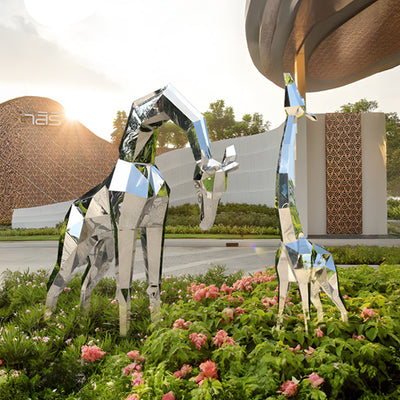
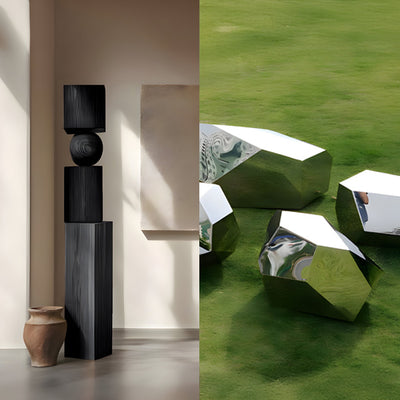
Mirror polish reflects sky, planting and architecture, which is why it suits playful forms like our large balloon dog sculptures. Concave mirror surfaces can also focus sunlight, and glare toward a terrace, a neighbor's window or a driveway is a real concern in a Texas or Arizona summer.
Brushed finishes soften reflections, hide fingerprints and read as calm and architectural on corporate plazas.
Bead-blasted surfaces give a soft satin glow with almost no glare. They hold more surface texture, so on a coastal site they need 316 and a more regular wash.
Smoother surfaces shed contaminants more easily, which is one reason high-polish 316 is often the most forgiving choice near the sea.

Truck Widths, Crane Reach and Where the Seams Go
A standard US trailer carries loads up to 8.5 feet (2.6 m) wide without an oversize permit. Go wider and you add escorts, permits and route restrictions. For overseas delivery, the internal width of a shipping container is tighter still. We plan the joints of every custom large steel sculpture around these limits before cutting a single sheet.
Sections are then either welded and dressed on site, which leaves no visible line but needs a skilled crew and a dry weather window, or joined with concealed internal flanges and bolts. Crane reach matters as much as road width. A 60-foot (18 m) reach sounds generous until the crane has to stand on the street behind a Malibu house and lift over the roofline. Send us the access route, gate widths and any overhead cables early.
Footings and Ground Anchors: The Line Item Budgets Forget
Every custom large steel sculpture needs a foundation designed for the same wind load that shaped it. Usually that means a reinforced concrete footing with anchor bolts cast to a template we supply, so the base plate lands exactly. In cold climates such as Aspen, the footing must sit below the frost line; on expansive Texas clay, a soil report can change the design entirely.
A local contractor typically handles this groundwork, which is why it drops out of so many commission budgets. Put it in the scope from the start, along with any lighting conduit you want buried before the concrete is poured.

Briefing a Custom Large Steel Sculpture: What Our Studio Needs Before Quoting
Budget for a custom large steel sculpture depends on scale, grade, finish, engineering, shipping, installation and the complexity of the form, so we do not quote from a sketch alone. The more of this list your brief covers, the more accurate the first quote.
Site photos from the main viewing points, plus one wide shot showing context
Approximate distance to salt water, saltwater pools or salted roads
Soil notes or a geotechnical report, if one exists
Sightlines: where the piece will be seen from, and at what distance
Orientation or a sun-path note for finish selection
Access route, gate widths, overhead obstructions and crane standing space
Target height range and any planning, HOA or permit constraints
Be candid about that height range. If the brief settles below 6.5 feet (2 m) and the setting is an interior or a covered space, a layered, translucent form on a slim steel support, such as Clear Layered Crescent Acrylic Sculpture on Steel (180cm), may suit the space better than commissioning structural stainless from scratch.
For form references, browse our stainless steel sculptures, or the wider outdoor sculptures and metal sculptures ranges if you are still weighing materials. Giant Sculptures will turn your brief into concept drawings, an engineering pathway and a tailored quote.
For wider placement ideas, Large Metal Garden Sculpture: Pick the Finish Before the Form is useful companion reading before finalising the setting and sightlines.