

























































































A bronze wall piece can look magnificent in a photo and fall flat on the wall, and the reasons usually trace back to choices nobody discussed at the start. Relief depth, viewing distance, patina, mounting weight: these get locked in early, and they are hard to unpick once metal is poured. Good bronze wall art is engineered as carefully as any freestanding figure, and the studio conversations behind it are more interesting than most buyers expect.
Looking for the full range in this category? Browse our Metal Wall Art collection for every available finish, size, and configuration.
We ship bronze wall reliefs and sculptural panels to homes and venues across the US and beyond, and the same handful of questions decide whether a piece sings or sulks. Here is how we think through them.

Key Takeaways Before You Commission Bronze Wall Art
- Scale to the wall and the walk-up. A piece read from 10 ft (3 m) needs different relief and detail than one seen from 30 ft (9 m).
- Patina is a decision, not a default. Copper bronze wall art, antique bronze wall art, and polished finishes age and read differently.
- Weight drives the fixings. Solid cast bronze is heavy; the wall substrate matters as much as the bracket.
- The maquette earns its keep. Approving a small model before fabrication is the cheapest quality control you will ever buy.
- Budget follows the brief. Material, scale, relief complexity, patina, and install all move the number, so ask for a tailored quote rather than guessing.

What Sculptors Actually Think About Before Taking On a Bronze Wall Art Commission
The first thing we assess is not the image, it is the wall and the eye line. Where does the viewer stand? How high does the piece sit? Is there raking daylight across it in the afternoon, or flat overhead light all day? Bronze relief depends on shadow to describe form, so a panel destined for a north-facing hallway with even light needs deeper undercuts than one on a wall that catches low sun.
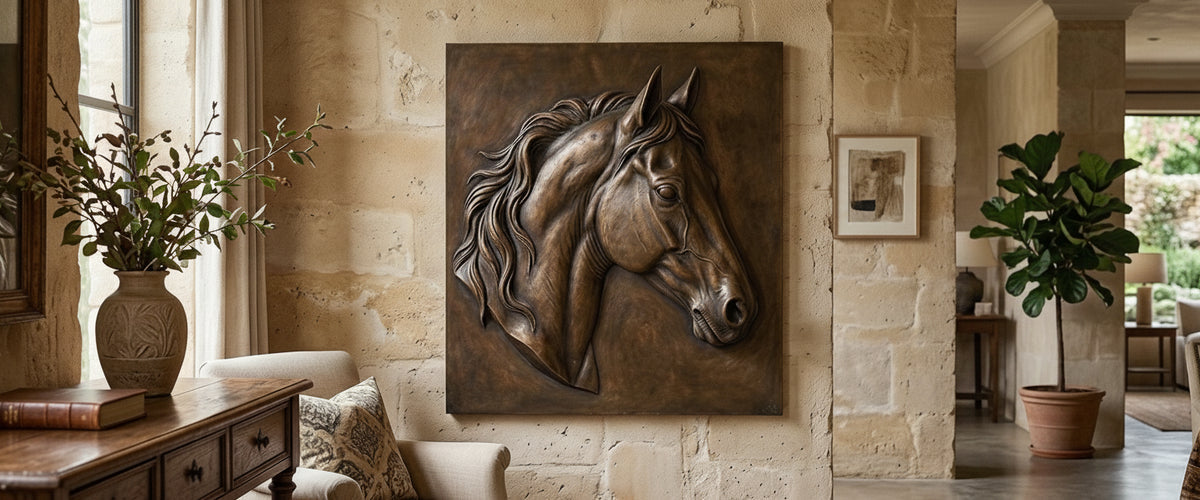
Then comes weight. Cast bronze is dense, roughly 8.5 times heavier than the same volume of water, so a large solid relief can run to hundreds of pounds. We often hollow-cast or build panels in sections to keep them mountable on ordinary construction. A client wanted a horse-head relief on a rammed-earth wall; the substrate could take the load, but only with a concealed steel backing plate we designed alongside the casting. That plate was decided in week one, not improvised on site.
The third question is honesty of material. Copper bronze wall art and true cast bronze are not the same animal. Bronze is a copper-tin alloy prized for centuries because it casts crisply and takes patina beautifully; the Tate's material notes are a clean primer on why sculptors have leaned on it since antiquity. If a supplier is vague about whether a piece is solid bronze, bronze-clad, or a bronze-toned coating over another metal, that vagueness tells you something.

Craft Decisions That Change the Final Result (and the Price)
Relief depth is the big lever. A shallow bas-relief reads as a drawing in metal, elegant and restrained. A high relief with figures pulling away from the ground reads almost like freestanding sculpture and throws dramatic shadow. High relief costs more to model, more to cast, and more to finish, because every undercut is a place the mold has to work harder.
Patina is the second lever, and it is where personality lives. A warm brown antique bronze wall art finish flatters classical subjects and traditional interiors. A verdigris or green-blue patina nods to weathered outdoor bronze and suits gardens and courtyards. A polished or lightly waxed surface pushes contemporary. Where a figural relief needs its finish to sit with the modeling rather than fight it, a piece like the Classical Figural Torso Wall Sconce Bronze Sculpture - 90cm at 90 cm shows how a controlled patina and a sculpted body can be tuned to each other.
Surface finish after patina matters too. Wax gives a soft, hand-rubbed glow and needs occasional refreshing. Lacquer locks the color but reads flatter and can eventually need stripping and redoing. For indoor pieces we usually favor wax; for exposed outdoor bronze we specify the protection to the climate.
Then there is fixing design, which buyers rarely ask about and always feel later. A French cleat, a hidden bracket, a standoff that floats the piece off the wall to catch shadow: each changes how the work sits and how easy it is to hang level. We design the fixing as part of the piece, not as an afterthought bought from a hardware aisle.

Why Some Bronze Wall Art Reads Right at 10 ft and Wrong at 30
Scale and detail have to agree with distance. A finely detailed bronze metal wall art panel packed with texture rewards a viewer standing a few feet away in an entrance hall. Put that same busy surface on a double-height wall seen from across a lobby and the detail collapses into visual noise; you lose the reading entirely.
Pieces meant for long viewing distances need bolder masses, cleaner silhouettes, and stronger shadow lines. Where the setting needs a contemporary reflection rather than classical weight, a circular panel such as the Orbitra Bronze Reflective Circular 3D Wall Art works at distance because its form is legible as a whole shape before you register any surface. That is deliberate. When we design for a big commercial wall, we test the composition at the intended distance using a scaled printout on the actual wall before anyone commits to fabrication.
Animal reliefs sit interestingly in the middle. For a feature wall that has to hold a room from across it while still rewarding a close look, a piece like the Traditional Horse Head Bronze Relief - 80cm at 80 cm carries both the near and the far view, which is part of why heads and busts stay popular for this job.
Studio Process: Maquette, Sample, Fabrication, Install
Every serious bronze wall commission runs through the same stages, and skipping one is where projects go wrong.
- Maquette. A small model, physical or digital, that fixes composition, relief depth, and proportion. This is your last cheap chance to change your mind.
- Patina sample. A test coupon in the chosen alloy and finish, viewed under the actual lighting where possible. Patina photographs unreliably, so a physical sample settles arguments.
- Fabrication. Casting (usually lost-wax for figural work), chasing, welding of sections, then the patina applied by hand with heat and chemistry. The Met's overview of lost-wax casting explains why this ancient method still gives the crispest results.
- Install. Fixings confirmed against the real substrate, weight signed off, and for large pieces a site survey before delivery.
For genuinely large or complex work, our bronze wall art range shows the span of relief styles, and the wider bronze sculptures collection is worth a look if a freestanding companion piece is in play. If your idea does not exist in the catalog, that is what commissioning is for.
Honest Red Flags to Raise Before You Commit
A few questions separate a confident maker from a hopeful one. Ask them early.
- "Is this solid bronze, bronze-clad, or coated?" All can be valid, but you deserve a straight answer, and it affects longevity and value.
- "How much does it weigh, and what wall does it need?" If nobody has asked about your wall, nobody has thought about your install.
- "Will I see the patina before you finish the whole piece?" A studio confident in its finishing will happily show a sample.
- "Who supplies the fixings, and are they concealed?" Visible brackets on a fine relief undo months of modeling.
- "What does aftercare involve?" Waxed indoor bronze is low effort; outdoor bronze needs a maintenance rhythm suited to its climate. The conservation care guidance from AIC is a sensible baseline for expectations.
The patina conversation matters most on darker, dramatic subjects, where the deep shadowed finish is what gives the piece its weight rather than something sprayed on at the end. On something like the Classical Gargoyle Demon Bronze Wall Sculpture - 90cm at 90 cm, that shadow has to be built into the modeling and the finishing from the start.
How Budget Actually Gets Set
There is no honest flat rate for bronze wall art, and anyone quoting one before understanding your brief is guessing. The number moves with alloy and casting method, physical scale, relief complexity, the patina and finish, engineered fixings, and installation. A large high-relief figural panel with a hand-applied antique patina and a concealed steel backing is a different project from a modest cast head. Send us the wall, the distance, the subject, and the mood you want, and we will price the piece that fits rather than a piece that merely resembles it.
Bronze rewards patience. Commission it properly and it outlives the room it was made for, which is exactly the point of choosing it over lighter, cheaper wall decor.
For wider placement ideas, 3d Art Wall Panels: What a Sculptor Weighs Before Taking the Commission is useful companion reading before finalising the setting and sightlines.