



































































































A 3D art wall panel that photographs beautifully on a designer's moodboard can fall apart the moment you stand in front of it. The relief is too shallow for the wall it lives on, the shadow lines vanish under flat downlighting, or a piece sized for a stairwell gets hung across a double-height atrium where it reads as a postage stamp. Most of the decisions that decide whether 3d art wall panels work happen long before fabrication starts, and buyers rarely see them. This is the part of the process we walk our clients through at Giant Sculptures, where wall pieces are treated as sculpture on a vertical plane rather than decoration you screw up and forget.
Below is how the studio actually thinks about a commission for 3d art wall panels: the craft calls that move the result, the scale traps, and the questions any serious buyer should ask before signing off.

Key Takeaways Before You Commission 3D Art Wall Panels
- Depth and viewing distance are linked. A panel read at 30 ft (9 m) needs deeper relief and bolder forms than one read at 10 ft (3 m).
- Material drives everything downstream: weight, fixing method, finish, and how the piece ages both indoors and outdoors.
- Lighting is part of the artwork. Raking light from the side reveals relief; flat frontal light kills it.
- Bespoke means samples. Ask for a maquette and a finish sample before full fabrication of your 3d art wall panels.
- Budget depends on material, scale, complexity, engineering, and install, not a shelf price. Request a tailored quote.

What Sculptors Actually Think About Before Taking a 3D Art Wall Panel Commission
The first question is never "what does it look like." It is "where does it hang, and how far back does the viewer stand." A panel destined for a hallway you brush past at arm's length is a different object from one anchoring a hotel lobby seen across a room. Sightlines, ceiling height, and the wall's structure all feed into the brief before a single form is modeled. The best 3d art wall panels start from that placement, not a picture.
The second question is weight. A carved wood panel and an etched metal panel of the same footprint can differ enormously in load, and that changes the fixing strategy. On masonry we can use resin anchors; on stud walls we may need to locate structure or add a backing rail. We have shipped 3d wall panel art to clients who assumed a decorator could pop it up in an afternoon, then discovered the wall needed reinforcing first. Asking early saves that scramble.
Then comes environment. Indoor panels can carry finishes that would not survive an exposed garden wall or a coastal terrace. Outdoors, we lean toward bronze, stainless steel, or Corten, materials that handle weather and age with intent rather than degrading. The 3D Wall Art collection shows the range of 3d art wall panels across both settings.

Craft Decisions That Change the Final Result (and the Price)
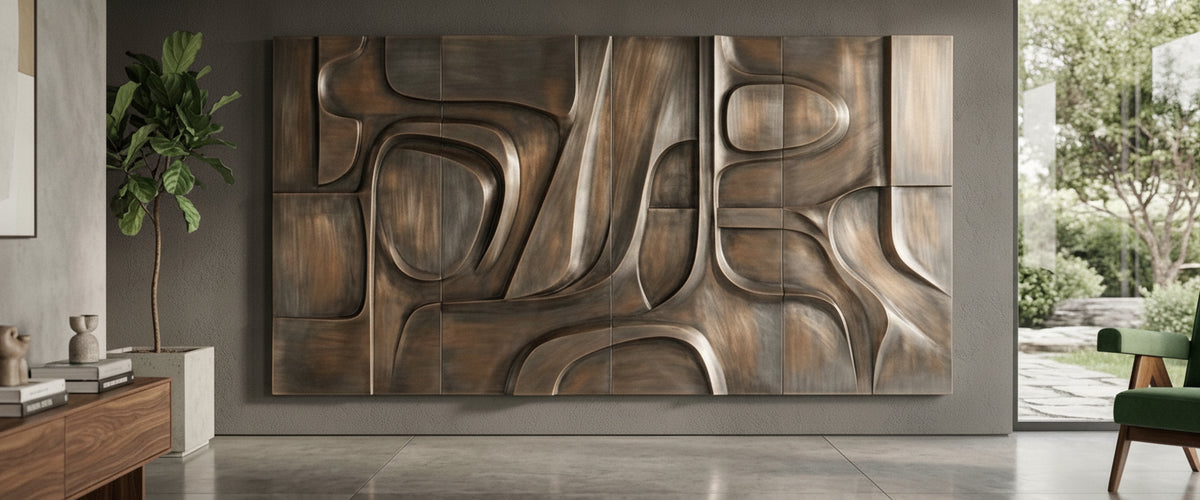
Relief depth is the big one. Low relief (bas-relief) sits close to the surface and reads as a subtle texture; high relief throws deep shadows and reads as near-sculptural from a distance. The deeper you go, the more material, modeling time, and structural thought the piece demands. That is where cost moves on 3d art wall panels.
Surface finish is the next lever. On bronze, a patina can run from warm brown to deep green-black, and each one changes how light catches the form. A polished stainless panel bounces the room back at you; a brushed or etched surface holds light softly. Where a panel needs to reward both a distant glance and a close inspection, an etched metal piece such as Echo Nature-Inspired Abstract Panel layers fine surface detail on top of the relief itself, so the form works at two viewing depths at once.
Modularity matters too. A single large panel makes a bolder statement but is harder to ship and install; a set of tiled 3d art wall panels lets you scale a composition across a wide wall and adjust spacing on site. A geometric tile like the Prisma Blue Geometric Panel can be repeated and re-spaced to fit an awkward run of wall, which is worth real money on tricky installs.
Color is a craft decision, not an afterthought. Powder-coated metal, colored resin, and patinated bronze all behave differently under artificial light versus daylight. We test finish samples under the client's actual lighting temperature wherever we can, because a warm halogen and a cool LED can make the same green read as two different colors.

Why Some 3D Art Wall Panels Read Right at 10 ft and Wrong at 30
This is the mistake we see most. A buyer falls for a panel at gallery distance, orders it, then hangs it where the primary viewing distance is three times greater. Fine detail that sang up close dissolves into mush across the room, and the piece looks busy and unresolved.
The fix is designing for the actual sightline. At 30 ft (9 m) you want fewer, bolder forms and deeper relief so the shadows do the work. At 10 ft (3 m) you can afford intricate etching and delicate transitions. Where a wall needs strong massing that still holds up close, a classical relief such as the Traditional Horse Head Bronze Relief - 80cm at 80cm carries its forms boldly enough to read across a room while rewarding a closer look at the modeling. When we scale bespoke 3d art wall panels up, we do not just enlarge the file; we re-balance the composition so it stays legible at the distance it will actually be seen.
Lighting is the other half of this. Relief is shadow, and shadow needs directional light. Raking light from the side reveals surface texture that flat frontal light flattens, a principle museums rely on when displaying reliefs (Getty Conservation Institute). Plan a wall washer or an angled spot from the side, not a downlight sitting flat above the panel, or you will pay for depth you never see.
Studio Process: Maquette, Sample, Fabrication, Install
A bespoke panel moves through clear stages, and skipping any of them is where projects go wrong.
- Maquette. A small-scale model or digital render of the composition. This is where you correct proportion and depth before committing to full material cost.
- Finish sample. A physical swatch of the chosen patina, powder coat, or etch on the real material. Judge it under your own lighting, not ours.
- Fabrication. Modeling, casting or forming, welding or assembly, then finishing. Timelines depend on material and complexity; larger bronze and stainless 3d art wall panels naturally take longer than a modular resin set.
- Install. Fixings specified to the wall type, a mounting rail where needed, and placement checked against sightlines and lighting on site.
For a figural piece that projects well off the surface, a wall-mounted form like the Classical Figural Torso Wall Sconce Bronze Sculpture - 90cm at 90cm sits proud enough to cast its own shadow, which means its center of gravity has to be accounted for in the fixing plan. That is exactly the sort of thing the install stage exists to catch.
Honest Red Flags Buyers Should Ask About Before They Commit
- No maquette or sample offered. A supplier who will not show you a model or finish swatch is asking you to buy blind.
- No fixing plan. If nobody has asked about your wall construction, the install has not been thought through.
- Vague material talk. "Metal" or "stone-effect" is not an answer. You want to know the actual alloy, timber, or casting material and how it ages.
- Detail that will not survive the distance. Ask whether the design was scaled for your viewing distance or lifted straight from a small original.
- Outdoor promises on indoor finishes. Confirm the finish is rated for weather if the panel goes outside. Bronze, stainless, and Corten earn their place here; many decorative coatings do not.
- A flat price with no scope. The cost of 3d art wall panels depends on material, scale, relief depth, finishing, engineering, and installation. A credible studio quotes against your brief rather than a single sticker.
You can browse finished examples of 3d art wall panels across the Bronze Wall Art collection and the Wood Wall Art collection to see how material changes the feel of a piece before you brief a bespoke one. For anyone weighing where to buy 3d wall art panels, the honest answer is to start with a studio that will talk through all of the above before it talks price.
For wider placement ideas, 3D Wall Art Panels: How to Choose, Place, and Commission Them is useful companion reading before finalising the setting and sightlines for your 3d art wall panels.