






































































































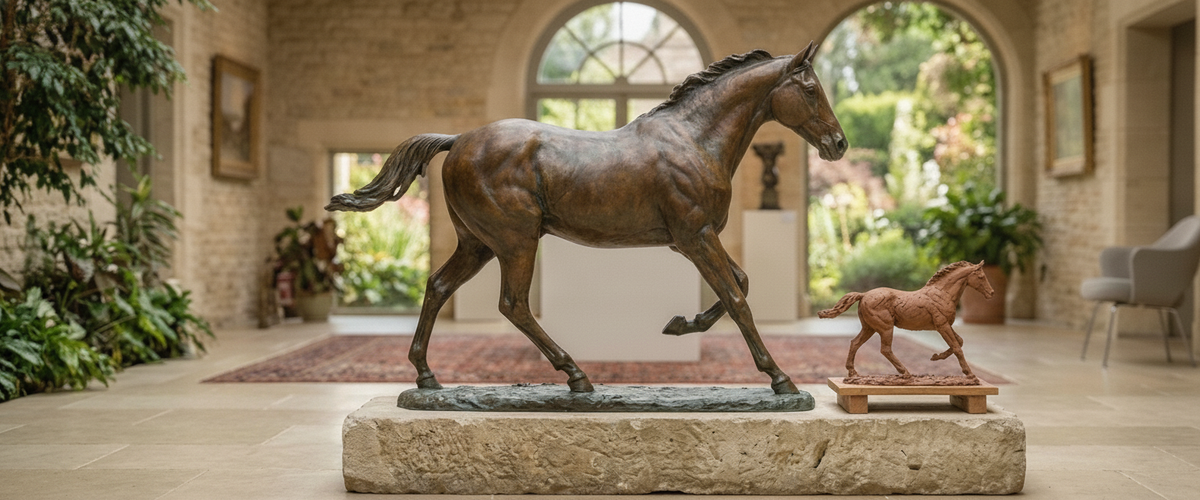

Most sculpture commissions that disappoint go wrong in the first email, when the client sends a mood board and no photograph of the actual spot. If you want to commission a sculpture for a garden, terrace, courtyard or hotel lobby, the site will shape the result more than any reference image. At Giant Sculptures we start every bespoke project with three questions. Where will the piece stand? Where will people see it from? What will the weather throw at it for the next fifty years?

At a glance
Brief the site first: viewing distances, sightlines, sun, wind, salt and frost.
Judge a studio on installed work that has aged outdoors, not on polished studio photography.
Expect five sign-offs: maquette, full-scale form, finish sample, crating and placement.
Make big changes at the maquette stage. They cost far more later.
The budget for a sculpture commission depends on material, scale, complexity, engineering, installation and finishing, so ask for a tailored quote.
Write the Brief Around Sightlines and Weather
A mood board tells a studio what you like. It says nothing about a main view from a kitchen window 60 feet (18 m) away, or a lawn that drops two feet toward the pool. Those details decide scale and pose, which is why anyone planning to commission a sculpture for a specific spot should lead with them. A life-size figure that feels commanding in a showroom can read as a garden ornament across a Napa vineyard terrace. A horse that suits an open paddock view can crowd a Manhattan rooftop.
Photograph the site from every spot where people will actually stand.
So write the brief as a site report. Photograph the spot from every place people will actually stand: the driveway, the main window, the terrace chair. Note the morning and evening light, because a dark patinated bronze can turn into a flat silhouette against a western sky. Then be honest about the weather. Freeze-thaw winters in Aspen, coastal salt in the Hamptons and hard UV in Texas each push the material choice in a different direction. Bronze copes with most of it if it gets sensible care. Marine-grade stainless steel handles salt air well. Corten does not, and is best kept away from coastal spray.
When you commission a sculpture for a planted garden, ask what the planting will look like in five years. We once enlarged a client's figure by nearly a foot (about 30 cm) at the maquette stage. Their landscape designer had pointed out that the yew hedge behind it would be twice as tall by the time the piece settled in.

How to Commission a Sculpture: Study Installs, Not Portfolios
Portfolio photography is shot on the best day, at the best angle, often before the piece has seen a winter. If you want to know how to commission a sculpture with confidence, ask the studio for images of work that has been installed outdoors for several years. Look at the base detail, the fixings and how the patina has aged around joints and seams. Uneven weathering at weld lines tells you more about craftsmanship than a perfect gallery shot.
Before you commission a sculpture from any studio, ask direct questions. Who engineered the fixings? Who managed the crane lift? Has the studio shipped to your country before, and who cleared customs? A studio that casts beautifully but hands installation to strangers leaves you carrying the risk on the most dangerous day of the project. When you browse our bronze figures and statues, use the same test. Look for consistent finishing across many pieces rather than one hero image.
Sign-Off One: The Maquette Is the Cheapest Moment to Change
The maquette is a small-scale model, usually in clay, wax or a 3D print, that fixes pose, silhouette and proportion. If you only push hard once in the whole sculpture commission, push here. Walk around it. Photograph it next to your site pictures. Hold it at arm's length to mimic the real viewing distance, and check that the outline still reads.
Compare the maquette against your site photos before approving the pose.
Changing a raised foreleg or the turn of a head costs very little at this point. On a commissioned horse, the choice between a rearing pose and a walking one changes the engineering, the base and the shipping weight, so settle it now. Look across a range of bronze horse statues and you will see how much a single leg position alters the stance from twenty paces.
Sign-Offs Two and Three: Full-Scale Form and Finish Sample
Once the form is enlarged to full scale, usually in clay over an armature or as a milled foam master, alterations take real labor and sometimes mean rebuilding whole sections. This is the point where commissioning a sculpture gets expensive if you change your mind. Small refinements to facial detail, drapery or muscle definition are normal at this stage. Changing the pose is not, and it will show up on both the invoice and the schedule.
The finish sample deserves more attention than most buyers give it. Patina is chemistry applied by hand, so ask to see it on a test plate in daylight rather than under studio lamps. A warm brown, a verdigris green and a near-black can all look right indoors and quite different on a gray Pacific Northwest morning. The core of lost-wax casting, which The Metropolitan Museum of Art traces back to antiquity, has changed surprisingly little. The finishing choices layered on top are where a sculpture commission becomes personal. For portrait work such as bronze busts and heads, approve the patina tone at this stage, because it is hard to reverse.

Sign-Offs Four and Five: Crating and Placement
For wider placement ideas, Art Deco Bronze or Clever Fake? How to Read a Figure Before You Buy is useful companion reading before finalizing the setting and sightlines.
Crating sounds like paperwork, yet it is where many international sculpture commissions keep or lose their schedule. Agree how the piece will be broken down (if at all), how it is braced inside the crate and who unpacks it. Large bronzes routinely weigh several hundred pounds, often far more, and the crate adds to that. Confirm access early: gate widths, driveway load limits, overhead cables and whether a crane can reach the final spot.
The last sign-off happens on site, and it should. Before the base is fixed, have the installers hold the piece in position, or set out a full-size cutout, and walk your sightlines again. Turning a figure ten degrees toward the main window can matter more than any detail approved months earlier. On a Texas ranch install, the client moved the plinth six feet (about 1.8 m) closer to the house once they saw the real piece at dusk. No drawing would have predicted that.
A Buyer's Checklist Before You Commission a Sculpture
Site photos from every main viewpoint, with rough distances noted
Climate notes covering salt, frost, UV and wind exposure
A material preference and the reason for it: bronze, stainless steel, Corten or stone
Target scale relative to nearby architecture and mature planting
A clear delivery route for trucks and lifting equipment
Named responsibility for engineering, fixings and foundations
Agreed sign-off points, with what changes cost at each one
A long-term care plan, including periodic waxing for bronze
When you commission a sculpture well, the finished piece looks inevitable in its spot, as if the garden had been planned around it. That comes from making decisions in the right order, with the expensive ones made early. If you are weighing a project, send our team your site photographs before your inspiration images. We will tell you what the space can carry, then quote against material, scale, engineering, installation and finishing. For significant pieces, a qualified conservator from the American Institute for Conservation directory is a sensible long-term ally.