






































































































Ask a studio for a commission quote and you get a number. Ask for the payment schedule and you learn how that studio actually works. An artist commission invoice for sculpture is a map of the build: what gets paid, when, and what each payment locks into place. Read it carefully and you always know where you stand. Skim it and you find out in month four, usually at the worst possible moment.

At a Glance
Read the schedule, not just the total. An artist commission invoice for sculpture is a build plan with money attached to each decision.
Three stages are standard: deposit at commission, a payment at clay approval, and a final balance before the piece leaves the foundry.
The deposit buys thinking, not bronze. Research, reference gathering, maquettes and armature engineering happen before any metal is poured.
Clay approval is the expensive signature. After it, the mold is made and changes stop being free.
A commission bust sculpture is priced differently from a life-size outdoor figure because likeness work, not tonnage, drives the hours.
Crating, freight, rigging and installation are separate lines. Ask for them up front rather than at the end.
Edition size, reproduction rights and mold ownership belong in the paperwork, not in a verbal understanding.
Budget depends on material, scale, complexity, engineering, finishing and install, so ask for a tailored quote rather than a ballpark.
The Three-Stage Payment Structure and What Each Stage Buys
Most serious studios, ours included, break a commission into three billed stages. The first releases the studio to start work. The second is triggered when you approve the sculpted clay or full-scale model. The third falls due when the finished piece is photographed, signed off and ready to crate.
Each stage is a gate, not just a payment. Money moves because a decision has been made and a phase is closed. That is why a well-written artist commission invoice for sculpture names the deliverable attached to each stage: "approval of quarter-scale maquette", "client sign-off on full-size clay", "final patination photographs issued". Vague invoices that say "second payment" with no linked milestone are the ones that cause arguments later. Percentages vary by studio and by project; the gates should not.
What the Deposit Actually Pays For
Buyers often assume the deposit covers materials. It rarely does. Before a single measurement is taken, the studio is buying reference photographs, sitting with you to agree on pose and character, building an armature that can carry wet clay without sagging, and running structural sums if the piece will stand outdoors in wind. On larger figures we also model a maquette so you can hold the composition in your hands and judge it from every side before we commit to scale.
That work is irreversible time. If a client withdraws after the maquette, the studio has still spent those weeks. The first line on an artist commission invoice for sculpture should therefore read something like "design development and maquette" rather than simply "deposit". Browse finished work in our bronze figures and statues collection and you are looking at the end of that process, not the start of it.
The clay approval gate is the point where a commission stops being flexible.

Clay Approval: The Most Expensive Signature in the Commission
Clay approval is where a commission stops being flexible. Once you sign, the studio takes molds from the clay, the original is effectively consumed, and the piece heads into wax, ceramic shell and bronze. Reopening a likeness after that means remodeling and recasting, which is a new job with a new number.
Take the approval seriously. Ask for photographs from at least eight angles, in daylight, at eye level rather than shot down from above. If you cannot visit the studio, ask for a live video call where the sculptor rotates the piece and holds a raking light across the surface. We have run those calls late at night to suit a family's time zone, and more than once a second pair of eyes on the call has caught a jawline the photographs had flattened out. Worth the late start.
Why a Commission Invoice for a Sculpture Bust Reads Differently
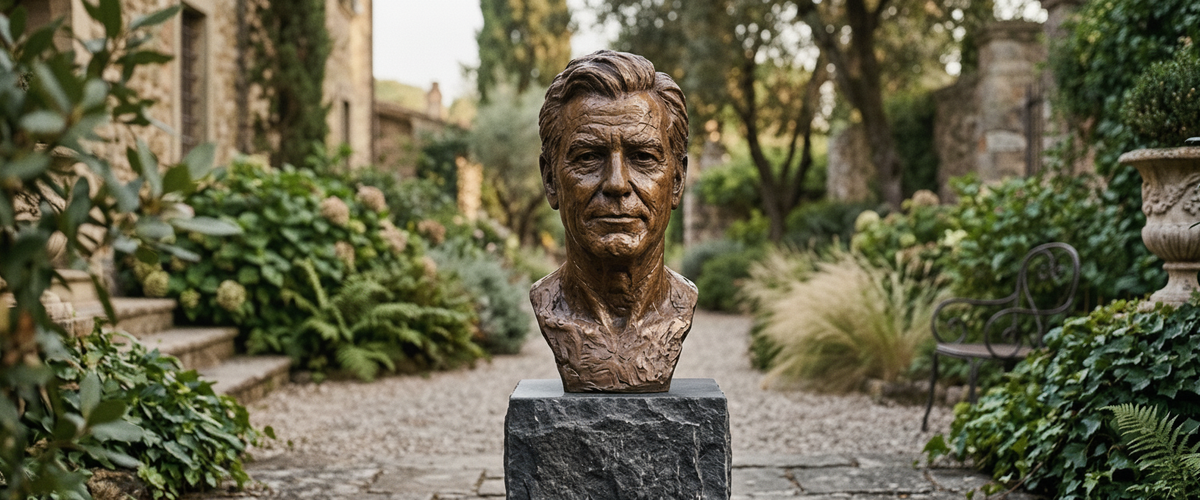
A commission invoice for a sculpture bust and an invoice for a life-size outdoor figure are built from different arithmetic. A portrait bust stands around two feet tall (roughly 60 cm) with its socle, so material cost is modest. What you are paying for is likeness: the days spent getting an eyelid, a mouth corner and the set of the ears to read as one specific person rather than a generic head. Expect more studio hours per pound of bronze than on any other commission type.
A life-size or larger outdoor figure flips that. Metal volume, internal armature, mounting plates, wind loading and foundry pour size dominate the cost, and likeness may be secondary or absent entirely. It is why an artist commission invoice for a sculpture bust often carries a heavier modeling line and a lighter engineering line, while a monumental figure does the reverse. If you are weighing a commission bust sculpture against a full figure, our bronze busts and heads collection shows how much presence a head can carry at close range.
On a portrait bust, modeling hours rather than metal volume drive the numbers.
Crating, Freight and Install: The Lines Buyers Never Think to Ask About
The sculpture is finished. Now it has to get to you. Custom crating, export documentation, insured freight, customs handling, crane or gantry hire, mounting hardware and site supervision all sit outside the making cost, and on an artist commission invoice for sculpture they should appear as itemized dispatch lines rather than being buried in a lump sum.
Ask early, because logistics can change the design. We have engineered a bronze horse to separate at the plinth because the only approach road to the site would not take a trailer carrying the full assembly, and that decision had to be made at clay stage rather than at dispatch. Anything in the weight class of our bronze horse statues deserves a site conversation before the mold is made. Even a crated commission bust sculpture needs a named delivery contact and a door it will actually fit through.
Edition Size, Reproduction Rights and Who Owns the Mould
Commissioning a sculpture does not automatically transfer copyright. In the US, ownership of the physical object and ownership of the underlying work are separate, and commissioned art only counts as work made for hire under narrow written conditions set out by the US Copyright Office. Settle three points in writing: how many casts exist in the edition, whether you hold exclusive rights to the image, and who keeps the mold once the edition closes.
Collectors buying a unique portrait usually want an edition of one and the mold destroyed or retained under a no-recast agreement. Corporate and civic buyers often want reproduction rights for marketing. Both are reasonable; neither is free, and both belong on the artist commission invoice for sculpture as named lines. On a family portrait, the rights clause on an artist commission invoice for a sculpture bust matters even more than the price. Professional bodies such as the National Sculpture Society publish guidance on commission agreements worth reading before you sign.
Change Requests After Sign-Off: Whose Clock, Whose Cost
Changes are normal. Changes after a gate has closed are a variation, and variations are billed. The fair approach is simple: the studio quotes the extra hours and any material waste before starting, you approve in writing, and the revised amount appears as a dated addendum to the original schedule. No surprise line items at final invoice.
Where it gets murky is who caused the change. If the sitter's family supplies a new photograph at clay stage that contradicts the brief, that is your clock. If the patina came back two shades off the approved sample, that is ours. Write the distinction into the agreement while everyone is still cheerful.

Checklist Before You Approve an Artist Commission Invoice for Sculpture
Does every payment stage name a specific deliverable and approval point?
Is the material, finish and patina specified, with a physical or photographed sample referenced?
Are crating, freight, insurance, customs and installation quoted or clearly excluded?
Is edition size stated, and is mold ownership after completion addressed?
Does the agreement say who pays for changes, and how variations are approved?
Is there a stated process if you reject the clay, including revision rounds included in the base fee?
Who carries the risk in transit, and at what point does title pass?
Commissioning with Giant Sculptures
We build bespoke work in bronze, stainless steel, Corten, stone and marble for private gardens, hotels, campuses and civic spaces, and we quote each project against scale, material, engineering and site access rather than a template. If you are comparing studios, set their headline figures aside and compare each artist commission invoice for sculpture stage by stage, whether the piece is a monument or a commission invoice for a sculpture bust. The schedule that tells you what happens at every gate, including the awkward gates, usually belongs to the studio that has shipped the most work. Tell us what you have in mind and we will price it honestly, stage by stage.
For wider placement ideas, What Separates Real Custom Headstone Makers from Catalog Resellers is useful companion reading before finalizing the setting and sightlines.