


























































































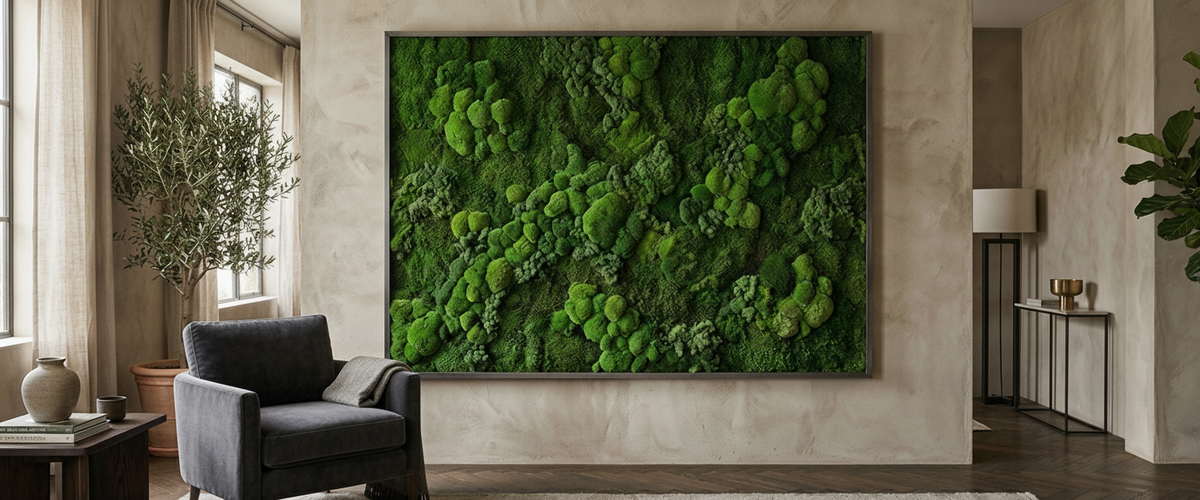

A moss panel looks like the lowest-maintenance thing in the building until the morning you notice one corner has gone the color of dry hay. Moss wall art panels get sold as install-and-forget greenery, and for the first twelve months that is broadly true. What buyers rarely hear at the point of sale is that preserved moss has a service life, that its enemies are invisible, and that where you hang it decides more about its future than what you spent on it.

At a Glance
Preserved moss is a treated material. It is no longer alive, so it cannot recover from damage.
Dry air is the main killer. Below roughly 40 percent relative humidity, green fades toward gray and the fronds get brittle.
Heat sources and air vents shorten life fast. Keep panels well clear of radiators, registers and diffusers.
Direct daylight bleaches faster than traffic ever will. South-facing glass is the problem, not passing crowds.
Texture buys you time. Mounded bun and reindeer moss disguise years of aging; flat sheet moss shows every patch.
Re-tiling beats replacement. A tired zone can often be re-mossed in place if the substrate was built for it.
For permanent statement walls, carved stone, bronze or engineered metal relief holds its look for decades with almost no intervention.
Preserved Moss Is a Treated Material, Not a Plant You Can Revive
Preserved moss is harvested, then its natural moisture is swapped for a glycerin-based solution and a stabilized dye. The result stays soft and springy without roots, soil, light or irrigation. It also stays fixed at whatever condition it arrived in. Once a section goes brittle or pale, no amount of water, plant food or attention brings it back, because there is nothing alive in there to respond.
This single fact should reframe how you shop for moss wall art panels. You are not buying a living wall that will fill in and improve. You are buying a finished decorative surface with a slow decline curve, and your job as an owner is to flatten that curve. Buyers who understand this ask better questions: how is the panel substrate built, can individual tiles be lifted, and is the same moss batch and dye lot available for a top-up in three years?
Placement does more for longevity than price: an interior wall with no direct sun and no airflow across the face.

The 40 Percent Humidity Line Where Green Turns Gray
Glycerin holds moisture, but it needs a reasonable amount of ambient moisture to hold onto. Sustained dryness pulls that flexibility out of the fibers. In practice, panels kept in the upper half of the 30 to 50 percent relative humidity band that the US EPA cites for healthy indoor conditions hold their color and hand feel far longer than panels in aggressively conditioned spaces. Sit below that for weeks at a time and the moss starts to crunch under a fingertip instead of yielding.
Desert and mountain climates deserve extra thought. A client fitting out a Scottsdale office wanted a full-height green wall behind reception, in a building running winter humidity in the twenties. We flagged it: the moss would have been brittle by the second season. That project became a carved stone relief instead, which was the right call for both the room and the climate. Where the brief is really asking for a planted, botanical mood in a climate that will not sustain moss, a stone panel like the Bamboo Grove and Rockery Marble Relief Wall Panel - 100cm carries the same green-space reference without depending on ambient moisture. Aspen, Santa Fe and most of the Mountain West in winter raise the same question for moss wall art panels.
Radiators and Air Vents Are the Worst Neighbors a Moss Panel Can Have
Building services quietly destroy more moss wall art panels than anything else, and two culprits do most of the damage. The first is a heat source directly below the panel; warm air rises straight up the face and dehydrates the lower third first, which is why tired panels so often fade from the bottom edge upward. The second is a supply diffuser or wall-mounted mini-split blowing across the surface. Constant moving air strips moisture and drives dust deep into the pile at the same time.
Before you commit to a wall, stand where the panel will go and hold the back of your hand up for thirty seconds. If you can feel air movement or warmth, choose another wall or move the service. Hospitality clients often discover the conflict after the joinery is fixed, and by then relocating a diffuser costs more than the artwork.

Why South-Facing Daylight Bleaches a Moss Wall Faster Than Footfall Ever Will
Dyed organic material is vulnerable to light in a way that stone and metal simply are not. Conservation research on light damage is clear that fading is cumulative and irreversible, and that the total dose over time matters as much as peak brightness; the Getty Conservation Institute's work on light and color change is a useful primer. A moss panel opposite a wall of south-facing glass in a California living room can shift noticeably in a single summer, while an identical panel in a busy hotel corridor with no direct sun stays even for years.
The practical rule: treat daylight exposure as the first placement filter for moss wall art panels, not an afterthought. North-facing walls, inner corridors, stairwell returns and windowless boardrooms are ideal. If the only wall available faces the sun, either specify solar-control film on the glazing or accept that you are running a shorter cycle.
Reindeer, Bun and Flat Sheet: Which Texture Hides Three Years of Aging Best
Texture choice is the most underrated durability decision when you are specifying moss wall art panels.
Reindeer moss is airy and lichen-like, with a broken surface and natural color variation. Because the eye already reads it as irregular, uneven fading blends in. Best long-term bet for large formats.
Bun or mound moss gives sculptural domes and shadow. The relief carries the composition even after color flattens, so it ages gracefully.
Flat sheet moss looks crisp and architectural on day one and is the least forgiving. Any patch, seam or bleached band reads immediately against a uniform plane.
Mixed textures scatter the light, hide tile joints and make a future repair almost invisible.
Mixing textures is usually the smart specification. A field of reindeer moss with bun moss drifts breaks up the surface, hides tile joints and makes future re-mossing far less obvious.
Dusting, Misting Myths and the Maintenance Nobody Mentions
Misting is the most persistent piece of bad advice attached to moss wall art panels. Preserved moss does not drink; spraying water onto it wets the dye and the backing board, encourages odor and can leave tide marks. Keep the checklist dry and gentle:
Dust every one to three months with a soft-bristle brush or a vacuum on lowest suction held slightly off the surface.
Work top to bottom so loosened dust falls clear rather than settling into the pile below.
Never wet the moss, and never use cleaning sprays, polish or fabric refresher on it.
Check the lower third twice a year for brittleness, which is your early warning that ambient air has gone too dry.
Photograph the panel at install under consistent light so you can judge color drift honestly later.
Keep a small spare tile or offcut from the original batch as a color reference.

When to Re-Tile a Tired Section Instead of Replacing the Whole Panel
Most moss walls fail unevenly. If one zone has gone flat next to a heat source while the rest is sound, re-mossing that area is cheaper and far less disruptive than a full strip-out, provided the panel was built as separate tiles on a cleat or frame system rather than as one glued monolith. Ask about that construction detail before you buy, not after. Blend new material into an irregular boundary rather than a straight line, and feather it with a slightly different texture so the repair disappears.
Full replacement makes sense when fading is global, the substrate has warped, or the piece has stopped earning its wall. That is often the moment clients start asking about something permanent.
When a Permanent Relief Panel Beats Moss Wall Art Panels
Moss suits soft, acoustic-adjacent interiors on a refresh cycle: co-working lounges, spa corridors, restaurant back walls that get reworked every few years. For a feature wall meant to outlive the fit-out, carved and cast relief is a different proposition entirely. Where the subject needs to stay naturalistic but the wall needs to stay unchanged, a carved panel such as the Standing Stag marble relief at around 59 in (150 cm) holds its detail indefinitely and shrugs off dry air, HVAC and sunlight.
Scale is where the comparison really bites. Moss reads best as a broad soft field; relief reads best as a composition with a focal point. On a double-height lobby wall, a single large-format piece such as the Six Galloping Horses marble relief at about 71 in (180 cm) earns the height better than a moss field that will need attention long before the lease renews. The 3D wall art and metal wall art collections show how depth and material change the effect, and the bronze wall art range is worth a look if you want a warmer patina.
Giant Sculptures works mostly at the large and bespoke end, so if the wall you are staring at does not match a standard format, we can commission a relief panel to your dimensions, subject and mounting method. Budget depends on material, scale, carving or casting complexity, engineering for the fixings, installation access and finish, so send drawings or photos of the wall and ask for a tailored quote. One thing our installers will always raise: relief panels concentrate real weight into a few fixing points, so substrate build-up and backing structure need confirming before anything gets ordered. Moss panels forgive a weak wall. Stone and bronze do not.
For wider placement ideas, 3d Wall Art for Office Spaces: The Two Distances That Decide Everything is useful companion reading before finalising the setting and sightlines.