






































































































Most office art fails in the first ten seconds of a building tour. Someone picks a panel from a thumbnail on a screen, it arrives, it goes up on the reception wall, and from the entry doors it reads as a flat gray rectangle. The depth that looked sculptural at 12 inches on a monitor has vanished. Every 3D wall art office brief we take on therefore starts with one question: how far away will people actually be standing? Choosing 3D wall art for an office is really a question of viewing distance, and almost every disappointing installation we get called about started with that single variable being ignored.
Looking for the full range in this category? Browse our Wall Art & Wall Decor collection for every available finish, size, and configuration.

Key Takeaways
Offices have two honest viewing distances: the corridor glance at 20 to 30 feet (6 to 9 m) and the seated stare at 3 to 6 feet (1 to 2 m).
At long range, relief shallower than about 1.5 inches (40 mm) stops casting usable shadow and flattens out.
At close range, the craft becomes the subject. Weld spatter, sanding scratches and filler lines all show.
Recessed downlights are the single most common reason a textured panel looks dead; aim accent light at roughly 30 degrees.
Plasterboard partitions can carry serious weight, but only with the right anchor strategy and a concealed cleat.
Keep art at least one structural bay away from the logo wall so it stays art rather than second signage.
Why 3D Wall Art for Office Walls Lives at Two Distances
A gallery lets people walk toward a piece and settle at whatever distance suits it. An office does not. Circulation routes, desk positions and meeting table geometry lock viewers into fixed spots. In practice, you get the corridor glance and the seated stare, and a 3D wall art office scheme that only performs at one of them will read as a mistake at the other.
So before anything else, stand where people will actually be. Measure it. A reception desk 26 feet (8 m) from the feature wall is a completely different commission from a boardroom credenza wall viewed from a chair pushed back at 5 feet (1.5 m). We ask clients for those two numbers before we discuss material, because they set the relief depth, the panel size and the finish grade.

Reception at 26 Feet: Shallow Relief Simply Disappears
Shadow is what makes dimensional work read. Push the viewer back to 26 feet (8 m) and the eye stops resolving small surface changes; all it registers is the tonal contrast between the lit face and the shadowed undercut. Relief under about 1.5 inches (40 mm) rarely throws a shadow deep enough to survive that distance under general office lighting, which is why so many entry lobbies end up with expensive texture that photographs beautifully and reads as wallpaper in person.
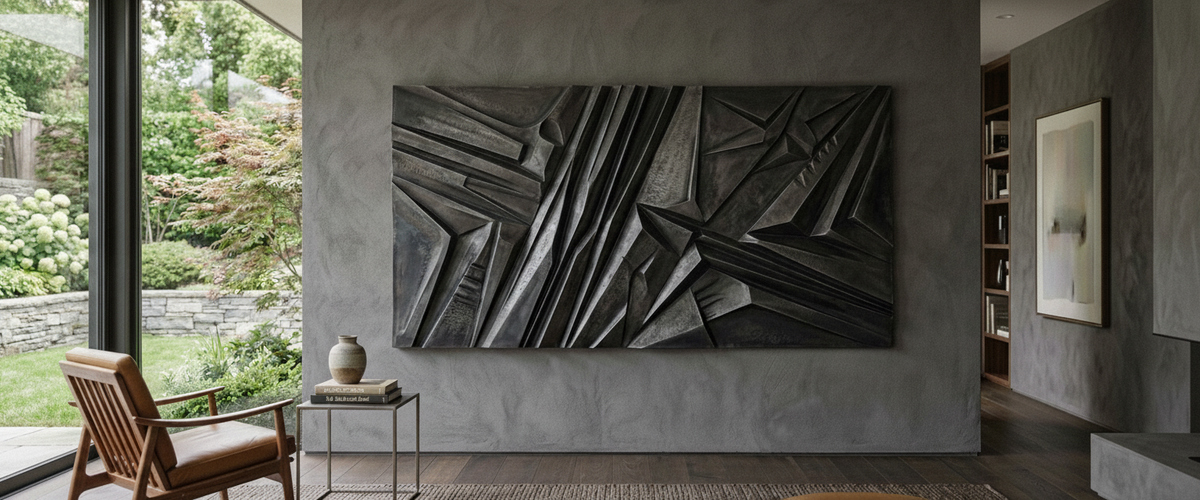
For long-range reception walls, go for fewer and deeper moves. Wide ridges, hard-edged facets, bold directional carving. Where the wall is seen mainly from the entry doors, a deep directional carving such as Barwick Charcoal Flow Abstract 3D Carving Wall Art is the safer bet than fine all-over texture, because the channels run long and deep enough to hold a continuous shadow line across the whole face instead of breaking into detail that muddles at distance. Scale matters too: a panel sized for a residential hallway will look apologetic on a double-height lobby wall. In a Dallas headquarters commission we shipped last year, the specified panel grew by nearly 40 percent between concept and fabrication purely because the client stood at the entry doors and admitted it looked small.
Deep directional channels keep long-range 3D wall art office panels legible from the entry doors.
The Boardroom at Arm's Length: Tool Marks Become the Subject
Close-range walls invert every rule above. At 3 to 6 feet, deep relief can feel aggressive, while surface quality carries the piece. People in long meetings will study that wall. They will see the grain direction, the tool path, the join between segments and any weld spatter you thought nobody would notice.
This is where specifying 3D wall art for office boardrooms gets genuinely technical. Ask what the finishing schedule is. Ask whether welds are dressed and blended or left proud as a deliberate mark. Ask about grain direction on brushed metal, because a directional finish running the wrong way against the room's light source looks like an error even when it was a choice. Mosaic and inlaid work rewards this distance particularly well; a panel like Sandmere Shell Mosaic keeps giving something back at 3 feet that was never visible from the door, which is exactly what a meeting-room wall has to do.
At seated distance, finish quality and grain direction do the work.
Recessed Downlights Flatten Everything, and the 30-Degree Fix
Standard office ceilings are lit for desks, not for sculpture. Recessed downlights on a regular grid throw light almost straight down, which means a wall-mounted relief gets grazed from directly above at best and washed flat at worst. It is the fastest way to kill a 3D wall art office installation: a panel with no shadow, no depth and no reason to exist.
The fix is accent lighting aimed from an offset position. Lighting guidance from the Illuminating Engineering Society and standard museum practice both point to aiming accent fittings around 30 degrees from vertical: steep enough to avoid glare bouncing back into people's eyes, shallow enough to rake across the surface and pull real shadow out of every ridge. Track or adjustable downlights set roughly 3 feet (0.9 m) out from the wall usually land close to that. If the ceiling is fixed and you cannot move a thing, choose deeper relief and higher contrast between raised and recessed faces to compensate.

Brushed Aluminum, Blackened Steel and Carved Oak Under Office LED
Neutral 4000K office LED treats materials very differently, and the sample you approved under warm studio lighting can look like a different object once it is installed.
Brushed aluminum: bright, cool and reflective. Reads crisply at distance, but it can pick up ceiling glare and mirror back the whole light grid if the brush direction fights the room. Best on walls with controlled sightlines.
Blackened steel: the strongest performer for shadow definition, because the dark surface makes the lit edge do all the talking. Patinated and waxed steel also ages with character rather than looking tired.
Carved oak: warms up a cold floor plate and softens acoustic harshness slightly. Wood does move with humidity, so ask about moisture content at fabrication if the building runs aggressive air conditioning.
Tone is part of the material decision, not a finishing afterthought. Where the interior palette is warm timber and stone rather than graphite and glass, a softer carved finish such as Barwick Mocha Drift Abstract 3D Carving Wall Art keeps the same relief language while sitting with the room instead of cutting against it. Our usual advice for 3D wall art in office interiors: bring a physical sample into the actual room and look at it at both distances before signing off. Comparing the metal wall art range alongside the carved timber work in our 3D wall art collection shows how sharply the same form changes character between finishes.
Fixing Into Plasterboard Partitions Without Hardware Showing
Modern commercial fit-outs are mostly steel stud and plasterboard, and that alarms people carrying a heavy panel. It should not. Correctly anchored partitions carry substantial wall loads; the Gypsum Association publishes assembly guidance worth handing to your contractor. The real risk to a 3D wall art office panel is not the wall, it is a fixing strategy chosen after the piece arrives.
Locate the studs and fix into them wherever possible. For heavier pieces, a continuous French cleat spread across two or more studs distributes load and lets the panel sit flush and level, with nothing visible. Where studs do not line up with the composition, toggle-type anchors rated well above the panel weight are the fallback, not the default. And decide early who is drilling: some corporate landlords require a permit for anything penetrating a demising wall.
Hanging Next to a Logo Wall Without Becoming Second Signage
Put a textured panel within a few feet of the etched logo and the brain files it as brand graphics. The trick is separation and difference. Give the artwork its own wall plane or at least a full structural bay of empty wall between it and the logo. Avoid repeating brand colors in the finish. Let the geometry be genuinely non-corporate, because anything that echoes a logo mark will be read as one.
A San Francisco client solved this neatly by moving the commission from the wall behind reception to the perpendicular wall facing the seating area. Same piece, same budget, entirely different reading. It became the thing visitors looked at while they waited rather than a backdrop competing with the company name.

Checklist Before You Commission 3D Wall Art Office Panels
Record the two viewing distances in feet, plus the wall's clear height and width.
Confirm relief depth suits the longest distance, not the photo.
Check the lighting plan; if there is no accent lighting, budget for it or specify deeper relief.
Ask for a physical finish sample viewed in the real room.
Get the wall build-up from the contractor before fabrication, not after delivery.
Agree the fixing method, cleat type and who installs.
Map the piece against signage, screens and wayfinding so it stays distinct.
Confirm cleaning guidance for the finish, especially on brushed metal in high-traffic zones.
Budget for a 3D wall art office commission depends on scale, material, relief complexity, finishing standard, engineering and installation access, so the honest answer is a tailored quote rather than a headline figure. At Giant Sculptures we build bespoke wall pieces to specific wall dimensions and specific viewing distances, and we would rather have the distance conversation before the drawing than after the crate lands. Start with the office art collection for context, then tell us where people will stand.
For wider placement ideas, 3D Wall Art for the Bedroom: Why Light Angle Beats Everything Else is useful companion reading before finalising the setting and sightlines.