




























































When a dragon fails outdoors, it usually fails at the tail, and almost nobody looks there when they buy. A large dragon sculpture is one of the hardest animal forms to engineer. You are asking metal or stone to hold a long, thin, twisting body in midair, often with one end unsupported, through decades of wind, heat and frost. The head gets the attention in the showroom. The tail gets the stress in the garden.

Large Dragon Sculpture: The Quick Answer
Body plan comes first. A serpentine Chinese dragon and a winged Western beast carry weight in completely different ways.
The spine is the armature. A coil stays rigid only if the internal frame runs unbroken between ground contacts.
Watch the tail. Long cantilevered tails crack, sag or vibrate before wings ever do.
Material sets the foundation. Bronze, stainless steel and marble each ask different things of the slab beneath them.
Settle it all in the maquette. Changes after metal is cut are slow and costly.
Serpent or Winged Beast: Two Body Plans, Two Load Paths
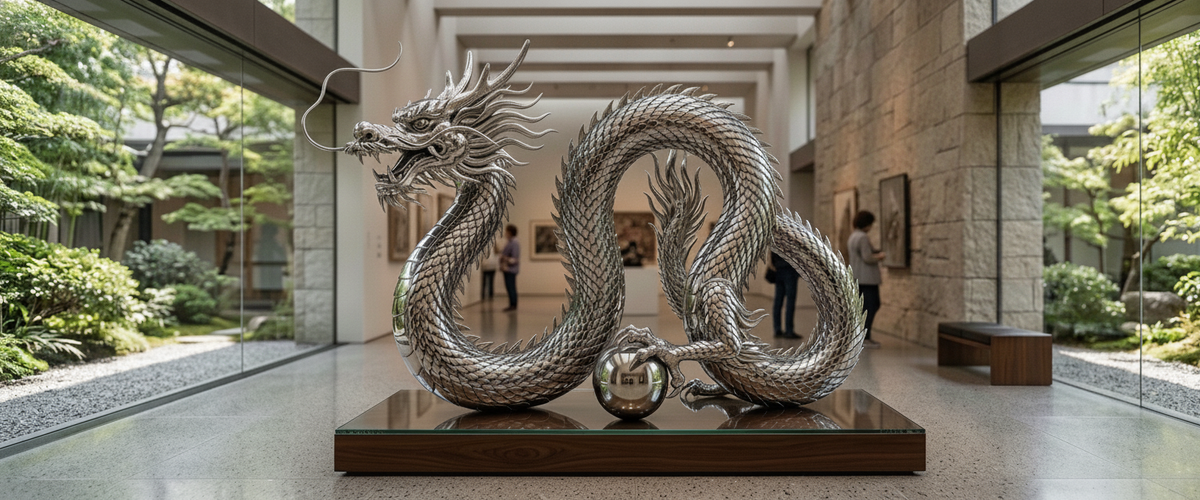
A large Chinese dragon sculpture is essentially a snake with legs. Its weight travels along the body and drops to the ground wherever a loop or claw touches down, so the sculptor can spread load across several points. A winged dragon stands on four legs like a heavy animal, with weight concentrated over the hips and shoulders, while the wings and neck act as long levers that pull against those joints.
Neither is better. They simply need different engineering, and a buyer should ask which load path a large dragon sculpture uses before falling for a silhouette. For an open lawn where the dragon has to stand on its own without bracing, a self-supporting coil such as the Coiled Dragon White Marble Garden Statue - 180cm makes more sense than a lifted, outstretched serpent: the loops fold back onto themselves, so the stone carries its own weight rather than reaching out into space.
A coiled body folds its weight back onto itself, so the stone never reaches out into space.
The Spine as Armature
In any large metal dragon sculpture, the visible body is a skin. What holds the shape is a continuous internal spine, usually welded steel tube or plate, that follows the centerline of every curve. Where makers cut corners is at the joins between sections. If the armature stops and restarts at each segment, the coil behaves like a chain rather than a beam, and over time it creeps out of line.
We ask our fabricators to run the spine through at least one ground contact on either side of every elevated loop. It sounds obvious. It is also the detail most often missing on cheaply made dragons.

Why the Tail, Not the Wings, Fails First
Wings look precarious but are usually braced back to the shoulders, shorter in reach than the tail, and built from relatively thin sheet. The tail is the opposite: long, tapered, often lifted clear of the ground for drama, and fixed at only one end. That makes the tail of almost any large dragon sculpture a cantilever with its thinnest section furthest from support, which is exactly where wind and vibration do the most damage.
A lifted tail is a cantilever: thinnest where the wind works hardest.
A common warning sign is a raised tail that starts to hum audibly in summer storms, which means it is flexing more than it should. The fix starts in the studio: hang sandbags off the tail tip before finishing and measure the deflection. Simple test. It catches the problem while stiffening is still cheap.
Hand-Cut, Laser-Cut or Cast Scales
Scales are where weight quietly piles up. Cast bronze scales read beautifully up close but add mass along the whole body. Laser-cut stainless steel scales are lighter and perfectly consistent, which can look mechanical unless they are hand-bent and varied. Hand-cut scales give the most life, at the cost of studio hours.
Think about viewing distance. At twenty feet (about 6 meters), fine scale detail blurs and what matters is how the scales catch light in rows. For a large dragon garden sculpture seen across a wide lawn, bolder, fewer scales often read better than intricate ones.
Steel, Bronze or Fiberglass: Wind Load and the Foundation
Stainless steel is strong for its weight, so slender forms stay slender, though coastal sites need a molybdenum-bearing grade such as 316; the International Molybdenum Association publishes useful guidance on why. Bronze is heavier and more forgiving of dents, ages to a rich patina, and demands a deeper footing. Fiberglass is light enough to install by hand, but that lightness is a problem in wind: an open-winged form can act like a sail and needs anchoring that matches its surface area, not its weight.
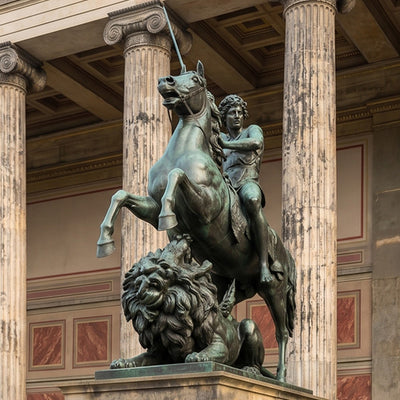
At the monumental end of bronze, the engineering problem flips. A mounted group on the scale of Saint George and the Dragon Bronze Statue - 350cm puts horse, rider and dragon onto very few contact points, so its foundation has to be designed around concentrated loads rather than spread ones. Where the setting calls for stone instead, a grounded, compact pose like the Seated Dragon Black Marble Statue - 130cm is closer to what marble does well, because stone is weak in tension and the best marble dragons avoid cantilevers almost entirely.

Claws, Pearl and Whiskers: Chinese Detail That Has to Be Engineered
Imperial iconography gives the Chinese dragon five claws, a flaming pearl and long whiskers; the Smithsonian's National Museum of Asian Art holds fine historical examples. At scale, every one of those details is a structural question. Whiskers become thin rods vulnerable to snapping, so we run them in solid stainless steel rod. The pearl is heavy and held at arm's length, so its claw needs internal reinforcement into the forearm. Treat these as engineering items, not finishing touches.
What the Maquette Must Settle Before Any Metal Is Cut
When you commission a large dragon sculpture, the maquette is your last cheap chance to change your mind. Before signing it off, confirm:
Ground contacts: how many, where, and what each carries.
Tail length and lift: whether it is supported, grounded or braced.
Scale method: cast, laser-cut or hand-cut, and the finished weight it implies.
Material and grade: matched to climate, coast and viewing distance.
Foundation drawing: slab size and fixings agreed with your contractor or landscape architect.
Access: whether the piece ships whole or in sections, and how it reaches the site.
Budget follows from these answers: material, scale, complexity, engineering, installation and finishing all move the number, which is why Giant Sculptures quotes every large dragon sculpture individually. Explore our dragon statues and sculptures for ready-made forms, or the bronze mythology collection for heroic scenes, then talk to us about a commission built around your site.
For wider placement ideas, Large Eagle Statue in the Garden: Why the Perch Matters More Than the Bird is useful companion reading before finalising the setting and sightlines.