






































































































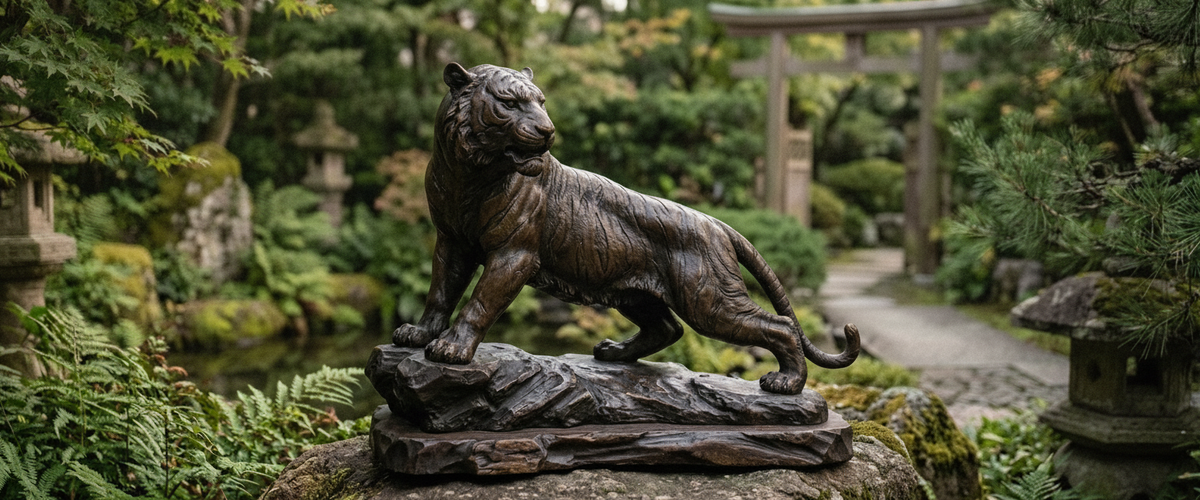

Most tigers cast in Meiji Japan were made by artists who had never seen a live one. That one fact explains nearly everything odd and appealing about a Japanese bronze tiger statue: the slightly too-round eyes, the housecat paws, the spine that coils like smoke. If you are weighing up an antique bronze tiger statue, or thinking about commissioning a new one, learning to read those quirks is the difference between owning a piece of craft history and owning a souvenir.
At a Glance
Look at the fur first. Fine lines cut into the metal after casting are the clearest Japanese signature.
Read the setting. Bamboo, rock and water around the tiger each carry a meaning.
Turn the stand over. A period carved wood stand fitted to the bronze is strong supporting evidence.
Think indoors. Most of these pieces are tabletop scale, often a foot or two long (roughly 30 to 60 cm).
Commission honestly. A new tiger in the Japanese manner should be signed and dated as new work.

Part Cat, Part Spirit: Why Meiji Tigers Look the Way They Do
Tigers were never native to Japan. Painters learned the animal from imported Chinese scrolls, traded pelts and, by many accounts, the family cat. The creature that emerged sat halfway between zoology and legend: the guardian of the west in Chinese cosmology, a beast said to command the wind.
Bronze workers of the Meiji era (1868 to 1912) inherited that painted tradition. When the samurai class was dissolved and sword fittings lost their market, many of the finest metalworkers turned to sculpture and export pieces, and the tiger became a favorite subject. The Metropolitan Museum's overview of Meiji period art traces how that shift reshaped Japanese decorative metalwork for Western buyers. So when a tiger bronze statue from this period looks a little feline and a little supernatural, read it as the brief the maker was working to. Good examples carry that tension with real conviction.
Bamboo, Rock and Waterfall: Reading the Setting
Little on a Japanese bronze tiger statue is decorative filler. The tiger rarely appears alone, and the motifs cast around it were chosen with care.
Bamboo bends in a storm without snapping. Paired with the tiger, it sets raw power against resilience, and the grove is the tiger's traditional shelter.
Rock signals permanence and territory. A tiger perched on a rock looking down reads as vigilance, a guardian on watch.
Water or a waterfall often hints at the tiger's absent partner, the dragon. Tiger and dragon were a classic pair, wind against cloud, earth against sky.
A head turned back over the shoulder is a guarding pose, and one of the most expressive in the repertoire.

Chiseled Fur Is the Japanese Signature
Here is the detail that separates a Japanese bronze tiger statue from its Chinese and European cousins. Chinese tiger bronzes tend toward stylized, archaic surfaces. French animalier sculptors modeled fur in wax, so the texture arrives already cast. Japanese chasers did the opposite: they took the cooled casting and cut thousands of fine strokes into the metal by hand, a technique often called kebori, or hair carving.
Under a loupe the difference is obvious. Chased lines are crisp and sharp-edged, varying slightly in depth and direction as the hand moved; cast-in texture is soft and slightly rounded. The foundry chasers we work with tell us a tabletop animal's coat can take longer to finish than the casting itself, which is why later reproductions skip it. Stripes were sometimes picked out with darker patina or inlaid alloys such as shakudo, and the V&A's Japanese collection holds fine examples of that inlay and chasing side by side.
Why the Carved Stand Tells You So Much
A period Japanese bronze tiger statue usually came with a hardwood stand carved as rocks, waves or roots, with a recess cut to the exact footprint of the casting. Wear on the wood should match wear on the bronze. Warning signs are easy to spot once you know them: freshly stained wood, modern screws, or a recess that does not quite fit the feet. Any of these can point to a later casting from a tired mold dressed up to look Meiji. A married stand does not condemn a bronze, but it should temper your confidence.
We treat bases the same way on contemporary work. On a modern animal piece such as the Clear Stag with Bronze Antlers on Black Marble Resin Sculpture - 180cm, the dark plinth sets the proportion and lets the bronze tones read clearly. A well-made stand does the same job for a tiger: it fixes the height, the sightline and how the piece sits on a console.
Made for the Tokonoma, Not the Lawn
The tokonoma is the raised alcove of a Japanese room, home to a hanging scroll, a flower arrangement and a single object, rotated with the seasons. A Japanese bronze tiger statue was scaled for that intimacy. In a Manhattan apartment, that translates to a console, a library shelf or a lit niche; in a Napa or Aspen house, a sideboard where light rakes across the chased fur from one side.
Keep them inside. Thin patinas, inlay and wooden stands do not survive sprinklers and freeze-thaw cycles. If you want a tiger guarding a driveway or a Hamptons lawn, that is a different object entirely: larger, heavier and engineered for weather, like the pieces in our bronze tiger statues collection.

Buying a Japanese Bronze Tiger Statue: A Checklist
Inspect the fur under magnification for crisp, hand-cut lines.
Check the heft. Even hollow-cast bronze feels dense; spelter, a cheaper zinc alloy, feels light and sounds tinny when tapped.
Look for a signature or seal, then research it; marks are easily faked, so treat one as a lead, not proof.
Match stand wear to bronze wear, and check the fit of the recess.
Ask for provenance in writing, including auction or dealer history.
Confirm the piece suits an indoor spot with side lighting.
Commissioning a New Tiger in the Japanese Manner
Antique supply is thin and quality uneven, so many clients ask us for new work instead. Giant Sculptures can commission a Japanese bronze tiger statue cast by lost-wax, hand-chased after casting, patinated in deep browns or near-black, and set on a carved hardwood or stone stand. We can also scale the idea up for outdoor use in heavier bronze; our wider bronze sculptures range gives a sense of finishes.
One rule is fixed: new work is signed and dated by the studio, with no invented seals or artificial aging meant to pass it off as antique. Budget depends on scale, chasing time, patina, stand and shipping, so we quote each commission individually.
For wider placement ideas, How to Read an Antique Bronze Tiger Statue Before You Buy is useful companion reading before finalizing the setting and sightlines.