





































































































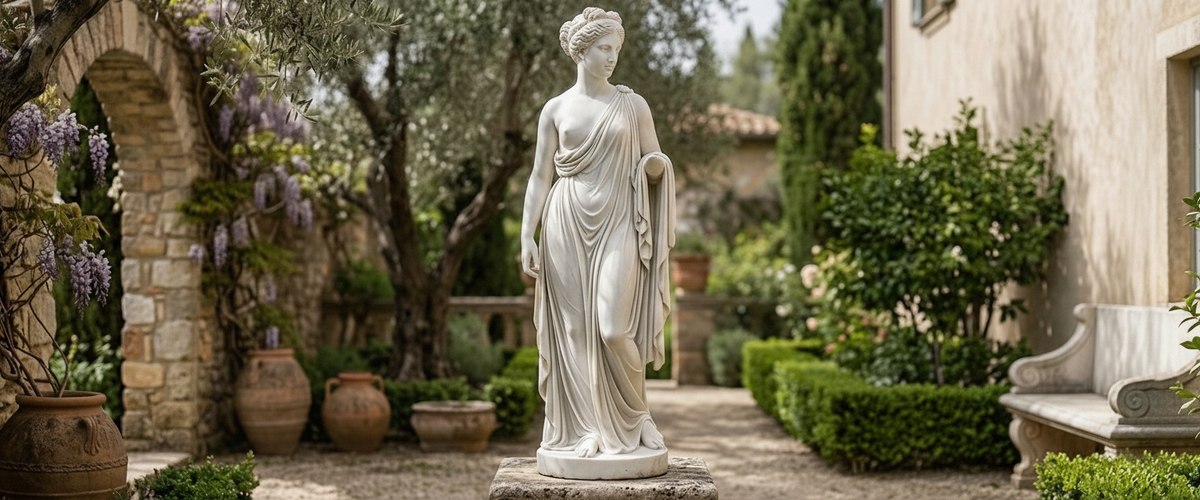

Most disappointing goddess statues fail in exactly the same place: the fabric. The face can be sweet, the proportions passable, the stone bright white, and the whole thing still looks inert because the drapery hangs like a bath towel on a peg. Learning to read that fabric is the single fastest way to judge a Greek goddess marble statue, and it takes about ten seconds once you know what you are looking at.

Key Takeaways
Carved drapery on a Greek goddess marble statue should describe the body underneath it. If folds sit on the surface like decoration, the carver never worked out the anatomy.
Fine, tight-crystal marble holds detail that coarse stone physically cannot. Crystal size sets the ceiling on how sharp a fold can be.
Hair edges, fingertips and attributes (spear, bow, apple, owl) are where carving standards quietly drop.
Deep shadow in the folds is the tell for real undercutting, and it reads clearly even in a listing photo.
Outdoors in a freeze-thaw climate, erosion begins in the deepest cuts, so detail and siting decisions are linked.
What Carved Drapery Does That a Molded Copy Never Manages
Greek carvers built an entire visual language out of cloth. The so-called wet drapery style, seen at its most extreme on the Nike parapet reliefs held by the Acropolis Museum, treats fabric as something clinging, pulling and falling under its own weight. Folds gather where the limb bends. Cloth tightens across the thigh and pools at the ankle. There is tension in it.
A molded or cast copy flattens all of that. Molds round off sharp arrises, fill the narrowest channels, and lose the razor edge where a fold turns back on itself. You end up with soft ridges of even depth, evenly spaced, running down the figure like corduroy. Stand ten feet (3 m) back from a Greek goddess marble statue and the difference is obvious: carved drapery moves, cast drapery sits still.
Real undercutting traps black shadow behind a bright edge; shallow work reads mid-gray.

Follow a Fold to the Body Beneath It
Here is the test we use in the studio. Pick one fold at the shoulder and trace it with your eye all the way down. In good carving it changes character as it travels, stretched over the collarbone, bunched at the elbow, released into a hanging cascade. It also implies a leg, a hip, a raised knee. If a fold simply runs from top to bottom at a constant width and never tells you anything about the figure inside the cloth, you are looking at surface decoration applied to a rough human shape.
This matters more at scale. On a piece under 2 ft (60 cm) the eye forgives a lot. On a life-size Greek goddess marble statue standing 6 ft (183 cm) or more, viewers approach it, walk around it, and read every plane change from a yard away. Weak anatomy under the fabric becomes impossible to hide.
Three Goddesses, Three Silhouettes: Choosing Your Greek Goddess Marble Statue
Buyers often ask for "a Greek goddess" without a name attached, then reject three proposals because the mood is wrong. The names carry the mood.
Aphrodite gives you the softest silhouette: slipping drapery, weight on one hip, an S-curve through the spine. She suits enclosed courtyards, pool terraces and interiors where the viewer gets close. Athena is vertical and armored, a column of a figure with helmet, aegis and a strong axis. She holds her own at the end of a long allée or flanking a formal entrance. Artemis is the athletic one: shorter chiton, mid-stride, often with a hound or deer beside her, and she needs open ground to make sense. If the huntress silhouette is the goal but the climate punishes stone, the same deer-at-the-knee composition translates into metal at roughly 8 ft (250 cm) in the Life-Size Classical Goddess and Deer Bronze Sculpture - 250cm. Browse the wider Greek and Roman statues range to compare stances before you settle on a name.

Crystal Size Sets the Ceiling
Marble is recrystallized limestone, and the size of those crystals decides how fine a cut the stone will take. Coarse, sugary marble fractures along crystal boundaries, so a knife-edge fold crumbles as the carver approaches it. Fine, dense statuary marble holds an edge and takes a polish that reads as skin. Conservation research on stone, including work from the Smithsonian's Museum Conservation Institute, ties grain structure to both how a marble carves and how it weathers.
The principle is easiest to read on small, tightly worked pieces where a single continuous edge runs the length of the form. The unbroken spiral on the Snail Marble Sculpture - 60cm at 60 cm only holds because the block is fine-grained enough to carry that turning ridge; in coarse stone the same line breaks up into chips. Ask which marble is proposed for your Greek goddess marble statue, where it is quarried, and whether the studio has carved fine drapery in that specific stone before.
Hairlines, Fingertips and Attributes
Three places give away a carver's real standard on any Greek goddess marble statue. First, the hairline: good work shows individual locks lifting away from the scalp with air behind them, not a helmet of scored lines. Second, fingertips, which are slow, fragile and easy to leave stubby. Third, the attribute, the object that names the goddess. A bow, an owl, a spear shaft or an apple gets carved last, often by a less experienced hand, and it frequently arrives clumsy and oversized. Ask for close-up photographs of all three before you approve anything.
The Shadow Test
Judging the undercuts on a Greek goddess marble statue from a listing photo is faster than people think. Look at the deepest folds and ask whether they go genuinely black. Real undercutting traps shadow, so the recess reads as a dark void with a bright edge above it. Shallow carving produces gray, soft, gradient shadow across the whole fold with no true dark. Scan the drape between the knees and inside the elbow; those are the two places a carver has to commit. If everything is mid-gray, the piece was worked shallow to save time.
Outdoors, Erosion Starts in the Deepest Cuts
A few hard winters in Aspen or the Hudson Valley teach the same lesson. Water sits in the deepest recesses, freezes, expands, and lifts crystals out. The crisp undercut you paid for goes first, softening while the broad surfaces still look fine. Marble also reacts to acidic rain, which dulls polish over time.
A raised, free-draining plinth keeps meltwater out of the carved recesses.
The fixes are practical: raise the figure on a plinth so meltwater drains away, keep it off wet lawn and out of sprinkler spray, avoid siting under trees that drip tannin, and consider seasonal covering in hard-frost regions. Where a client wants monumental scale outdoors in a punishing climate, we often steer the commission toward bronze from the bronze mythology and goddess statues range and keep a Greek goddess marble statue for sheltered courtyards and interiors. For a drive court or lawn axis read from 100 ft (30 m), something on the order of the Monumental Classical Chariot with Goddess and Horses Bronze Sculpture - 600cm at 600 cm carries the classical language at that distance without exposing fine drapery undercuts to frost. Marble under cover, bronze in the open view: that split is the one we recommend most often, and it is the one that ages best.

Buyer's Checklist Before You Commission
Name the goddess first, then the pose. The attribute changes the silhouette more than the height does.
Confirm the marble type, quarry and grain, and ask to see the studio's previous drapery work in that stone.
Request close-ups of hairline, hands and attribute, not just the three-quarter hero shot.
Check the shadow depth in the folds on every supplied photograph.
Set viewing distance before setting height. A piece read from 30 ft (9 m) needs different fold depth than one read from 3 ft (1 m).
Agree the base, dowel and fixing detail in writing, including weight loading if the piece sits on a terrace or roof structure.
Plan access and craning early. Stone weight, not stone cost, is what derails installations.
Ask for a tailored quote. Budget depends on marble grade, scale, complexity of the drapery, engineering, installation and final finishing, so a real figure only comes from a real spec.
Giant Sculptures commissions large-scale classical work in marble, bronze, stone and engineered metalwork, and we would rather talk you out of the wrong stone than ship a figure that softens in five winters. If you are weighing a Greek goddess marble statue against a bronze alternative, or comparing a full figure to a bust, the marble sculptures and marble busts and torsos collections are the right place to start narrowing it down.
For wider placement ideas, Why Most Greek Goddess Statues Fail the Contrapposto Test is useful companion reading before finalising the setting and sightlines.