

































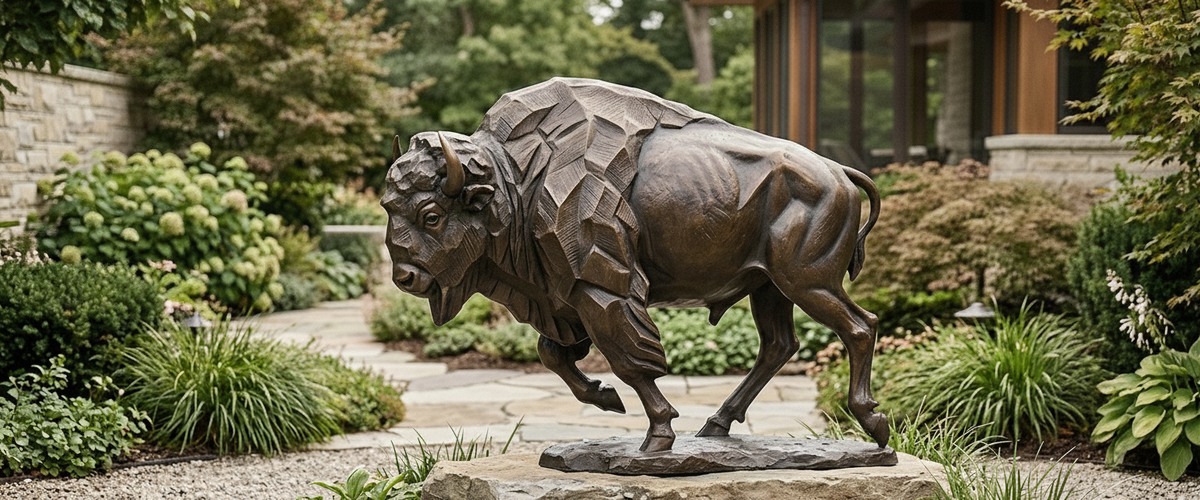

Most bison bronzes fail in the same place, and it is the part everyone thinks they know: the hump. Get that wrong and the whole animal collapses into a shaggy cow. A good bronze bison sculpture is legible at a distance because its silhouette does the work before any surface detail registers, and that silhouette is built on bone, not on guesswork. Buyers who learn to read three or four structural cues can separate a properly observed cast from a copy of a copy in about ten seconds.

At a Glance: What Separates a Strong Cast From a Weak One
Hump: driven by long dorsal vertebrae, so it peaks forward, just behind the neck, not over the mid-back.
Head carriage: low and forward, with a broad brow, a heavy beard and short upward horns.
Taper: enormous forequarters dropping to narrow, almost deer-like hindquarters.
Surface break: a clear frontier where woolly forequarters end and smooth summer hide begins.
Engineering: thin legs carry real mass on any large bronze bison sculpture, so ask about wall thickness, internal armature and base fixing.
Patina: warm brown or near-black keeps the hump readable outdoors; flat mid-tones do not.
The Hump Is a Skeleton, Not a Bulge
A bison's shoulder hump exists because the vertebrae over the forequarters extend upward into long bony spines, and heavy muscle attaches to them so the animal can swing its head through deep snow. The National Park Service notes this structure plainly in its bison biology pages, and it matters for a bronze bison sculpture because the hump has a defined peak and a long, sloping run down to the hips. Weak models treat it as a soft mound stuck on top, which is why cheap casts look inflated rather than powerful.
Seen from the side, the high point should sit close behind the skull and slope steadily to the hips.
When our modelers block in a bronze bison sculpture, the spine comes first and the wool goes on last. If you are viewing a maquette or a render, walk around to the side and look for that forward peak sitting close behind the skull. If the high point drifts toward the middle of the back, no amount of texture will rescue it.
Beard, Brow and Short Horns: Three Cues That Stop a Bull Impersonation
Plenty of animal bronzes sold as bison are longhorn or Angus forms with extra fur. The tells are all in the head. An American bison bronze sculpture should show a broad flat brow cushioned by dense curly hair, horns that are short, dark and hooked upward rather than spreading sideways, and a heavy chin beard that hangs below the jaw like a curtain. The head sits low, roughly level with the chest line, because the animal carries it forward rather than up.
Pose is the other half of that reading. Where a predator bronze earns its drama from coiled tension, as the horizontal spine and gathered haunches of a piece like the Classical Prowling Lion Bronze Sculpture - 40cm do, a bronze bison sculpture earns it from bulk and a low center of gravity. A sculptor who makes the head too lively or the stance too athletic has misread the species.

Shoulder Mass to Narrow Hindquarters
Stand thirty paces back and a bronze bison sculpture should read as a wedge. Vast at the front, tapering hard behind the ribcage, finishing in hips and rear legs that look almost undersized. That taper is the single most recognizable thing about the animal, and it is what makes a life-size piece work as a landscape object in an Aspen meadow or on a Texas ranch approach. Cast too evenly and the form turns into a barrel on legs.
Scale amplifies the problem. A mature bull stands around 6 feet (1.8 m) at the hump and can weigh close to 2,000 pounds (900 kg) in life, so a full-size bronze bison sculpture is a serious object to site and to move. We usually advise clients to view the model from the primary approach angle before signing off, because a taper that reads well in three-quarter view can vanish when the piece is seen head-on from a driveway.
Wool Against Smooth Hide: Where Observation Shows
Bison shed dramatically. Through summer the hindquarters go slick and almost bald while the head, hump and forelegs stay deep in wool, and that frontier line is a gift to a sculptor. A well-modeled bronze bison sculpture shows the wool breaking into ragged hanging clumps rather than a uniform allover texture, and the smooth rear catches light in broad planes that contrast with the shaggy front.
The frontier between ragged wool and slick hide is where honest observation shows up in the cast.
The same principle governs any wildlife bronze worth commissioning. On a life-size bird such as the Life-Size Traditional Bald Eagle Bronze Sculpture - 110cm, coverts, scapulars and primaries are each grouped and cut differently, so the eye reads a feathered animal rather than a textured surface. Uniform texture across an entire body is the surest sign the model was worked from photographs of another sculpture rather than from the animal itself.
Slender Legs Under a Ton of Body
Bison legs are genuinely thin for the load they carry, and that is where a poorly engineered bronze bison sculpture quietly fails. Each leg is a narrow bronze column carrying a hollow but heavy body, and the stress concentrates at the ankle, the knee and the weld joins between sections. Lost-wax casting, described well by the V&A's overview of bronze casting, produces the piece in parts that are then joined, chased and blended, so the quality of those joins decides the lifespan of the sculpture.
Ask for wall thickness, internal stainless armature details and how the hooves are anchored. On outdoor commissions we normally specify concealed threaded rods running into a concrete pad rather than surface plates, both for stability in wind and to stop the piece becoming a liftable target. If a maker of large bronze bison sculptures cannot answer engineering questions in plain terms, that is your answer.

Patina: Which Finish Keeps the Hump Legible
Patina is not decoration on a bronze bison sculpture; it is contrast management. Warm chocolate brown with darker recesses reads as fur and keeps the hump's shadow line visible in flat overcast light. Near-black with lighter highlights on the shoulder crest works hard in snow country and against pale stone.
Verdigris is a different case. On a classical or abstract form, the even green skin across the Bronze Abstract Organic Wave Sculpture Brass - 91cm is part of the design language, it unifies the surface deliberately. On a bison it does the opposite, sitting evenly across wool and hide alike and killing the tonal break you paid for.
Whatever finish you choose, plan for annual waxing on exposed pieces. Coastal sites need more attention than dry inland ones. You can see the finishes we apply to bronze bison sculptures and everything else across our bronze animal sculptures and the wider bronze garden statues range.
Questions Worth Asking a Bronze Bison Sculpture Supplier
Before the first wax is poured, put these to any foundry or supplier you are considering:
Can I see a clay or digital maquette from four angles, including the approach view from my site?
Where does the hump peak in relation to the skull, and can that be adjusted?
What is the bronze alloy and the nominal wall thickness at the legs?
How many cast sections, and where do the joins fall?
What internal armature material is used, and is it corrosion resistant?
Which patina recipe is proposed, and can I see it on a sample coupon in daylight?
How is the piece fixed down, and what foundation do I need to prepare?
What crating, rigging and lift access does delivery require?
Budget depends on scale, alloy, casting complexity, finishing hours, engineering and installation, so ask for a tailored quote rather than a headline figure. Giant Sculptures works on bespoke bronze bison sculpture commissions of this kind regularly, and the projects that go smoothest are always the ones where the client pushed hardest on the maquette stage. The full bronze sculptures range is a useful gauge of finish quality and modeling standard before you brief a commission.
For wider placement ideas, Antlers Break First: An Insider's Guide to Bronze Deer Garden Statues is useful companion reading before you finalize the setting and sightlines for a bronze bison sculpture.