














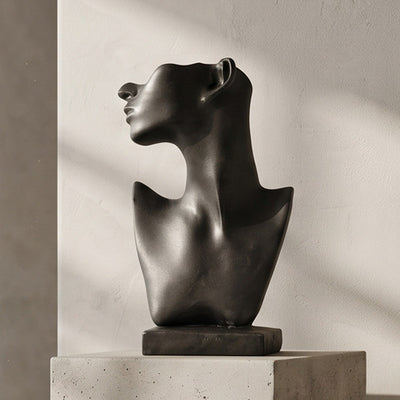










































































Stand ten feet (3 m) back from a weak abstract bronze and you can feel the problem before you can name it. The casting may be clean, the patina even, the welds invisible. The shape still says nothing. Almost every disappointing abstract bronze sculpture fails at the same point: the outline and the empty space held inside it were never resolved, and no amount of close-up surface detail rescues that later.

Key Takeaways Before You Buy
Voids are structure, not leftovers. The gaps carry as much of the composition as the metal.
Judge the silhouette at ten feet (3 m). If it reads as mush from there, it will read as mush forever.
Patina changes the geometry. Near-black sharpens edges; verdigris softens and spreads them.
Ballast and wall thickness decide whether a lean looks like motion or a hazard.
Backdrop matters more than plinth height. A busy hedge swallows the openings that make the piece work.
Negative Space Does the Heavy Lifting
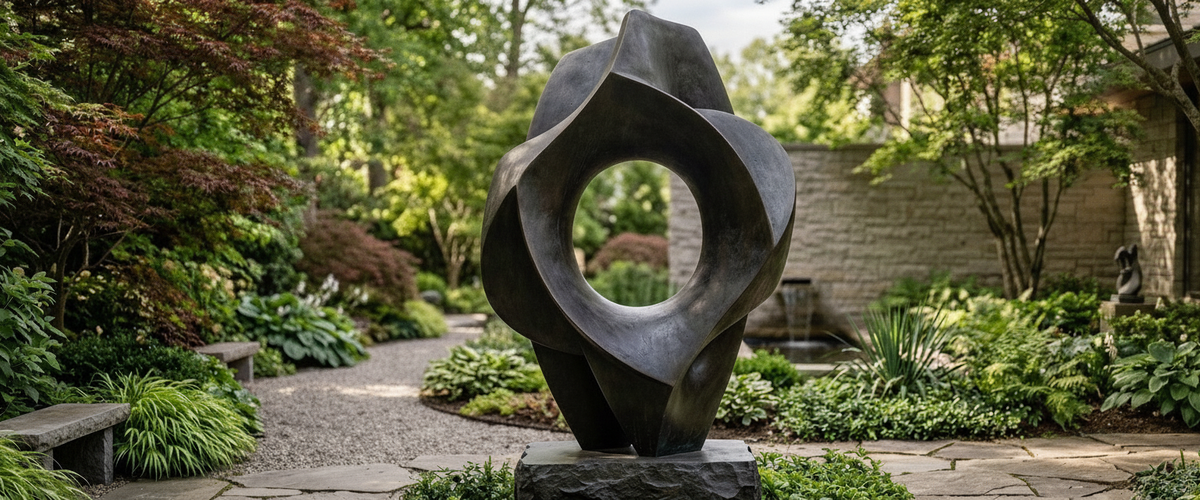
In figurative work, the body tells you where to look. Strip the figure away and the openings take over that job. A well-resolved abstract bronze sculpture uses its voids as shapes in their own right: a long tapering slot that pulls the eye upward, a single wide aperture that frames a tree or a stretch of sky, a pinch point where two masses nearly touch and the tension lives in the millimeter of air between them.
The openings frame the garden behind them, which is how you know they were designed rather than cut away.
The test is simple. Cover the bronze in your mind and look only at the holes. If those shapes are interesting on their own, the piece is sound. If they read as random offcuts, you are looking at a solid form with some material removed rather than a composition. Working through the bronze abstract sculptures collection with that filter on is a fast way to train your eye.

The Ten-Foot Silhouette Test
Nobody meets a large sculpture at arm's length first. They see it from a driveway, across a lawn, through a lobby's glass wall. So back up ten feet (3 m) from any abstract bronze sculpture you are shortlisting, photograph it on your phone, then shrink the image to a thumbnail. You are checking whether the outline still has a spine: a dominant direction, a clear rhythm of thick and thin, one moment of drama rather than four competing ones.
Fine chasing and hand-worked texture reward the second viewing, not the first. Buyers fall for a maquette in the studio because the surface feels wonderful under the hand, then find the full-scale version reads flat across a wide gravel courtyard. Close-up detail almost never rescues a weak outline; a strong outline, on the other hand, survives fog, dusk, snow and a bad camera angle.
Patina: Near-Black Tightens, Verdigris Dissolves
Patina is a chemical finish worked into the surface of the alloy, and it changes how the geometry reads more than most buyers expect. A near-black or deep brown patina compresses the form. Edges look crisper, the voids punch out as hard shapes, and the whole piece gains weight against a pale wall. Green verdigris does the opposite: it scatters light across the surface, blurs transitions, and makes an already open composition feel airier and older. Museums treat patina as an integral part of the object rather than a coating to be scrubbed away, which is why the Tate's definition of patina is worth reading before you ask for anything to be "cleaned up".
The practical rule: choose near-black for a tight, geometric abstract bronze sculpture, and for anything set against greenery, where a green patina simply vanishes into the background. Choose verdigris or a lighter mottled finish for organic forms placed against stone, render or pale gravel.

Weight Where You Cannot See It
Abstract bronzes lean. That is often the whole point, and the lean is what reads as motion from a distance. It is also the engineering problem. A cantilevered arm reaching three feet (0.9 m) off the vertical axis needs answering somewhere the viewer never sees: extra wall thickness in the load path, an internal stainless armature, and a base with real ballast or bolt-down fixings into a poured pad.
Ask three questions of any large abstract bronze sculpture. What is the wall thickness at the thinnest section? How is the internal armature tied to the base? Is the base designed for surface ballast or for anchoring? Traditional lost-wax casting, the method behind the Hellenistic bronzes the Getty gathered for Power and Pathos, produces hollow forms, which is exactly why the hidden metalwork matters so much on a modern outdoor commission.
Abstract Bronze Horse Sculpture: Where Suggestion Becomes Description
Horses are the most common subject in this category, and the most commonly overdone. An abstract bronze horse sculpture works while it stays on the suggestion side of the line: the arc of a neck, the lift of a shoulder, a mane implied by three planes rather than a thousand strands. Add nostrils, tendons and a defined eye and you have a stylized figurative piece with a rough finish, which is a different purchase entirely.
Where the brief calls for gesture rather than anatomy, a pared-back group like Cirque Bronze Horses Sculpture - 93cm at 93 cm (about 37 in) sits on the right side of that line, with the negative space between the animals doing as much compositional work as the bodies. Set it beside an openly figurative treatment at almost the same height, such as the Large Contemporary Winged Horse Bronze Sculpture - 90cm, and the difference in intent becomes obvious within seconds. Both are valid; they answer different rooms. If you want the wider range side by side, the bronze horse statues collection lays out the spectrum.

Plinth, Plain Wall or Open Lawn
Backdrop is the decision most buyers skip. An open composition needs something behind it that lets the voids stay legible. A plain rendered wall, a still pool, a clipped yew block or clear sky all work. A mixed border in July does not; the openings fill up with foliage and the outline dies.
A plain render behind the work keeps every void legible from the far end of the terrace.
Open lawn is generous but demands height. An abstract bronze sculpture under about five feet (1.5 m) tends to shrink on a broad lawn unless you raise it on a plinth or place it where a path forces a close approach. Monumental work has the opposite problem: at 400 cm (roughly 13 ft), a piece on the scale of the Monumental Classical Winged Horse Bronze Sculpture - 400cm needs real sightline distance and a foundation designed before delivery, not after. Work through large bronze sculptures with your longest available viewing line in mind rather than your favorite corner.
What a Maquette Shows, and What Only the Full Cast Reveals
A maquette is honest about air. Proportion, void shape, balance and the direction of travel all transfer accurately from a scaled model. What it cannot tell you is how the patina will behave across a large continuous surface, how the piece changes as you walk around it at full height, or how much visual mass the base needs once the sculpture is over your head.
For an abstract custom bronze sculpture, we normally recommend approving the maquette for form, then reviewing patina samples on a sizeable test panel rather than a coupon the size of a playing card. On one terrace commission that panel review changed the client's mind twice: the brown they loved on a small sample read almost orange across a two-meter flank in afternoon light.
Buying Ready-Made or Commissioning: A Quick Checklist
Thumbnail the silhouette before you look at anything else.
Check the voids against your backdrop, not against a white studio wall.
Confirm fixing method: ballast, bolt-down, or dowel into a pad.
Ask what the patina schedule is and whether it is waxed or lacquered.
Ask about edition status if you are buying from a resale platform.
Plan access: gate widths, crane or hiab reach, ground protection.
Get a tailored quote. Budget on this work depends on material, scale, complexity, engineering, finishing and installation, so no honest range exists until the design is fixed.

Secondary-market listings, including the abstract bronze sculpture inventory on 1stDibs and similar platforms, suit collectors chasing a specific abstract bronze sculpture artist or a signed edition. Commissioning suits anyone with a site condition to solve: a specific sightline, a wind-exposed roof terrace, a lobby with a height limit, a client who wants an object that exists once. Giant Sculptures works on the second kind, casting and engineering bespoke pieces to survive decades outdoors, and the abstract sculptures range is a reasonable starting point for shaping a brief.
Read the gaps first. Everything else is negotiable.
For wider placement ideas, A Large Bronze Horse Sculpture Needs Room to Move is useful companion reading before finalising the setting and sightlines.