






































































































Walk up to a poorly made classical figure and your eye finds the fault before your brain names it. The knee looks like a bag of marbles. The collarbone runs flat across the chest instead of curving into the shoulder. Life size Greek statues are unforgiving that way, because everyone alive has spent a lifetime looking at human bodies, and the moment a figure gets the joints wrong the whole piece reads as decoration rather than sculpture. Price rarely tells you which one you are getting. Anatomy does.

Key Takeaways Before You Shop
Judge the joints first. Knees, ankles, clavicles and knuckles are where weak casts and worn molds collapse into mush.
Material sets the lifespan. Bronze and true marble are multi-generation purchases; cast marble and resin are shorter-term outdoors, especially in freeze-thaw climates.
The plinth is part of the sculpture. A figure on the wrong base looks shorter, cheaper and oddly stranded.
Plan the groundwork early. A life-size bronze needs a real footing, a clear access route and lifting equipment, not two friends and a hand truck.
Ask what it actually is. Faithful reproduction, modern homage and vaguely "antique" styling are three different products with three different values.
Anatomy First: Where Cheap Casts Give Themselves Away
Ask a sculptor where a figure is hardest to model and you hear the same answers: hands, feet, and the transitions where bone sits close under skin. Our patina team can tell within seconds whether a wax came off a well-maintained master, because the clavicle either has a crisp ridge running out to the acromion or it does not. On a poor cast it softens into a shallow trough, and the neck looks glued on.
Knees are the other giveaway. A real patella sits slightly off-center depending on how the weight is loaded, with tendon lines running down into the shin. Cheap life size Greek statues render that as a smooth dome, which is why so many look like they are standing on prosthetics. Check the standing leg against the free leg too: in genuine contrapposto the hips tilt, the shoulders counter-tilt, and the spine makes a shallow S. If both legs read identically, the maker copied a pose without understanding it. Ask for close-ups of the hands, toes and back of the neck before you buy anything at this scale. Sellers who are proud of their casting send those images happily.
Detail settles the argument: on well-cast life size Greek statues the patella, tendons and drapery edges stay sharp.

Marble, Cast Marble, Bronze and Resin at Life Size
Hand-carved marble is the material most buyers picture, and for interiors it is superb: light travels a short distance into the stone before scattering, which is why marble skin looks alive in a way no coating imitates. Outdoors it is more demanding, since acid rain, salt air and freeze-thaw cycling all work on the surface, and ringlets and fingers are vulnerable to knocks and ice.
Cast marble (marble dust bound in resin) copies detail well and costs less, but composites chalk and yellow under strong UV unless properly formulated and maintained. Straight resin sits below that again: fine for event work and sheltered interiors, wrong for a permanent garden figure in Texas sun or an Aspen winter.
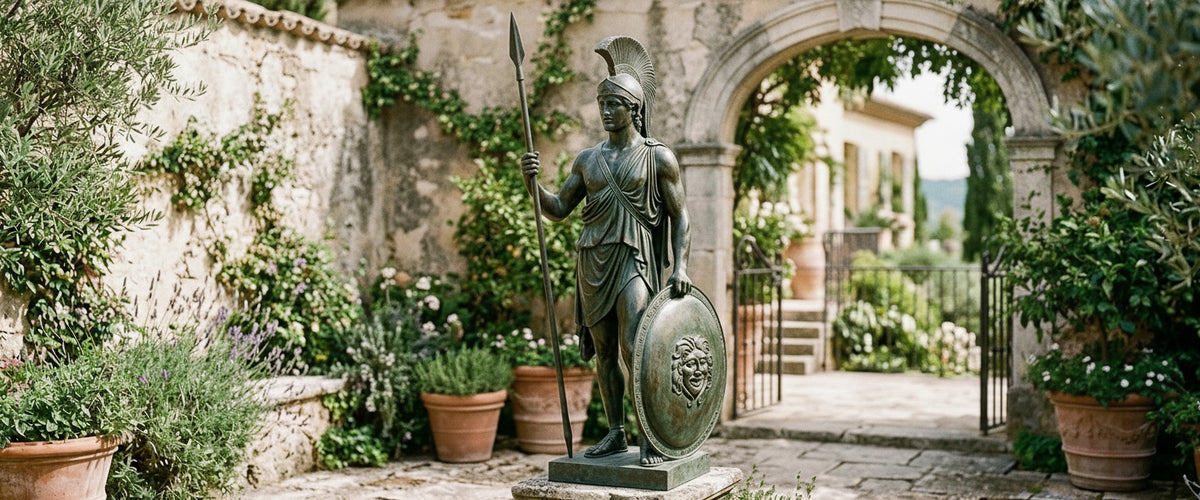
Bronze is the honest long-term answer, and there is a historical joke in that. Many famous "Greek" marbles in museums are Roman copies of Greek bronze originals that were later melted down, and the British Museum collection holds plenty of these second-hand survivals. Casting classical figures in bronze is closer to the original intention than carving them in stone. At true standing height, bronze carries fine surface detail without fragility, and its patina deepens rather than degrades. The Life-Size Classical Greek Warrior Bronze Sculpture at 250cm reads at around 8 ft 2 in.
Copy Quality: Sharp Mold Detail Versus Fourth-Generation Mush
Here is the part of the trade nobody advertises. Molds wear out. Take a mold from an original, cast a piece, then take a mold from that piece and repeat. Every generation loses crispness and gains shrinkage. By the fourth or fifth, the hair is a wig, drapery folds are rounded ropes and fingernails have vanished. That is the biggest quality gap between two life size Greek statues that look identical in a thumbnail.
Signs of a tired mold: parting lines sanded flat rather than chased back, drapery edges that never come to a knife edge, symmetric "pillowing" across large planes, and hair read as grooves instead of strands. On bronze, look for chasing marks in the recesses. Good casting survives a long time: the Ashmolean Cast Gallery is still used to teach anatomy from nineteenth-century plasters that hold their detail. Apply the same standard commercially: ask how many generations removed the mold is, and whether the master is the supplier's own.
The Plinth Problem That Catalog Photos Crop Out
Photographers crop bases. Gardens do not. A standing figure needs a plinth that reads as deliberate architecture, and proportion is the most common mistake we see in finished installations. Too short and the figure looks like it sank; too tall and it becomes a lamppost with a person on top.
Starting points we use with clients: for a figure viewed from 20 to 30 ft (6 to 9 m) across a lawn, a plinth around one quarter to one third of the figure's height holds the composition together. Keep the footprint slightly wider than the stance. Match plinth material to the garden architecture rather than the sculpture; limestone or honed granite sits well under bronze, while heavily veined marble often fights a marble figure. Scale up carefully, too. A Life-Size Classical Greek Warrior Bronze Statue - 300cm, roughly 9 ft 10 in, is heroic rather than life size and wants a lower, broader base. If unsure, mock it up with stacked timber and a broom handle, then look from the kitchen window for a week.
Plinth height and backdrop do half the work: a dark hedge keeps the silhouette legible from across the lawn.

Weight, Access and Footings in a Real Garden
Life size Greek statues in bronze typically run into the hundreds of pounds (well over 100 kg) once the base plate is included, and marble is heavier still. That turns a purchase into a small construction job.
Access route: measure gate widths, path bearing capacity, low branches and turning circles. On one Hamptons install the only route ran through a rose walk, so the crate went in over scaffold boards.
Lifting: confirm whether a crane, spider lift or gantry is needed, and who provides it. This is usually the biggest surprise line.
Footing: a reinforced concrete pad below frost depth, sized to the plinth, with cast-in anchors. Skipping it is how figures lean after two winters.
Drainage: keep bronze out of daily sprinkler spray; mineral-heavy water leaves streaks.
Security: mechanical fixing plus a low-profile anchor for anything visible from a road.
Aftercare is simple for bronze: rinse, dry, and wax annually with microcrystalline wax, more often near the coast. Marble wants gentle cleaning and no acidic products, ever.
Provenance and Honesty: Reproduction, Homage or Vague Antiquity
Three categories get muddled, sometimes deliberately. A faithful reproduction is a documented copy of a known work with the source named. A homage is a new figure in classical style, which is what most modern warriors, discus throwers and draped goddesses are. Then there are pieces sold with distressed surfaces, invented "excavation" language and no maker named.
Our classical work is contemporary, cast and finished today to classical proportion. That is a strength, not an apology, because the alternative is owning something whose story collapses in a resale conversation. If you are searching for life size Greek statues for sale and a listing implies antiquity without stating it, ask directly: who made it, when, from what master, in what material. Worth knowing too: those white marbles were painted originally, so "authentic classical" is a moving idea, not a fixed one.
Where a Standing Figure Earns Its Sightline
The best placements are ones the garden already suggested: the axis you walk without thinking, the gap in a hedge that frames nothing yet, the end of a pool where the eye stops. One figure closing that view beats three scattered ornaments. Specifics that work: the far end of a lap pool; a niche cut into yew, where dark foliage sets off bronze patina; a landing halfway up terraced steps; a double-height entry hall where the back and top of the head are read from a gallery above. Avoid open lawn with nothing behind it. To calibrate heights, compare our life size and large statues and life size bronze statues collections side by side.

Checklist Before You Order Life Size Greek Statues
Request close-ups of hands, feet, knees and clavicle before paying a deposit.
Confirm material precisely: solid bronze, hand-carved marble, cast marble composite or resin.
Ask how many mold generations removed the piece is, and whether the master is in-house.
Get height with and without the plinth, plus base plate dimensions and fixing centers.
Ask for shipping weight so your installer can size lifting equipment.
Agree the footing specification before delivery, not after the crate arrives.
Clarify patina or finish, and the recommended aftercare.
Confirm the piece is described honestly as reproduction or contemporary homage.
For bespoke work, discuss pose, height and finish early, then ask for a tailored quote.
Commissioning Rather Than Buying Off the Shelf
Plenty of buyers arrive wanting a standard classical figure and leave with something adjusted: a different height to suit a hedge line, a hand position that reads better from the approach path, a patina tuned to the stone of the house. That is routine work for us at Giant Sculptures, and it is often what separates a piece that sits in a garden from one that belongs to it. Commissioning also lets you solve engineering up front, such as internal armatures for wind loading or a hidden mounting plate that keeps the plinth detail clean. Take your time on the anatomy questions, because well-made life size Greek statues will outlive the planting around them. That is the whole argument for getting the knee right.
For wider placement ideas, Large Life Size Statues: How Scale and Placement Decide Whether a Piece Lands is useful companion reading before finalising the setting and sightlines.