





































































































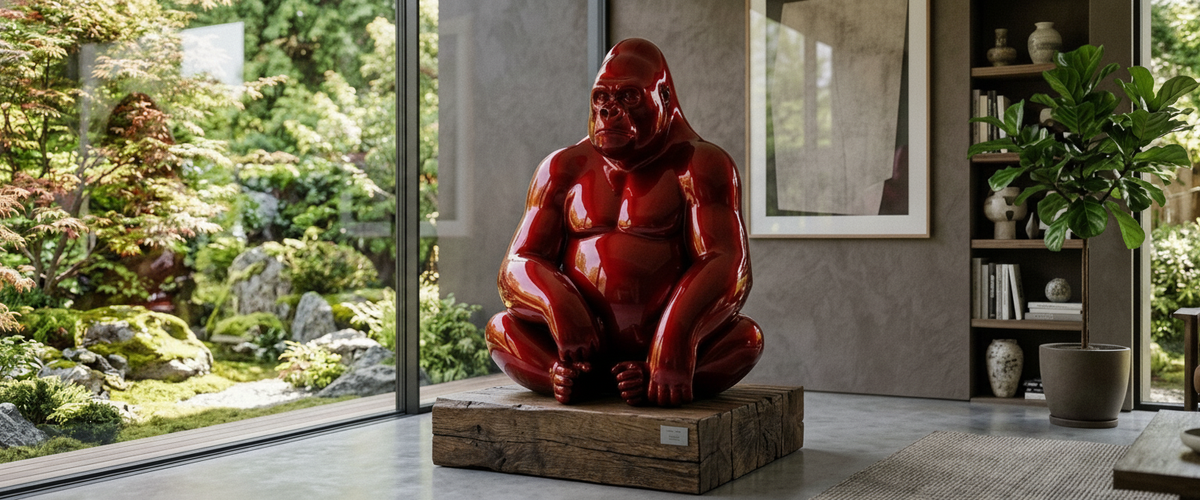

Scroll through a pop art sculpture sale for ten minutes and you will meet the same seated gorilla in six colors, at four price points, from three sellers who each describe it as exclusive. The photography is flattering, the color is loud, the copy is thin. What you rarely get is the information that decides whether the piece still looks sharp in your entryway a decade from now: how the form was made, what the gloss is sitting on, and whether anyone can tell you which number in the run you are buying.
Pop sculpture rewards confident buyers and punishes casual ones. The genre was built on repetition and mass-culture imagery, which is exactly why provenance and finish quality carry so much weight when a pop art sculpture for sale looks identical to four others online. Below is how we read a pop art sculpture sale at Giant Sculptures, where most of our pop commissions end up in hotel lobbies, retail windows and large private homes rather than on a shelf.

Quick Answer: What to Check in Any Pop Art Sculpture Sale
Edition status. Limited edition, open run or studio one-off. Ask in writing, not by inference.
Substrate, not just color. Cast bronze, fabricated stainless steel and painted resin behave very differently over twenty years.
Finish quality. Look for orange peel, seam lines, sanding ghosts and dust nibs in raking light.
Scale against the room. A 20 inch (50 cm) piece reads as an object; a 6 foot piece reads as architecture.
Colorway. Stock finishes are chosen for catalog photos, not for your walls.
Documentation. No certificate, no foundry mark, no number means no resale story.
Decoding the Listing: What a Pop Art Sculpture Sale Page Is Usually Selling
Most discount listings are selling one of three things. The first is a cast resin or composite form from a shared mold, sprayed in a trend color and sold by dozens of retailers under different names. The second is a genuine studio piece, editioned and documented, priced accordingly. The third is a hybrid: a real design, produced in volume, with the edition language quietly removed. The problem with a typical pop art sculpture sale is that all three sit side by side under near-identical photographs.
Read the material line carefully. "Mixed media" and "high-grade composite" usually mean resin. That is not automatically a problem indoors, and Pop as a movement has always been comfortable with industrial production methods, as MoMA's overview of the movement makes clear. It becomes a problem when a resin piece is priced like a cast bronze, or when it is sold for a courtyard in Scottsdale where UV and heat will chalk the surface within a few summers.

Limited Edition, Open Run or Studio One-Off
Sellers routinely price these three categories as if they were interchangeable. A limited edition means a fixed number of casts, each stamped, with the mold retired or defaced afterward. An open run means the seller can keep producing indefinitely. A studio one-off means the piece exists once, usually because it was commissioned.
Ask three questions before you commit: how many exist, who holds the mold, and what documentation ships with the piece. If the answer is vague, assume open run and value it that way. We have had collectors call us after buying a "limited" pop figure only to find the identical piece, same pose, same color, on three other sites the following month.
Motifs with a Twelve-Month Shelf Life
Every pop art sculpture sale trades in recognizable imagery, and some of that imagery expires. Meme characters, brand parodies and whatever silhouette dominated Instagram last spring tend to look tired fast. Animal forms, human gesture and abstracted everyday objects hold up far longer because they are not tied to a single cultural moment.
The test is simple: could the piece survive a change of color without losing its point? A form with classical weight and stance can, because the treatment is doing the contemporary work and the treatment can be redone. A logo-driven sculpture cannot, because the reference is the whole idea, and references date.
Gloss Tells the Truth
Finish is where the cheap end of the market gives itself away. Tilt the sculpture toward a window and look along the surface, not at it. Orange peel, that faint dimpled texture, means the topcoat was sprayed too fast or too thick. Seam lines along the spine or limbs mean mold joints were filled rather than properly dressed back. Dust nibs mean the piece was not sprayed in a clean booth.
Good pop gloss is closer to automotive refinishing than to decorative painting: multiple base coats, wet sanding between them, then a clear coat that is polished rather than simply sprayed. For outdoor placement, the coating system matters more than the color, and protective coating is its own engineering discipline: organizations such as AMPP publish the standards serious fabricators work to. Notice which sellers post close-up photos of the surface. Most do not.

Sizing a Pop Piece for a Hallway, Lobby Desk or Shopfront
Pop sculpture is unforgiving about scale because the color already commands attention. A few working rules from installs we have shipped:
Hallway or entry console: 16 to 24 inches (40 to 60 cm). Big enough to anchor, small enough to walk past without dodging.
Lobby reception desk: 24 to 36 inches (60 to 90 cm), set off-center so it does not fight the sight line to staff.
Shopfront window: 4 feet and up, sized against the glass opening. Shoppers judge it from 15 feet away at an angle, not head on.
Atrium, courtyard or plaza: monumental scale. At the height of the Monumental Contemporary Hippopotamus Ballerina Bronze Sculpture - 350cm, a pop form can hold a double-height space that a tabletop version would vanish in.
One Napa client bought a piece online for a tasting room and had it sized to the console rather than the room. It disappeared. We rebuilt the same subject at triple the height in bronze with a hand-polished gloss finish, and it became the photograph everyone takes on arrival.
Color Commissions: The Stock Finish Is Rarely the Right One
The colorway shown in a listing exists to photograph well on white. Your room is not white, and your lighting is not a studio strobe. Warm LED pulls yellows forward and flattens cool blues; north-facing daylight does the opposite. We regularly respray a standard pop form in a client's specified color reference, matched to a fabric, a brand palette or a stone sample. A compact console-scale subject such as the Pop Art Gorilla Sculpture at 20 inches (50 cm) is the easiest kind of piece to treat this way, because the silhouette carries the sculpture and the color is a variable rather than the idea.
Commissioning the color also lets you change the finish level. High gloss is the default, but satin reads more expensive in a restrained interior, and a metallic base under a tinted clear coat gives depth that flat color cannot. Cost depends on material, scale, complexity, engineering, installation and finishing, so the sensible route is a tailored quote rather than assuming a respray is a minor add-on.

What Resale Looks Like Without an Edition Number
Secondary market value for anything bought in a pop art sculpture sale is built almost entirely on documentation. With a numbered edition, a foundry mark and a certificate, a piece has a chain of custody a buyer can verify. Without those, you are selling an attractive object, and attractive objects trade on condition and color relevance alone.
That is not a reason to avoid open-run pieces. It is a reason to buy them for the room rather than for the spreadsheet, and to buy editioned or commissioned work when long-term value matters. Material plays into this too: where a painted resin form depends entirely on its finish holding up, a cast bronze pop subject like the Life-Size Contemporary Resting Hippopotamus Bronze Sculpture - 100cm keeps an intrinsic material value underneath whatever colorway sits on top of it.
Buyer Checklist Before You Commit
Run this list against any pop art sculpture sale before you pay.
Confirm in writing whether the piece is limited, open run or unique.
Get the substrate named: bronze, stainless steel, stone or resin.
Request a raking-light photo of the surface, not just a hero shot.
Ask what the topcoat is and whether it is UV-stable for your location.
Measure the sight line, not the shelf. Check viewing distance and approach angle.
Check base weight and fixing method if the piece sits anywhere with foot traffic.
Ask whether the color can be matched to your reference before production.
Confirm what documentation ships with it.
Ask about crating, delivery access and who handles placement.
Our pop art sculptures collection shows the range of forms and finishes we produce, and contemporary and modern sculptures covers the same graphic confidence in a quieter palette. When a piece needs to be a specific height, a specific color and yours alone, our commission team builds it from scratch.
For wider placement ideas, Bronze Angel Statues for Sale: How to Read a Cast Before You Buy is useful companion reading before finalising the setting and sightlines.