





































































































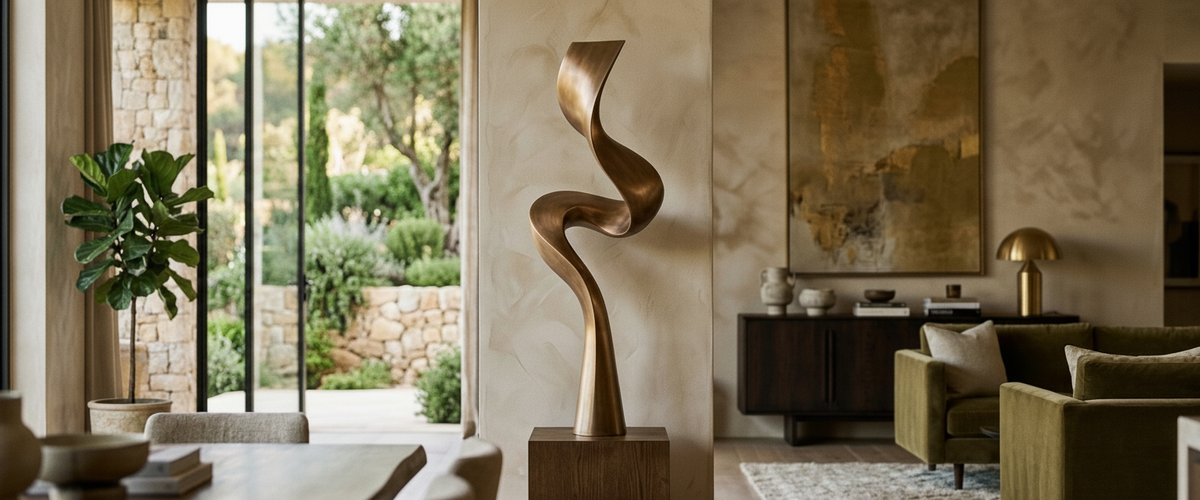

Most organic sculpture fails at the back, not the front. A single curve can photograph beautifully from one angle and then collapse into a shapeless lump the moment you walk past it at speed. That is the risk in this category: makers resolve the hero silhouette, and the three-quarter view gets left to chance. Buy a flowing piece from one studio photograph and you are trusting a profile you have never actually seen.

At a Glance
Organic form follows growth logic (bone, shell, seed pod, wave). Abstract form does not have to follow anything.
A curve only looks deliberate when something rectilinear disagrees with it: a door frame, a stone wall, a square plinth.
Always check the rear and the underside. Good organic pieces are resolved in the round; weak ones have a flat, unfinished back.
Ceramic, cast stone, oiled wood, bronze and stainless steel each carry a continuous curve in a completely different voice.
Shrinking an organic form to tabletop size flattens its best profile. Scale is part of the design, not a variable.
Outdoors, curves collect water. Drainage and undersides matter more than finish color.
Organic Form Versus Abstract Form: Where the Two Part Company
The terms get used interchangeably and they should not be. Abstract sculpture simply means the work does not depict a recognizable subject; it can be sharp, geometric, brutal, industrial. An organic form sculpture is narrower. It borrows the logic of living things: tapering, swelling, branching, twisting around an implied axis. Art historians file this under biomorphism, a term Tate applies across a twentieth-century lineage that runs from Brancusi's smoothed bird forms to Henry Moore's reclining figures, where a hip becomes a hill.
Why does the distinction matter commercially? Because organic sculpture is far more forgiving in soft interiors and planted gardens, and far less forgiving of sloppy making. Geometry can hide a poor weld in a crisp corner. A continuous curve cannot hide anything.
A Curve Needs Something Straight to Argue With
Put a flowing bronze form in the middle of a lawn with no hard edges nearby and it reads as decoration. Put the same piece where a limestone terrace meets clipped hedging, or three feet off a rectilinear glass wall, and the curve suddenly looks intentional. Contrast does the work. On a Napa terrace we worked on, a single organic steel piece did almost nothing until it was moved to sit against the vertical rhythm of a board-formed concrete wall: same sculpture, different argument.
A curve only reads as deliberate once a straight edge disagrees with it.
The same rule applies indoors. Double-height hallways, square-panelled joinery and long straight sightlines are where a curved piece earns its keep. At around 4 feet (1.2 m), a work on the scale of Harmony Organic Steel Sculpture sits best slightly off-center from a structural line, so the eye compares the curve to the straight edge without the two fighting for the same spot.

Square Plinth, Round Base: The Pairing That Flatters
Base choice is where good pieces get undermined. A square or rectangular plinth under an organic form flatters it, because the base states the grid and the sculpture breaks it. A round base under a round form mumbles; both elements say the same thing and neither lands.
Two practical notes from the studio. First, keep the plinth narrower than the widest point of the sculpture so the form appears to overhang and breathe. Second, match the plinth material to the architecture, not the sculpture. Honed bluestone in the Hamptons, board-formed concrete in Aspen, travertine in a Texas courtyard. The plinth belongs to the building; the sculpture belongs to itself.
Walk Around It Before You Buy
Some curves genuinely collapse at the back. Ask for photographs from four positions at a minimum, plus one low angle. On a cast bronze piece, look at how the curve resolves where it meets the base: does it taper cleanly or stop abruptly, as if the mold ran out? On fabricated metal, check whether seams follow the direction of the form or cut across it. A well-resolved wave form keeps its rhythm from every side, with the rear reading as a considered surface rather than a blank.
For commissions, we send clients turntable video or clay maquette photographs before anything is scaled up. It is the cheapest correction in the whole process.
Ceramic, Cast Stone, Oiled Wood and Metal All Speak Differently
The same gesture in glazed ceramic, patinated bronze and Corten: three very different voices.
A ceramic organic sculpture gives you the softest surface of the lot: glaze pools in the hollows, and the light travels rather than reflects. It suits interiors and covered loggias. It is also the most fragile choice and the most vulnerable to freeze-thaw damage if the body is porous, so treat glazed ceramic as an indoor or sheltered proposition in climates with hard winters.
Cast stone reads quieter and heavier; it grays down gracefully and takes moss in a way clients in the Pacific Northwest tend to like. Oiled solid wood is the favorite at tabletop scale, which is why the Ethnicraft natural organic sculpture look travels so widely: hand-finished teak, warm, tactile, deliberately imperfect. Wood needs stable humidity and re-oiling.
Metal is where scale becomes possible. Bronze holds fine detail and patinates predictably, and a cast piece such as Bronze Abstract Organic Wave Sculpture Brass - 91cm keeps its weight and warmth even in overcast light. Mirror-polished or brushed stainless steel does the opposite, turning a biomorphic form into a light instrument that picks up sky, water and planting. For a garden that wants that shifting reflective skin at full height rather than a static mass, Molecular Silver Organic Steel Outdoor Sculpture is the closer fit. Corten suits flowing forms in dry, planted settings where the rust tone flatters grasses. It is worth working through the organic sculptures range material by material to see how differently each one carries the same gesture.

The Tabletop Trap
Shrinking an organic form rarely works. A curve designed at 7 feet (2.1 m) relies on the viewer moving; at 14 inches (36 cm) you see the whole thing at once and the best profile flattens. Forms drawn natively for pedestal scale are tighter and denser on purpose. If you love a monumental piece but only have a console, commission a related form at the smaller scale rather than a miniature of the big one.
Outdoors, Curves Hold Water
Concave surfaces are puddles waiting to happen. Before you install, check three things: whether hollows drain or pool, whether the underside is sealed and vented, and whether the fixing detail lifts the base clear of standing water. Water freezing inside a trapped cavity is a common cause of failure in outdoor pieces sent back to us for repair. Conservation advice from the International Sculpture Center lands on the same point: routine inspection costs far less than repair.
Outdoor Organic Sculpture Checklist
Confirm drainage holes in every concave area, positioned at the true low point.
Check the base plate detail: stainless fixings, non-ferrous shims, drainage gap.
Rinse salt and dust off polished stainless quarterly; coastal sites more often.
Wax bronze annually to keep the patina stable and even.
Keep irrigation heads from spraying the piece directly; mineral spotting is avoidable.
Inspect welds and joins each spring, especially on slender tapering sections.
Commissioning a Curved Form
Bespoke is the honest route when the site has a specific sightline, a wind load, or a plinth already built. At Giant Sculptures we work from a sketch or reference through maquette, engineering review, material selection and finishing, then crate and ship worldwide. Budget depends on material, scale, complexity, engineering, installation access and finish, so the sensible next step is a tailored quote rather than a guess. If you are weighing painted or coated metalwork against bare finishes, the iron sculptures range shows how much a coating changes the way a curve reads in daylight.
Get the base, the backdrop and the walk-around right and an organic sculpture will hold a space for decades. Get them wrong and even a beautifully made curve will quietly disappear into the planting.
For wider placement ideas, Organic Shapes in Art: Why the Curve Outlasts the Corner is useful companion reading before finalising the setting and sightlines.