














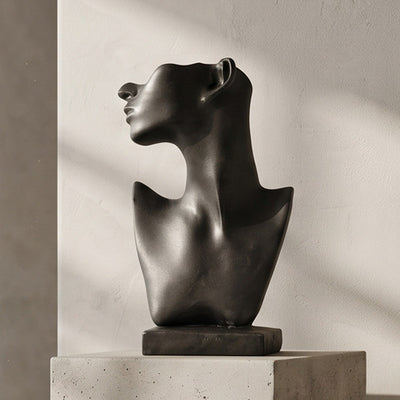



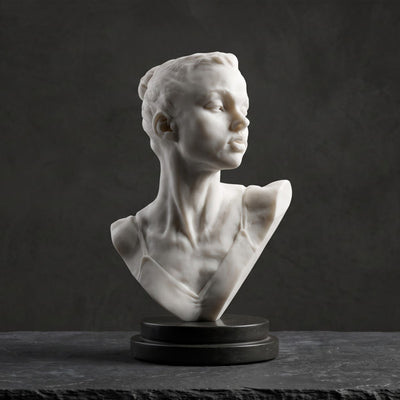
















































































Set a hard-edged cube in a Napa courtyard and watch what happens from fifty feet away: the edges flatten, the shadow goes gray, and the piece quietly turns into furniture. Organic shapes in art behave differently. A swelling, curving form keeps producing new information as you walk around it, because the light never breaks in the same place twice. That is the whole argument for the curve, and it has been running for about five thousand years.

Key Takeaways
Organic shapes in art are irregular, flowing forms drawn from nature: bone, pebble, seed pod, wave, torso. Geometric shapes are ruler-made; organic ones are not.
Curved silhouettes survive distance better than sharp edges, which is why they work so well in large gardens and open plazas.
Cast bronze, carved stone and welded stainless skins each handle biomorphic form differently. The finishing, not the shaping, is where budgets and timelines really sit.
Soft forms earn their keep against hard architecture: glass corners, concrete stair returns, orthogonal courtyards.
Cost depends on material, scale, engineering, finish and installation, so ask for a tailored commission quote rather than assuming a figure.
From Cycladic Stone to Mid-Century Bronze
The Cycladic marble figures carved in the Aegean around 2800 BC are already doing it: no ornament, no detail, just a pared-back body reduced to an egg-shaped head and a long shallow curve down the flank. The Museum of Cycladic Art holds hundreds of them, and what strikes you in person is how modern they look. Nearly five thousand years later, mid-century sculptors picked up the same thread: bronze reclining figures with voids driven straight through them, pierced forms borrowing their profile from a weathered pebble or a shoulder blade. The Henry Moore Foundation documents how directly those shapes came out of collected bones and flints kept on studio shelves.
The lesson for a buyer is simple. Organic shapes in art are not a passing style. They are the shapes people keep returning to when they want a piece to feel permanent rather than fashionable.
The Silhouette Test
Before we quote on any large commission built around organic shapes in art, we run what the studio calls the silhouette test: print the form solid black at postage-stamp size and look at it from across the room. If the shape still reads, it will read at scale. If it turns into a smudge, no amount of surface finish will save it.
Sharp geometry fails this test outdoors more often than people expect. A crisp edge needs raking light to declare itself, and on a flat gray afternoon in the Hamptons it disappears. A swelling form carries its own light. The highlight rolls across the belly of the curve regardless of weather, so the piece keeps a legible profile at 100 feet (30 m) and still rewards a hand on it at arm's length. That dual range is rare, and it is the main reason our clients with long sightlines lean organic.
A swelling profile keeps a readable outline at long viewing distances, in any light.
How One Continuous Curve Controls the Eye
Good biomorphic sculpture is usually one gesture, not five. The eye enters at the widest point, travels the line, hits a pause where the form thickens, then releases at the tip. Break that line with a second competing curve and the piece starts arguing with itself. Organic shapes in art rarely disappoint because the surface was wrong; they disappoint because the gesture was muddled.
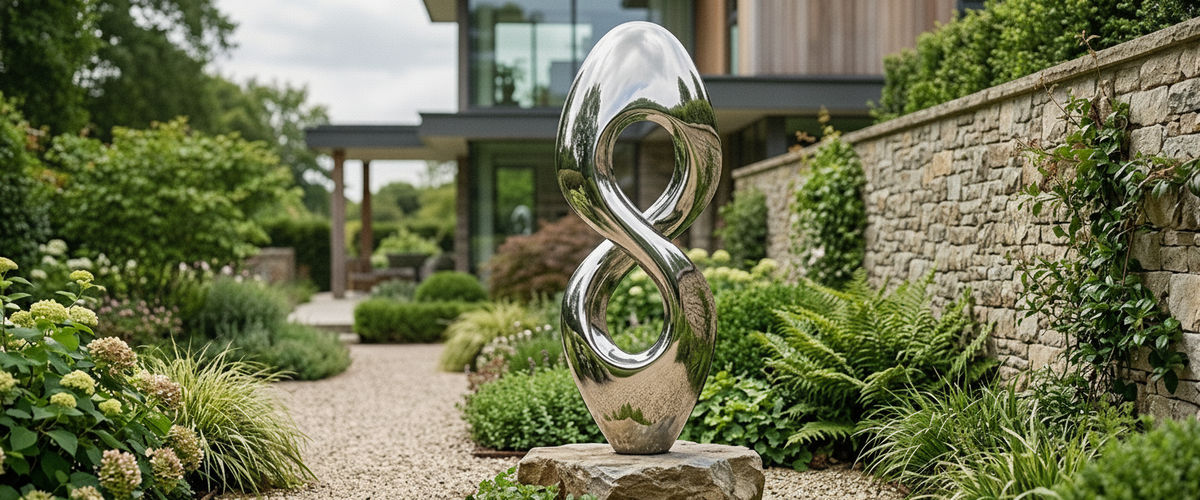
Height decides how firmly that gesture lands. Below roughly waist height a curved form reads as an object; above chest height it starts to read as a presence, and that shift changes how a room or terrace behaves around it. Where the brief calls for presence rather than accent, a mirror-polished vertical such as Molten Silver Organic Steel Sculpture at 155cm (about 5 ft) keeps the twist rising in one unbroken sweep, so the reflections stretch along the line instead of fragmenting across it.

Which Materials Carry Organic Shapes in Art at Scale
Cast bronze is the most forgiving. Anything a modeler can build in clay can be cast, including undercuts, deep hollows and pierced voids. Bronze also patinates to a stable, living surface that suits curved work, since patina pools slightly in the recesses and lifts on the high points.
Maquette stage: the form is judged in the hand long before it is scaled up.
Carved stone and marble impose their own discipline. Curves are achievable and gorgeous, but a cantilevered arm or a narrow neck in stone needs structural thinking, and the block dictates the maximum envelope. Granite and marble reward a soft form with weight and coolness that metal cannot fake.
Welded stainless and Corten skins are how most large organic pieces get built now. The form is panel-beaten or press-formed over an internal frame, then welded, ground and finished. For coastal and poolside sites we specify marine-grade stainless; for inland gardens where you want the form to sit warm against planting, Corten's oxide layer does the job. On a wide lawn, a grouped set of simple curved masses such as Pebble Organic Outdoor Steel Sculpture, at 90cm and 118cm, usually holds the ground better than one isolated object of the same total volume.
Hand-Finishing on a Curve
This is where organic shapes in art get expensive and where cheap work betrays itself. On a flat panel a sanding seam hides. On a compound curve it catches light along its whole length and reads as a scar from across the garden. Our finishers work a curved skin in progressive grits, always following the direction of the form rather than the direction of the weld, and check the piece under moving light before signing it off. One rushed seam undoes a month of shaping. Finish choice changes the tolerances too: where a setting wants warmth rather than reflection, Aurora Copper Organic Abstract Steel Sculpture is closer to the right design language, though a soft copper tone gives you less contrast to hide behind and will register every ripple in the substrate.
Soft Forms Against Hard Architecture
Organic shapes in art are at their best when something rigid is pushing back. Three placements consistently work:
Glass corners. A curved form set where two glazed walls meet gives the eye something to rest on and stops the corner reading as a void. Common in Los Angeles and Austin new-builds.
Stair returns and half-landings. A vertical biomorphic piece on the turn is seen from three levels, so the changing profile does real work.
Enclosed courtyards. Four straight walls need one thing that is not straight. We shipped a pair of curved stainless forms to a Connecticut courtyard where the client had wanted a single large piece; splitting it into two related masses let them keep a walking route through the space, which the single object had blocked.
Avoid burying a curved form in dense planting. The silhouette is the asset; give it sky, gravel, water or lawn behind it. Working through the organic art collection with that background question settled will shorten your shortlist fast.

Studio Practicalities: Organizing Art Supplies Around Curved Work
Plenty of people researching organic shapes in art are making their own maquettes, and curved work makes a mess in a way flat work does not. A few things we insist on in our own model shop:
Keep a dedicated art supply organizer for clay tools and rasps only, sorted by profile rather than by length, so the right curve comes to hand without hunting.
Store abrasives in a shallow art materials organizer by grit sequence, left to right. Grit order is the most useful habit any art organizer can enforce.
Keep wet plaster and armature wire away from finished surfaces. Art organization in a model shop is about protecting the work, not tidiness for its own sake.
Photograph each maquette stage against a plain wall, and label a small art supplies organizer box per project so stages do not get mixed up.
The Questions We Ask Before a Biomorphic Maquette Begins
Whether the client is a private collector, a landscape designer or an arts organization commissioning organic shapes in art for a public site, the brief starts the same way:
What is directly behind the piece, at the viewing distance that matters most?
Is the primary approach frontal, or do people walk around it?
Do you want reflection, absorption or oxidation as the surface behavior?
What is the load path? Curved forms often need a hidden plate and footing rather than a visible plinth.
Coastal salt, pool chemistry, freeze-thaw, irrigation spray: which of these will the piece live with?
Who maintains it in year five, and how tall a ladder do they own?
Answer those and the maquette stage moves quickly. Giant Sculptures builds bespoke organic forms in bronze, stone and engineered metalwork at scales that need craning in, and every commission is quoted against material, size, structural work, finish and installation rather than a shelf price. Send a site photo with the sightline you care about, and we will tell you honestly whether the curve you have in mind will hold that space.
For wider placement ideas, 10 Stunning Stainless Steel Sculptures That Could Be in Your Garden is useful companion reading before finalising the setting and sightlines.