











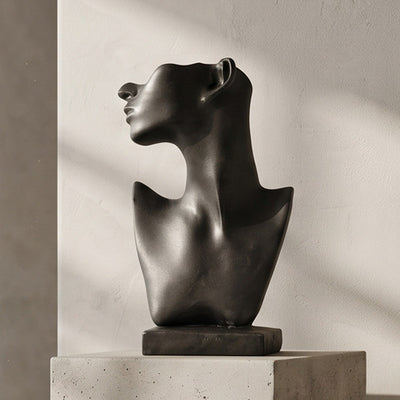








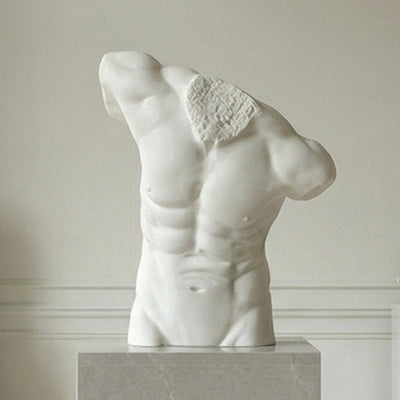









































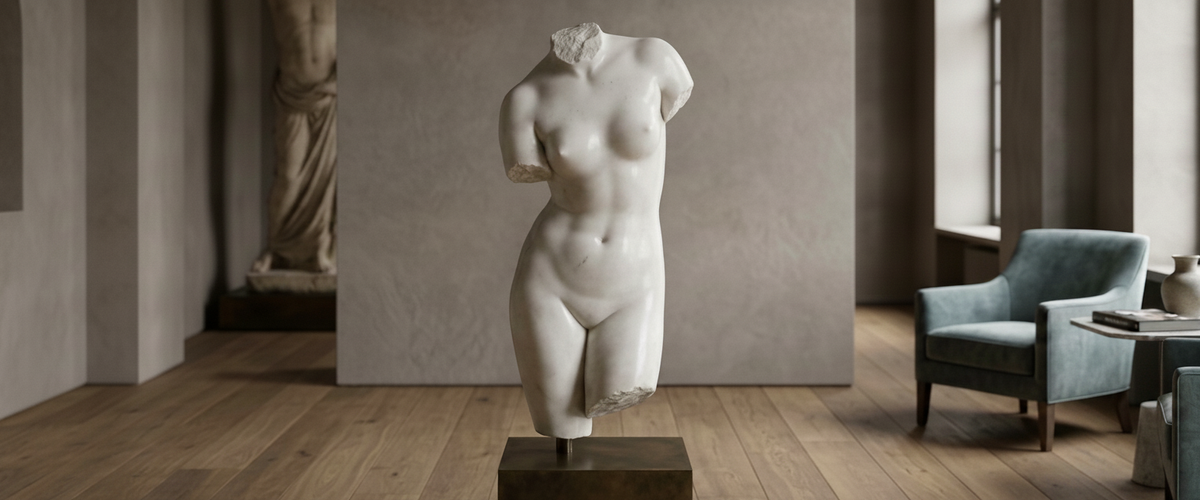

A figure with no head, no arms and nothing to look at you with should be a difficult thing to sell. Yet a marble torso sculpture is often the piece a client keeps coming back to after they have walked past four complete figures. Strip away the face and the gesture and what is left is pure structure: ribcage, hip, the twist through the waist. Buyers respond to that. It reads as ancient and modern at the same time, which is why the marble torso sits comfortably in a Napa winery entrance and in a Tribeca loft with concrete floors.

Key Takeaways
The fragment is the genre now. Roman marble torso sculpture began as accidental survival and became a deliberate form in its own right.
Judge the twist, not the missing parts. A good torso carries contrapposto through the abdomen and hips alone.
Look at the break edges first. Honest, tool-textured fracture faces read as sculpture; slick rounded stumps read as ornament.
Set it at chest height. Plinth choice changes the figure more than the carving does.
One strong light source beats four weak ones. Raking light is what makes marble musculature legible.
Budget depends on stone grade, scale, carving hours, finishing and installation, so ask for a tailored quote rather than assuming a figure.
How Roman Fragments Stopped Being Damage
Most surviving classical bodies lost their extremities to time, iconoclasm, quarry reuse or careless excavation. Heads and arms are thin at the join and go first. By the eighteenth century, collectors and the sculptors who restored for them had learned that a torso could stand alone, and the fragment gained its own authority; the British Museum's Greek and Roman collections are full of bodies that read as complete works despite their losses, and the museum's collection records show how many were prized precisely as fragments.
That history matters commercially. When you buy a roman marble torso sculpture today, you are buying an accepted visual language, not a broken object. Designers use it the way they use a single antique column: a signal of depth in an otherwise new build. We have shipped torsos into houses in Austin where every other surface was under two years old, and the piece did the work of fifty years of collecting.
A half-life-size torso set at chest height, where the fragment reads as a figure rather than as debris.

Finding Contrapposto Without a Gaze
Classical figures balance weight on one leg, drop the opposite hip and counter-rotate the shoulders. Remove the head and arms and that spiral has to be carried by the trunk alone. Look for a diagonal: one hip higher, the ribcage rotating against it, the linea alba curving rather than running straight down. A turning torso marble sculpture done well makes you want to walk around it, because the silhouette changes every 45 degrees. In a marble torso sculpture, that spiral is the entire performance.
Weak examples sit square. The abdomen is symmetrical, the hips level, and the piece dies from any angle other than dead front. When we review carving samples in the studio, the fastest test is to photograph the model from four sides. If two of those photos look identical, the twist was never there.
Honest Breaks Versus Manufactured Ones
The fracture edge is where quality hides, and a marble torso sculpture is judged first on how it ends. On genuine antiquities the break is irregular, slightly crystalline, and often stained differently to the polished surface. On a well-made contemporary piece, the carver mimics that logic: the break is left with visible point and chisel texture, and it cuts across muscle in a way that follows the stone's grain rather than a designer's convenience.
Signs to be wary of include perfectly circular shoulder stumps, breaks polished to the same sheen as the chest, and a neck cut that looks like it came off a saw table. Ask how the fracture was finished, and ask for a close photograph at raking light before shipping. It is the single most useful image you can request.
Raking light across a shoulder break: tool texture and crystalline structure are what you are paying for.
Carrara, Statuario and Cast Marble Under Raking Light
Hold three samples at arm's length in strong side light and the differences stop being abstract. Standard Carrara shows soft gray veining and a slightly cool white; it forgives, and it suits larger pieces where a little movement in the stone helps. Statuario is whiter, more translucent at the edges, and shows skin transitions better, which is why it has been the preference for figurative carving since the Renaissance. Cast marble, meaning crushed stone bound in resin, looks convincing in photographs and flat in person: the surface stops light instead of letting it in a millimeter or two. A solid marble torso sculpture keeps that shallow glow; a cast one never quite does.
If a marble female torso sculpture is going somewhere it will be seen close up, in a hallway or on a console, pay for the better stone. At distance in a garden or a double-height atrium, Carrara with honest veining is often the smarter buy. Our marble busts and torsos collection covers both registers, and the wider marble sculptures range is worth scanning to calibrate what different stone grades look like at scale.

Chest Height, Never Knee Height
The most common mistake we see is a beautiful marble torso sculpture parked on a low plinth. At knee height it reads as a fragment on the floor. Bring the navel to roughly the viewer's own navel or higher and the piece becomes a presence. A rough rule: aim for the top of the plinth at 34 to 44 inches (86 to 112 cm) for a half-life-size torso, and let the piece finish somewhere around chest to eye height overall.
Plinth material is a real decision, not a default. A plain honed stone block disappears and lets the body speak. A sculptural pedestal makes a statement of its own, which can work in a commercial lobby where you want two events instead of one; where the room can carry that much base, something on the order of the Gold Mirror Molten Drip Marble Pedestal Sculpture, 110cm turns the support into an object in its own right. In a private study, restraint usually wins.
Niches, Consoles and One Good Light
Four recessed downlights will flatten a marble torso sculpture into a white blob. What marble wants is a single directional source, placed high and to one side, so shadow pools under the ribs and along the oblique. Niches work well because they supply a dark backing plane, but they also cut off the rear view; only use one if you have accepted that loss.
Conservation practice also argues for control rather than blast: guidance from the American Institute for Conservation on collections care is a useful primer on handling, cleaning and environment for stone. In practice, keep marble away from acidic cleaners, dust dry, and expect outdoor pieces to weather. One client in the Hamptons wanted marble on an exposed terrace; we talked them into stone for the interior torso and bronze for the garden figure, and both have aged the way they hoped.
In the Round or as Relief: Which Sides Will You Lose?
Decide early. A fully carved marble torso sculpture in the round justifies a freestanding position and rewards circulation, so it belongs in a stair hall, a gallery landing or the center of a courtyard. A relief or half-round torso is designed for a wall, costs fewer carving hours, and solves tight corridors. Neither is a compromise if the placement is honest about it.
Material comparison helps here too. Marble reads as light itself, while bronze holds thin edges and takes patina. Where a scheme needs the figure to sit dark and graphic against pale walls rather than dissolve into them, a cast piece such as Cranhall Bronze Torso Figure Sculpture, 100cm is closer to the right design language than white stone.
Scale is easier to argue in the hand than on a mood board. A small study like the Melcote Red & Grey Torso Sculpture, 26cm works as desk-scale evidence of pose and break line before anyone commits to a full-height carving.

Buyer Checklist Before You Commit
Run these questions before you sign off on any marble torso sculpture, bought from stock or commissioned.
Ask for photos from four sides, plus one raking-light shot of the fracture edges.
Confirm the stone type and grade in writing, and whether it is solid marble or cast.
Check the weight against your floor, mezzanine or console loading.
Confirm how the piece dowels or pins to the plinth, and who is responsible for that fixing.
Agree crating, delivery access and whether installation is included.
Decide the primary viewing angle before you choose a niche.
Ask about lead time for bespoke carving; hand work on stone is not fast.
Commissioning a Bespoke Marble Torso Sculpture
Bespoke is where a marble torso sculpture earns its place, because scale and pose can be tuned to the actual site. We start from a reference brief or a clay maquette, agree the twist and the break lines, then confirm stone selection before carving begins. Buyers often change one thing at maquette stage: they raise the break at the thigh, or drop the shoulder line, and the whole figure improves. Giant Sculptures handles that back and forth as a normal part of the process, alongside plinth engineering, crating and worldwide delivery. Pricing follows stone grade, scale, carving complexity, finishing and installation requirements, so the sensible next step is a tailored quote rather than a guess. Browse the bust and torso sculptures range to shortlist a starting point, then tell us the room.
For wider placement ideas, Marble Garden Statues: What Winter Really Does to White Stone is useful companion reading before finalising the setting and sightlines.