

































































































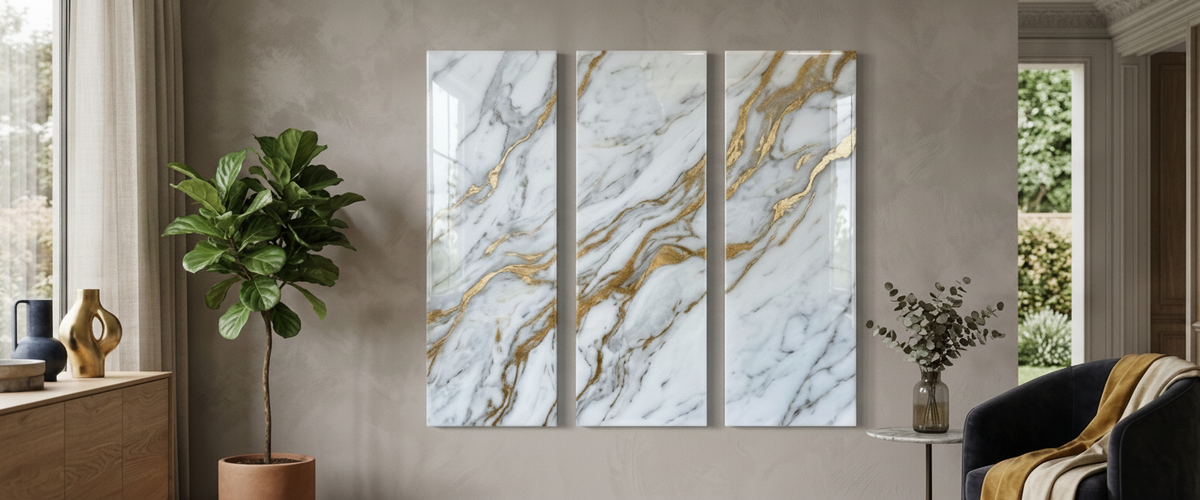

Plenty of the liquid marble wall art sold online has never met a drop of resin. It is a high-resolution photograph of somebody else's pour, printed on canvas, stretched over a pine frame and priced as art because the swirls read as marble from twelve feet away. That is a perfectly honest product if the listing says so. The trouble starts when a buyer pays for depth and receives pixels, then hangs it under a run of downlights and watches the illusion collapse.

At a Glance
What to check before you commit to liquid marble wall art:
Three different things share the same name: a genuine pigment pour, a printed image sealed under a resin skin, and a plain giclee print.
Depth is the honest signal. A thin sealing coat and a deep cast resin surface behave nothing alike in light.
Multi panel sets live or die on vein alignment across the gaps between canvases.
Finish beats color in a room with ceiling spots. Gloss turns walls into mirrors.
Resin chemistry decides year five. Cheap systems drift amber; UV-stabilized systems stay cold and clean.
Bespoke pours can match a palette and a scale, never an exact reference image vein for vein.
Pigment Pour, Resin Skin or Print: What Sits Behind Liquid Marble Wall Art
A true pour is made by flooding a rigid panel with tinted resin or acrylic mediums, then moving the pigment with air, heat or tilt until the veins settle. Nothing is drawn. The pattern is a record of how fluids behaved on one particular afternoon, which is why no two panels ever repeat.
A resin-skinned print is a printed image with a clear coat poured over the top. It has gloss and a little physical depth, but the veining is flat beneath the surface. Held at an angle, the veins stay locked in one plane rather than sitting at different levels inside the material. The third category is a straightforward canvas print with no resin at all, sometimes varnished to fake the shine.
None of these is dishonest by nature. What matters commercially is that they occupy very different tiers of cost and longevity, and the phrase liquid marble wall art gets applied to all three without distinction.
The Arm's-Length Test for Liquid Marble Wall Art
Stand close enough to touch the piece, then look across the surface at a low angle rather than straight on. On a real pour, the veins have physical edges. Metallic pigments catch light at slightly different moments as you shift your head, because they are suspended at different depths. Cells and lacing have raised rims you can feel with a fingertip.
On a print, every highlight fires at once. The gold reads as printed ink, flat and obedient, and the reflection sheet is unbroken. Ask any supplier for a raking-light photograph rather than a flat product shot. Sellers with genuine pours send it happily. Sellers with prints send you the same catalog image again.
Raking light does the work: on a genuine pour the veins sit at different levels rather than in one flat plane.
Why Veining Rarely Survives the Gutters
Split liquid marble wall art across three canvases and you introduce gaps, usually one to two inches (25mm to 50mm) of wall between panels. A vein that crosses a gutter has to resume on the far side at the right angle, the right width and the right height, or the eye reads it as broken rather than continuous.
Most liquid marble multi panel canvas wall art sets are cut from one printed image, which is why the geometry works but the depth does not. Genuine multi panel pours are harder: the panels are poured together as one field, then separated, and shipping order matters because a swapped left and right panel destroys the flow. We label panels on the reverse after a client in Scottsdale hung a three-piece set in reverse and knew it looked wrong long before working out why.
Consistent gutter spacing is what makes a multi panel set read as one continuous field.
Where continuity across the gutters matters more than the pour itself, a set built from independent but related compositions is the safer buy. The Fantoria 3-Set Abstract Portrait Oil Canvas Wall Art is built that way rather than as one image sliced apart, so hanging tolerances stay forgiving and a half-inch of drift never reads as a mistake.

Gloss, Satin and Matt Under Downlights
High-gloss resin is what sells liquid marble wall art in photographs and what ruins it in real rooms. A ceiling grid of narrow-beam spots hits a glossy panel and bounces straight back as hot white discs, and you lose the veining entirely from the main seating position.
Satin is the safest default for a dining room, hallway or lobby with fixed downlighting. Matt kills reflection but also flattens the sense of depth that justified buying a pour. Before you choose, stand where people will actually stand and note where the light sits. If your ceiling fittings are directly in front of the wall rather than washing down it, go satin and thank yourself later.
When the lighting is fixed, aggressive and impossible to re-aim, it can be worth stepping away from resin altogether for that particular wall. A framed two-panel piece such as the Kansora Leopard Emblem 2-Set Framed Wall Art sidesteps the mirror problem completely, and with only one gutter to align it suits narrower runs above a console or sideboard.
Depth Is the Tell: Thin Coats and Deep Casts
Depth is where liquid marble wall art earns its price. An eighth of an inch (about 3mm) of resin is a sealing layer. Over an inch (25mm or more) is a cast body with real internal space, where pigment sits at genuinely different levels and light travels through before it comes back. The second costs considerably more to make, weighs far more, and needs proper fixings into studs or masonry rather than drywall anchors.
Weight is the practical constraint most buyers miss. Deep resin on a large panel gets heavy quickly, and a heavy piece on a plasterboard partition is a repair job waiting to happen. If you want physical relief without the mass, sculpted wall pieces solve it differently. A layered panel like the Everwyn Tales Forest Stag Fantasy Landscape 3D Wall Art builds shadow through form rather than poured depth, and the rest of the 3D wall art range follows the same logic, with fixing requirements that stay predictable on a stud wall.
Which Marble Wall Art Panels Yellow at Year Five
Resin ambering is the single biggest long-term risk with marble wall art panels, and it hits white and pale gray palettes hardest because there is nowhere for the shift to hide. Unstabilized epoxy exposed to daylight drifts warm within a few years. UV-stabilized casting systems and acrylic-based pours hold their color far longer, though no polymer is truly permanent.
Conservation bodies have documented how light drives irreversible change in synthetic materials; the Smithsonian's guidance on light damage is a useful primer, and Tate's conservation research covers the aging behavior of plastics in collections. The practical takeaway: ask what resin system was used, ask whether it is UV-stabilized, and keep pale liquid marble wall art off walls that take hours of direct sun. A north-facing wall in a Manhattan apartment is a far kinder home than a west-facing Napa dining room with full afternoon glare.

Buyer's Checklist Before You Commit
Confirm in writing whether the piece is poured, resin-coated print, or print only.
Request a raking-light or side-angle photograph of the actual panel.
Ask the resin depth and whether the system is UV-stabilized.
Get the total hanging weight and the recommended fixing type.
Choose finish based on your existing lighting, not the product photograph.
For multi panel sets, confirm gutter spacing and whether panels are labeled for order.
Check crating and edge protection; cured resin chips at corners in transit.
Ask what happens if a panel arrives damaged, and who handles the replacement pour.
What a Bespoke Pour Can and Cannot Promise
Hand us a reference image and we can match the palette, the metallic accent, the density of veining and the overall scale of the composition. We can build to a wall width, split across two or five panels, and pour to a depth that suits the fixing conditions. What no studio can promise is a vein-for-vein copy of a photograph, because the pattern is set by fluid behavior during the pour rather than by drawing. Humidity in the studio on the day changes how cells open.
Clients who understand that constraint tend to be the happiest ones. The brief that works is directional: cool white with a single warm gold vein, low turbulence, satin finish, sized for a 14 foot (4.3m) wall. The brief that disappoints is a screenshot with an instruction to replicate it exactly.
Because our core work sits in large-scale bronze, stainless steel and stone, we tend to talk buyers through how a poured panel will sit alongside more permanent materials. A marble-effect panel behind a console reads very differently once there is a cast metal piece from the bronze wall art range on the adjacent wall, and planning both together avoids two competing focal points. If you are still comparing formats, the wider wall art and wall decor collection is the place to start, and our team will quote your liquid marble wall art commission once material, scale, depth and finish are settled.
For wider placement ideas, Marble Wall Art for the Home: The Wall Matters More Than the Stone is useful companion reading before finalising the setting and sightlines.