





























































































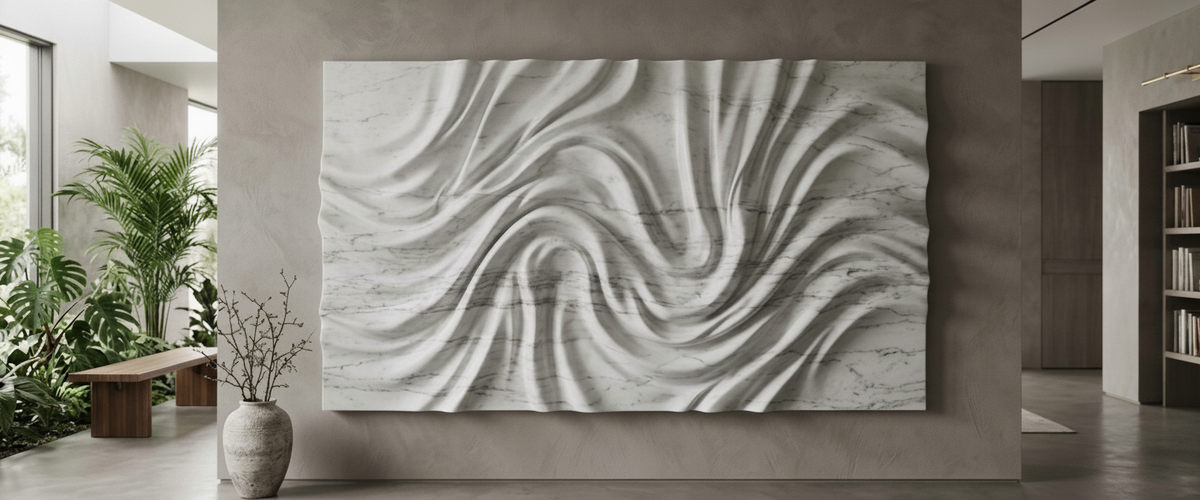

The stone rarely fails. The wall does. Almost every problem we hear about with marble wall art home installations starts behind the panel: a plasterboard anchor rated for a framed print, a stud that was assumed rather than found, a bathroom fixing that spent two years quietly corroding in steam. Marble is one of the most forgiving art materials you can own, provided the thing holding it up was specified with the same care as the carving.

Key Takeaways
Know the build-up. Solid slab, thin veneer and cast stone behave completely differently on a wall, and they weigh completely differently too.
Weigh before you shop. One-inch (25 mm) marble runs roughly 14 lb per square foot (about 68 kg per square meter). Scale that across a panel and the number gets serious fast.
Fixings are the whole game. Studs, masonry anchors or a hidden steel subframe carry marble wall art home panels. Plastic plugs in plasterboard are how panels end up on the floor.
Light decides what you see. Grazing light reveals relief depth; a flat ceiling wash flattens it into wallpaper.
Sealing is maintenance, not insurance. Marble etches from acids, not from dirt.
Solid Slab, Thin Veneer or Cast Stone: Know What Is Hanging There
Three products get sold as marble wall art for the home under the same phrase. A solid carved slab is exactly what it sounds like: one piece of quarried stone, worked front and back, heavy and permanent. A thin veneer is a marble face, often 3/8 inch (10 mm) or less, bonded to an aluminum honeycomb or composite backer, which cuts weight by more than half while keeping real stone at the surface. Cast stone and marble-filled composites use crushed marble in a binder, poured into a mold; they take fine detail well and are the lightest of the three, but they do not have the depth of natural veining that makes a slab worth owning.
Ask the supplier which one you are buying, in writing. When clients ask us to quote marble wall art for a home, the first question back is usually about the wall, because a solid carved relief and a veneer panel of the same face size are two different engineering problems wearing the same finish.
Weight per Square Foot Against Plasterboard, Stud and Solid Brick
Weight is the first honest test of any marble wall art home plan. Marble is dense, around 170 lb per cubic foot (roughly 2,700 kg per cubic meter). Run the arithmetic and a 3/4 inch (19 mm) panel lands near 11 lb per square foot (about 54 kg per square meter). A panel covering nine square feet is then pushing 95 lb (about 43 kg) before you add a frame or subframe. That is a fireplace-sized piece, not a monument.
Standard plasterboard on timber studs will happily take that load through the studs and will not take it through the board. Metal stud partitions, common in newer apartment builds, are worse: the board is often the only thing your anchor is gripping. Solid brick, block and concrete are the easy cases. If you are working with a partition wall and you want a heavy piece anyway, the honest answer is to open the wall and add noggings or a plywood backing pad before the plasterer returns. Clients who plan marble wall art home installations mid-renovation never call us back about a sagging panel.

Fixings That Hold, and Fixings That Quietly Let Go in Year Two
Failure is rarely dramatic. It is creep: an anchor slowly chewing a larger hole in soft board until the top edge tips forward. What holds marble wall art home panels long term is mechanical, into structure. Sleeve or wedge anchors into masonry. Structural screws into located studs, not into where a stud probably is. For anything substantial, a concealed aluminum or steel Z-clip or split-batten system spreads load across two or more fixing points and lets the panel sit tight to the wall.
Two details people skip when they hang marble wall art in the home. First, use stainless fixings in any damp room; plated steel will bloom rust straight through a pale stone within a few years. Second, most heavy panels want a small bottom restraint or shim, so wall irregularity does not leave the base standing proud and levering on the top clips.
If the wall genuinely cannot take stone, change material rather than change your standards. Not every marble wall art home idea survives a metal-stud partition, and on a wall that will never carry a slab, an acrylic relief such as the Panthra Emerald Green Acrylic Stripe 3D Wall Art gives you real modelled depth at a fraction of the load per square meter, and the wider 3D wall art range exists for exactly that constraint.
Veining Direction Decides Whether a Panel Reads Calm or Restless
This is the choice buyers of marble wall art for the home regret most, and it costs nothing to get right. Veining running roughly horizontal settles a room; it widens a wall and sits quietly behind furniture. Diagonal or strongly figured veining is active and wants space around it. In a paired or bookmatched arrangement, the mirrored veins become the subject, so the carving needs to be simple or the two fight each other.
Orientation also interacts with the carving. Deep relief cut across the vein looks confident; relief cut along it can read as though the stone is cracking. Ask for photographs of your actual slab before cutting. Any serious workshop will send them.
Raking Light Versus a Flat Ceiling Wash
Relief lives on shadow. Set a downlight 6 to 12 inches (150 to 300 mm) out from the wall so the beam rakes down across the surface, and a half-inch of carved depth throws a shadow you can read from across the room. Push that same fitting three feet out, or bury the panel under a flat ceiling wash, and it disappears into a pale rectangle. This is the single cheapest upgrade to marble wall art home displays: move the light, not the art.
The same rule governs how you group pieces. A two-part hang such as the Artelis 2-Set Fox & Panda Animal Framed Wall Art only holds a corridor if both panels get the same light angle; light one from the left and one from the right and the symmetry collapses before anyone has looked at the subject.
Bathrooms and Kitchens: Steam, Grease and the Acid Problem
Wet rooms and cooking spaces are where marble wall art home choices get properly tested. Marble in a steam-heavy bathroom is fine. Marble near a hob is a slower problem. Airborne cooking grease settles into the micro-porosity of honed stone and yellows over a few years, and it will not brush off. Polished surfaces resist this far better than honed or textured ones. In bathrooms, the real enemy is acid: limescale removers, some bathroom sprays and toiletries will etch a dull mark into the surface within seconds. The Natural Stone Institute is blunt about this, and so are we.

Sealing, Dusting and How a Marble Panel Looks in Year Five
Year five is where a marble wall art home panel either still looks quarried or looks tired. An impregnating sealer slows staining; it does not stop etching, because etching is a chemical burn, not a stain. Reseal when water stops beading on a test patch rather than to a calendar. Day to day, dry dusting with a soft brush or microfiber does most of the work, and museum conservation guidance on caring for stone makes the same point: less intervention, more often.
Five-Minute Care Checklist
Dust dry first, always, before any damp cloth touches the surface.
Use pH-neutral cleaner only; no vinegar, no lemon, no descaler.
Blot spills immediately, especially wine, coffee and oils.
Check fixings and the top edge gap once a year.
Test water beading annually and reseal only when it fails.
Keep a photograph of the panel on day one for comparison.
Commissioning Marble Wall Art for Your Home
Bespoke is the right route when the wall has an odd proportion, when a room needs one piece rather than a gallery of small ones, or when you want carving that answers the architecture. Giant Sculptures works at large scale, so a marble wall art home commission normally starts with wall build-up and structure, then material, then design. We often ask for a cardboard mock-up taped in place for a week before anything is cut; it settles arguments about size faster than any render.
Budget for a marble wall art home project depends on stone selection, panel size, carving depth, subframe engineering, finishing and installation access, which is why we quote per project rather than publish a figure. If stone is out of scope for a particular wall, our metal wall art and broader wall art and wall decor ranges cover lighter builds without dropping to disposable decoration. For a stairwell that needs modelled relief rather than a flat print, but where the plasterwork rules out stone, a sculpted piece like the Blossomkin Bird 3D Floral Wall Art is closer to the right design language than another framed canvas.
Get the wall right and marble wall art home installations outlast every other finish in the room. That is the whole point of buying stone.
For wider placement ideas, Unique Wall Art Decor for Walls That Need More Than a Canvas is useful companion reading before you finalise the setting and sightlines for marble wall art at home.