






































































































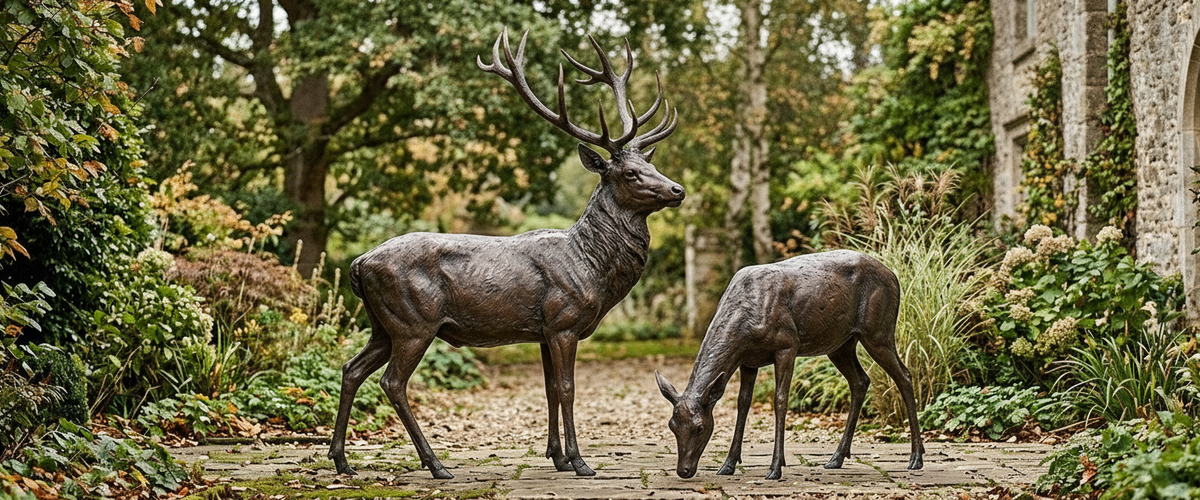

Ask five sellers what "life-size" means and you will get five different measurements, all of them technically honest. With life-size statues, life-size is a slippery label. Each piece sells on a single number, and that number might be shoulder height, height to the antler tips, or nose-to-tail length. The gap between those figures can decide whether a bronze stag commands a Napa lawn or looks like it wandered in by mistake. This guide uses deer, the subject buyers misjudge most often, to show what a 1:1 measurement really describes, why the setting and the finish change how big a piece reads, and how to test the size on site before you commission anything.

Quick Answer
For life-size statues, life-size means 1:1 with the real subject, but listings quote different dimensions. Always ask which one.
Open lawns shrink a true life-size animal. Woodland edges and walls make it read larger.
Heroic scale (roughly 1.1 to 1.5 times life) suits human figures seen from a distance or raised on plinths. Animals usually stay true.
Indoors, the effect flips. A life-size stag dominates a hallway.
Finish matters. Dark bronze recedes; pale stone advances.
Stake out a full-size outline on site before any sculpting begins.
What Life-Size Statues Actually Measure
Real animals vary more than most buyers assume, and with life-size statues, life-size follows the species, not a standard. A white-tailed deer, the species most American clients picture, stands roughly 3 feet (about 90 cm) at the shoulder, according to the Smithsonian's National Zoo. A mature red deer stag is a bigger animal, around 4 feet (about 1.2 m) at the shoulder, as Britannica notes. Both are honest life-size subjects. They are not the same object on your lawn.
Antlers complicate things further. On antlered pieces, the quoted height usually includes the rack, so the body itself sits lower than the headline number suggests. When a listing gives a single figure, such as the 170 cm (about 5 ft 7 in) quoted for a traditional bronze deer pair with doe companion, ask for the shoulder height and overall length too. Those two numbers tell you far more about presence than the top line.
This is the core point for anyone comparing life-size statues and life-size sculptures of deer across different sellers: match like with like. A "life-size" listing that quotes nose-to-tail length can look generous on paper and modest in the ground.

Why a True 1:1 Deer Looks Smaller on an Open Lawn
The eye judges size by what surrounds an object. Put a deer in the middle of open turf with nothing but sky behind it and the brain has no yardstick, so it reads the animal as smaller and farther away than it is. Outdoors, with life-size statues, life-size is partly a matter of context. Move the same bronze to a woodland edge, with tree trunks and understory planting around it, and it snaps back to its real size, because that is where people expect to see deer.
This comes up often. A client sees a stag photographed in the middle of a broad meadow and asks for it to be scaled up. Our usual answer is to move it closer to the tree line instead. Nine times out of ten the piece reads correctly from the house, and the commission stays at true scale, which also keeps it cheaper and easier to install. Of all the life-size statues we place, life-size deer are the ones most often misjudged on open ground.
Heroic Scale: When a Figure Goes Beyond 1:1
Not all life-size statues stay life-size. Sculptors have long pushed human figures beyond 1:1 when they will be seen from below or across a distance. A figure on a plinth loses visual height to foreshortening, and a deliberate enlargement restores the proportions the viewer expects. For a formal garden axis or a double-height entrance, a figure sized like the classical female figure in bronze at 230 cm (about 7 ft 6 in) will hold its own where a strict 1:1 figure would start to look slight.
Animals are different. People know how big a deer is, so for animal life-size statues, life-size accuracy matters; an oversized one looks wrong rather than grand. Our rule: keep animals true and change the placement, unless the piece will stand very high or very far away. Pairing an animal with a human figure also fixes the scale for the viewer. On a big estate, a composition such as the Highland bull and drover group reads convincingly at distance because the drover gives the eye a ready measure for the animal beside him.

Indoors, a Life-Size Stag Fills a Hallway Faster Than You Think
Bring the same deer inside and the illusion reverses. Walls, ceilings and doorframes give the eye constant reference points, so indoor life-size statues feel larger than life-size. Antler span is the usual surprise: it widens the footprint at head height, exactly where people walk. In a narrow townhouse hall, mock up the rack in foam board first. More than one client has swapped a stag for a doe after that exercise, simply to keep a stair landing passable. We like to leave at least 3 feet (about 90 cm) of clear walkway around any indoor piece.
Dark Bronze Recedes, White Stone Advances
Finish changes perceived size almost as much as dimensions do. Two life-size statues, life-size in every measurement, can read a full size apart. A deep brown or black patina absorbs light and sinks into a dark yew hedge, so it can look a size smaller at dusk. White marble or pale limestone does the opposite against green planting, pushing forward and reading larger. Polished stainless steel reflects its surroundings and can partly dissolve into them. If a piece must hold its own at distance, choose a lighter patina or pale stone. If it risks overpowering a small courtyard, go darker.
Stake It Out First: The Full-Size Outline Test
Before any sculpting begins, we ask clients to mark the piece out on site. For life-size statues, a life-size outline beats any drawing. It costs an afternoon and saves months of second-guessing.
Set bamboo canes at shoulder height and at the top of the head or antlers.
Run string between them to trace the body length and the widest point.
For indoor pieces, cut a cardboard silhouette at full size.
View it from the main windows, the drive and the terrace.
Check it in early morning and evening light.
Photograph it and live with it for a week before signing off.

Decision Criteria Before You Commission Life-Size Statues
Viewing distance: at normal garden distances, life-size statues should stay life-size; at long range, consider placement changes, or heroic scale for figures.
Backdrop: sky and open lawn shrink a piece; trees, walls and hedges anchor it.
Plinth height: a raised figure may need enlargement to keep its proportions.
Footprint: measure antler span, tail and base, not just height.
Finish against setting: dark on dark disappears; pale on green advances.
Access: check gates, doorways and lifting routes for delivery.
Budget for life-size statues, life-size or heroic, depends on material, scale, complexity, engineering, installation and finishing, so the right next step is a tailored quote. Giant Sculptures works on bespoke commissions at true and heroic scale, and our team will help you read the site before a single wax is poured.
Start with our life-size and large statues, or look through our bronze deer statues if a stag or doe is already on your shortlist. Bring your cane measurements and a few site photos. For most animal life-size statues, life-size is the right call, and we can tell you quickly whether true 1:1 suits your setting.
For wider placement ideas, Planning a Life Size Gorilla Statue? Start With the Shoulders is useful companion reading before finalizing the setting and sightlines.