






































































































Most rooms fail their art before the art ever arrives. A ceiling too low, a sightline broken by a sofa, a plinth that wobbles when a dog walks past. An indoor sculpture is one of the few objects in a home or lobby that people walk around rather than past, so the decision deserves more thought than picking a print. Get the scale, material and position right and a single indoor sculpture can do the work of an entire wall of decoration.
We ship large and bespoke work into homes, offices and hospitality spaces, and the same questions about choosing an indoor sculpture come up again and again. This guide answers them in the order they actually matter.
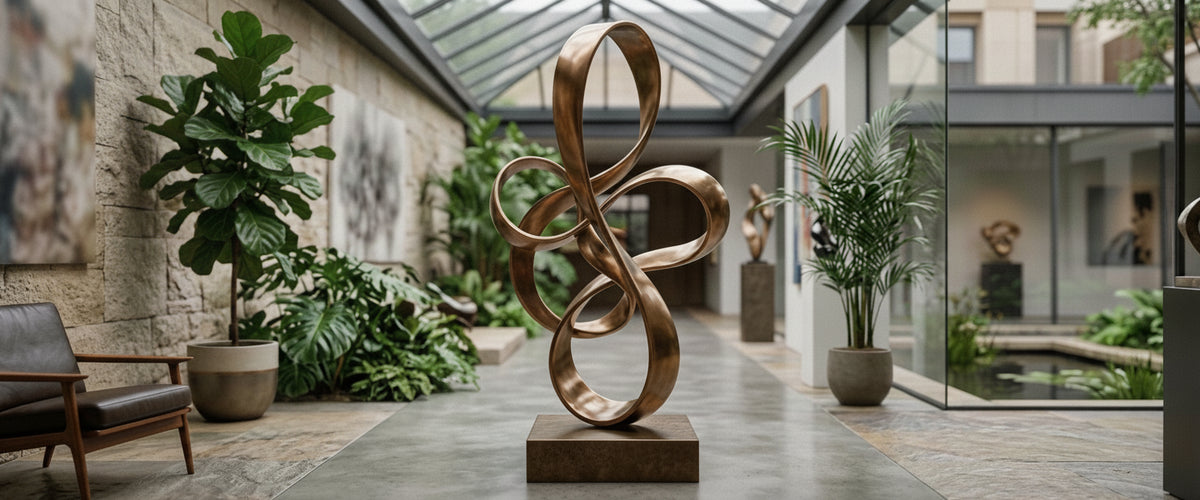
A tall bronze sited on the primary approach in a double-height space.

Quick Answer: What to Settle Before You Buy
Scale first. Measure the room, the doorways, and the height above the intended spot before you fall for a piece.
Match the material to the room's climate. Bronze, stainless steel and stone all behave differently under heating, humidity and direct sun through glass.
Decide the sightline. An indoor sculpture placed on the main approach reads far stronger than one tucked in a corner.
Plan the base and floor load. Large indoor sculptures need a level, load-bearing spot and often a fixing plan.
Budget by material, scale and complexity, not by a headline number. Request a tailored quote for bespoke work.

What Indoor Sculpture Means, and Who It Suits
An indoor sculpture is any freestanding or wall-mounted three-dimensional work made or finished for interior display. That covers a lot of ground, from a tabletop bronze to a piece that fills the void of a double-height atrium. The category also includes pieces you might assume live outside; plenty of bronze and stainless steel work reads beautifully as an indoor sculpture once the finish and base are chosen with interior light in mind.
The indoor sculpture suits three kinds of buyer especially well. Homeowners with generous entrances, stairwells or open-plan living space who want one confident focal point. Designers and architects specifying for a lobby, hotel or restaurant where the piece has to survive foot traffic and photograph well. And collectors who want scale indoors without the weathering variables of a garden. Whether you are furnishing a large great room or an office reception, the brief is the same: one deliberate object, correctly sized, correctly lit.

Materials, Finishes and Scale Decisions
Material is where an interior indoor sculpture quietly succeeds or fails. Bronze is the workhorse for indoor work because it is stable, takes a huge range of patinas, and needs almost nothing from you once it is in place. Museum conservators note that bronze is a durable copper alloy whose surface patina can be actively maintained, which is one reason it holds up so well indoors (see the Getty Conservation Institute on the care of bronze surfaces). For a figurative anchor in a hall or reading corner, a piece like the Large Classical Seated Angel Bronze Sculpture - 180cm at around 5.9 feet (180 cm) works indoors precisely because the patina holds its color under artificial light and the mass keeps it grounded on a hard floor.
Stainless steel behaves very differently. Polished steel bounces light and reflects the room back at you, which can be electric in a modern space and distracting in a busy one. Matte or brushed finishes calm it down. Stone and marble bring weight and quiet, but they are heavy, and floor load becomes a real conversation rather than a formality.
On scale, the common mistake is buying an indoor sculpture too small. A piece that looked large in a photo can vanish in a big room. As a rough working rule, a floor-standing work wants to reach at least a third of the way to the ceiling to register as intentional. For a standard 8-foot (2.4 m) room that points toward pieces in the 3 to 4 foot range; for a double-height space you can go well past 6 feet (1.8 m) before it feels big. Where a soaring atrium can carry a form that draws the eye upward, an expansive open-winged piece such as the Large Contemporary Flying Cranes Bronze Sculpture - 250cm at around 8.2 feet (250 cm) uses the vertical space rather than getting lost in it. Indoor floor sculptures also need breathing room around the base, so factor in the clear space, not just the footprint.
A brushed stainless piece sized to a lobby's main approach.
A Note on Water, Kinetic and Ice
Indoor water sculpture can be wonderful, but it asks for planning. A recirculating bronze fountain such as the Large Traditional Chinese Dragon Bronze Fountain - 150cm at around 4.9 feet (150 cm) needs a power source, a splash margin, and honest thought about humidity in an enclosed room. An indoor kinetic sculpture adds movement and needs clearance on all sides so nothing catches. An indoor ice sculpture is a different animal entirely; it is an event centerpiece with a lifespan measured in hours, so treat it as catering rather than collecting. For any permanent indoor sculpture, the durable metals earn their keep.

Where to Place Indoor Sculpture for the Strongest Impact
For wider placement ideas, Affordable Contemporary Bronze: Where to Place It so It Actually Reads is useful companion reading before finalising the setting and sightlines.
Placement is half the value of the indoor sculpture. The strongest position is almost always on the primary sightline, the view you get as you enter or as you reach the top of a stair. That single decision does more than any accent lighting.
Entrances and stairwells reward height and animal or figurative forms that hold a pose. A leaping or reaching subject, such as the Large Contemporary Leaping Hare and Bell Bronze Sculpture - 150cm at around 4.9 feet (150 cm), reads well from below and from the turn of a staircase. Open-plan living wants a piece that resolves from several angles, since people will circle it. Reception and hospitality spaces benefit from a form that photographs cleanly, because guests will do your marketing for you.
Two practical placement rules from the studio. Keep large pieces away from direct sun through south-facing glass; concentrated light through a window can heat one side of a bronze unevenly and, over years, affect a wax finish. And leave a walk-around margin of at least 2 to 3 feet (0.6 to 0.9 m) wherever you can, because an indoor sculpture that people brush past stops feeling like art.
Budget, Commissioning and Delivery
There is no single price for an indoor sculpture, and anyone quoting one without seeing the brief is guessing. Cost tracks material, scale, complexity of the form, the finish, engineering for stability, and installation. A polished stainless piece with a mirror finish involves far more hand-finishing than a textured bronze of the same size. Casting a bespoke figure costs more than adapting an existing model. The honest answer is to describe the space and the intent, then ask for a tailored quote.
Commissioning a bespoke indoor sculpture follows a fairly steady path. You share references, room dimensions and the mood you are after. We work up a concept and, for larger projects, a scaled maquette so you can approve proportion and pose before anything is cast. Then production, finishing, crating and freight. Lead times depend on the method and the size, so it is worth starting the conversation early if the piece is for a specific opening or event.
Delivery is the step buyers underestimate most. A heavy bronze needs a clear route in: door widths, stair turns, elevator dimensions, and a floor that can carry the load. We plan access before we build the crate, because the most beautiful piece is useless if it will not fit through the front door. Tell us about tight thresholds up front and we route around them.
Buyer Checklist
Measured ceiling height and floor space at the exact spot.
Doorway, corridor and stair or elevator dimensions along the delivery route.
Confirmed floor load capacity for stone, marble or large bronze.
A plan for the base and, where needed, fixing to floor or wall.
Lighting: where the light comes from and whether you will add accent lighting.
Distance from radiators, vents and direct sun through glass.
A tailored quote covering material, finish, engineering and freight.
How Giant Sculptures Helps With Bespoke Indoor Projects
We specialize in large-scale and bespoke work, which is exactly the territory where an indoor sculpture project goes wrong without guidance. That means advising on the right material for your room's climate and light, sizing the piece to the space rather than to a catalog photo, and engineering a base that keeps a tall bronze stable on a hard floor. For designers and architects, we work from drawings and mood boards and provide the specification detail your project needs.
Browse the indoor sculptures collection to see the range of forms and scales, or the wider sculptures and statues collection if you are still shaping the brief. When you have your next indoor sculpture in mind, send us the dimensions and a photo, and we will tell you honestly what will work in it.