





























































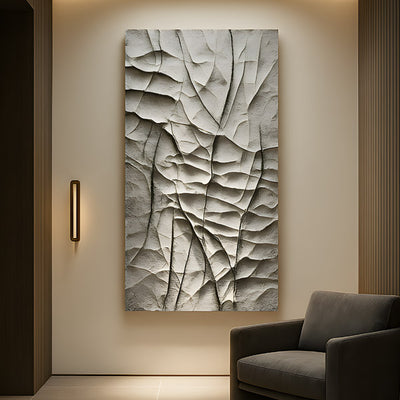
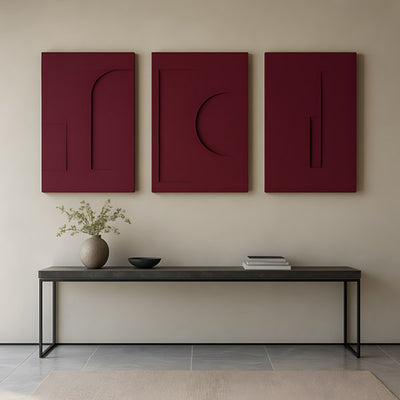































Hold a flashlight against the wall at a low angle and most pieces sold as unique wall art decor fall apart in about four seconds. The surface goes flat. The shadows repeat on a grid. What looked hand-carved in a product photo turns out to be a mold pulled a few thousand times, sanded smooth, and sprayed a convincing shade of stone. Buyers rarely get caught by bad taste; they get caught by good photography.
At Giant Sculptures we spend most of our week on large-scale commissions in bronze, marble, stainless steel and Corten, which means we look at surfaces for a living. The tells that separate unique wall art decor from repeat production are consistent. Once you know them, you can assess a wall panel from across a showroom.

Key Takeaways
Tool marks and pour lines are the cheapest thing to fake badly and the hardest thing to fake well, which makes them the first real evidence of unique wall art decor.
Relief depth is the first quality mass production removes, because deep undercuts break molds and slow demolding.
A numbered edition of thirty from a real studio often has more individual character than an anonymous import sold as a one-off.
Check the back, the edges and the fixing system. Copies stop pretending where the camera never looks.
Hang it where it can win. A carved panel competing with a fireplace and a television loses.
Tool Marks, Pour Lines and the Evidence a Print Run Cannot Fake
Carved stone carries a record of how it was made. Claw chisel tracks in the recessed background, slightly different rhythm in the left corner than the right, a softer polish where a thumb worked the drapery. Cast bronze carries its own evidence: chased seams, a faint pour direction in the patina, the small irregularities that a finisher decides to keep. None of it is damage. It is authorship, and authorship is what you are paying for in unique wall art decor.
Mass production erases exactly this. Composite panels are sanded to a uniform tooth so the coating sits evenly, which kills the microtexture that catches light. If every square inch of a panel reflects identically, a machine or a mold decided the finish, not a person. Look for repeated "random" texture too: hand-applied surface work never repeats at a fixed interval, and a mold always does.
Relief Depth Is the First Thing Mass Production Flattens Out
Depth is expensive. Deep undercuts mean more carving hours in stone, more complex molds in metal casting, and higher breakage rates in transit. So the volume market shaves it off. You end up with figures that read as drawings pressed into a surface instead of forms that genuinely emerge from it.
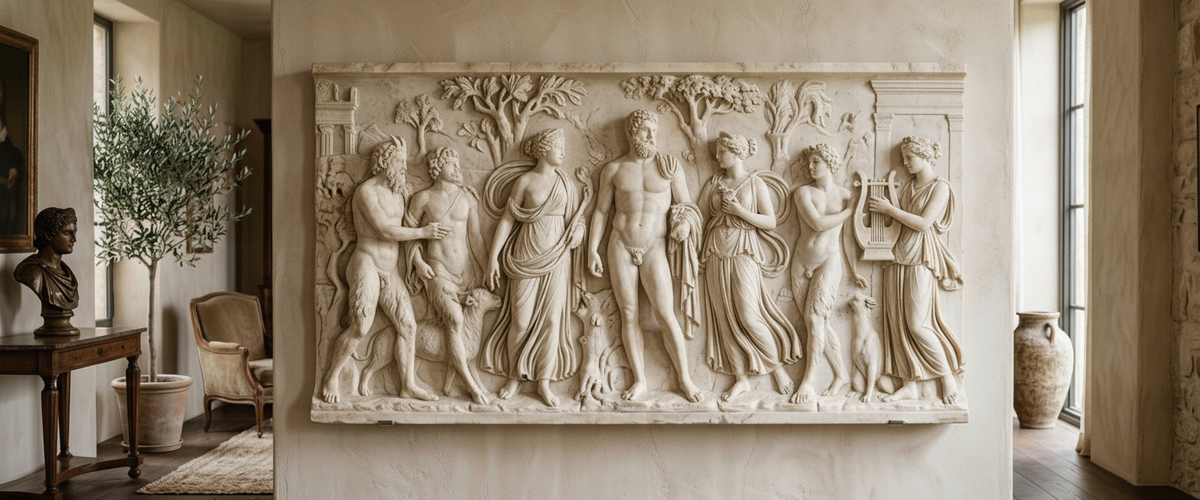
High relief is what makes a wall piece behave like sculpture at different times of day. Assyrian palace reliefs are the classic case: entire campaigns narrated in stone, still legible today through cut depth and shadow alone, long after the original paint disappeared. Depth is also why a panel such as the Apollo and the Muses Marble Relief Wall Art - 180cm (roughly 5 ft 11 in) still holds a room: the figures step forward from the ground plane far enough to throw real shadow across the stone. Flatten that by half and it becomes wallpaper with ambition.
The same logic applies to abstract work. Where the setting asks for a contemporary language rather than classical narrative, a carved timber panel like the Barwick Mocha Trace Abstract 3D Carving Wall Art earns its place through cut depth and grain direction rather than printed pattern, and sits more easily against oak and rattan than stone does. Depth, not pattern, is the load-bearing quality in unique wall art decor. Browse the 3D wall art range with that as your first filter and half the market disqualifies itself.

Why an Edition of Thirty Can Be More Singular Than a "One-Off" Import
"One of a kind" is an unregulated phrase. Plenty of containerized product is technically unique in the sense that the coating was hand-wiped, then repeated across a warehouse full of identical blanks. Meanwhile a numbered bronze edition of thirty is cast from one artist's model, chased by named hands, and patinated in small batches where atmosphere, temperature and chemistry shift between pulls. Number seven and number twenty-two are visibly different objects.
The question worth asking a seller is not "is this unique?" It is: who made the original model, how many exist, and what part of the finishing was done by hand? A supplier who can answer all three is selling unique wall art and decor. A supplier who dodges the last two is selling a photograph. Unique wall art decor is a claim about process, not vocabulary.
The Raking-Light Test
Conservators examine surfaces with light held almost parallel to the plane, because a shallow angle exaggerates every ridge, seam and fill. It is standard practice in conservation work, it works just as well in a living room with a phone flashlight, and it remains the fastest free test for unique wall art decor.
Hold the light about 15 degrees off the wall surface and sweep slowly. Genuine carving shows irregular facets and varied shadow lengths. Molded product shows soft, rounded edges (molds rarely hold a crisp arris through hundreds of pulls), plus parting lines running vertically through the composition and small circular flat spots where the panel was pushed out of the tool. If you are buying online, ask for a raking-light video. Honest studios send one; catalog resellers go quiet.
Backs, Edges and Fixings: Where Copies Stop Pretending
Turn the piece over. The reverse of unique wall art decor is finished, not hidden. Carved stone has a worked back with visible saw or bush-hammer texture and, on larger panels, engineered anchor points set into the mass rather than glued to it. Cast metal has a hollow interior with gate stubs ground back and, on serious work, a foundry mark. Composite panels usually have a smooth mold-shiny reverse, a foam core, and a sawtooth hanger stapled into place.
Edges matter just as much. On authentic stone, the side profile shows the same material all the way through, with tool texture continuing around the return. Coated composites show a color break where the spray stopped. Weight tells the rest of the story: a marble panel of any real size needs a structural fixing into blockwork or a steel subframe, which is why we specify anchors as part of the piece on anything approaching the scale of the Archangel Triumph Marble Relief Wall Art - 350cm (about 11 ft 6 in). Anyone selling a big stone panel with no fixing conversation has not thought about your wall.

Hanging a Genuine One-Off in a Room That Already Has a Focal Point
We shipped a pair of carved panels to a Napa tasting room where the client had planned to flank a 10-foot fireplace. Both pieces fought the stonework and lost. We moved them to the corridor leading in from the terrace, where visitors met them head-on at walking pace, and the room finally read correctly.
The rule we use: a relief panel wants its own wall, an angled light source, and roughly 30 to 40 inches (75 to 100 cm) of clear breathing room on the sides. A room holds one lead voice, and unique wall art decor needs to be it. Hang the visual center at about 60 inches (152 cm) from the floor for standing spaces, lower in seated rooms. Sight-lines beat symmetry every time. Entry halls, stair landings and the wall you see from a sofa all outperform the chimney breast. For covered loggias and courtyard walls, work from the outdoor wall art options where frost resistance and fixing corrosion have already been engineered in.
Buyer Checklist for Unique Wall Art Decor
Ask for raking-light images or video of the actual piece, not the studio sample.
Confirm material all the way through, not just the visible face.
Ask how many exist and what was finished by hand.
Request the reverse-side photograph before payment.
Check the fixing specification against your wall build (stud, block, brick or steel).
Measure the shadow gap: how far will the piece stand off the wall?
For outdoor placement, confirm freeze-thaw suitability and fixing metallurgy.
Budget realistically: material, scale, carving complexity and installation all move the number, so ask for a tailored quote.
When to Commission Instead of Buy
Commissioning makes sense the moment your wall has a dimension, a story or a sight-line that no catalog piece will satisfy. We regularly scale a relief composition to a specific bay, adjust depth for a particular light direction, or carry a client's motif across marble and bronze so an interior and a garden wall speak to each other. That is where genuinely unique wall art decor stops being a shopping exercise and becomes a design decision. Start with the wall art and wall decor range to set direction, then talk to our studio about scale, material and fixing before you commit to a size.
For wider placement ideas, Large Abstract Wall Art for Hallways: Bold Lines Win at Walking Speed is useful companion reading before finalising the setting and sightlines.