





































































































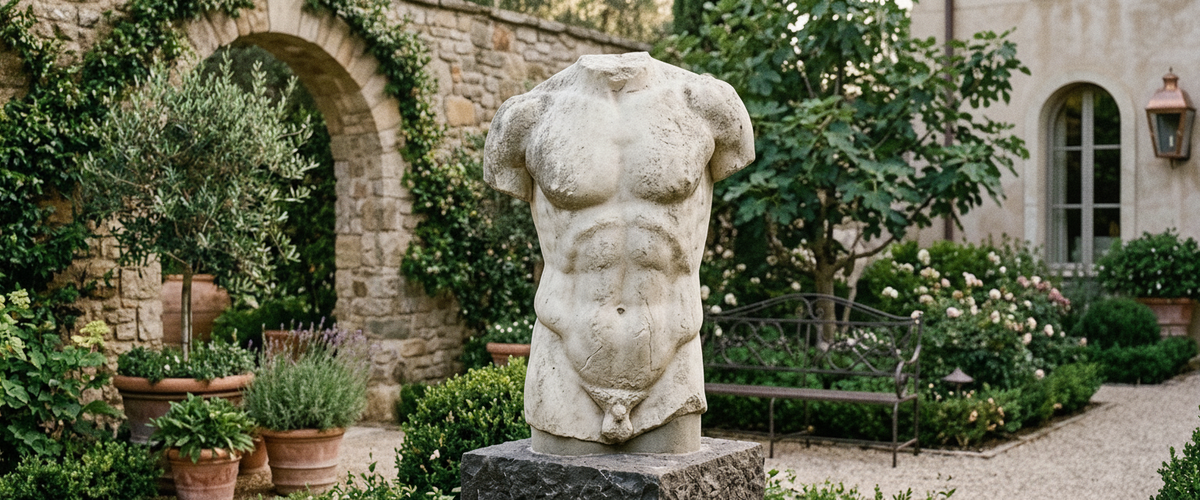

Most torsos sold as "Roman" were carved in recent decades, and there is nothing wrong with that as long as everyone is honest about it. The trouble starts when a modern piece is dressed up with a fake patina and a vague provenance story. A Roman marble torso sculpture, whether ancient or newly carved to classical standards, leaves physical fingerprints: tool marks, structural scars, crystal behavior in the stone, the way a surface has aged. Learn to read those and you can form a fast, defensible opinion in a showroom, an auction preview or a dealer's back room.

Quick Answer: What to Check, in Order
Six things to look at, in this order, on any Roman marble torso sculpture you are offered.
The back. Roman workshop pieces made for niches are often left rough behind. A perfectly modeled back suggests a free-standing original or a modern carving.
Drill evidence. Running-drill channels in hair, drapery folds and armpits point to Roman workshop practice; modeling done entirely with chisels points to an earlier tradition or a modern hand.
Strut scars. Small broken stubs at the hip, thigh or upper arm are structural, not damage, and they are one of the most reliable signs of a marble copy after a bronze.
Muscle transitions under raking light. Weak carvers give up where the oblique meets the rib cage.
Crystal size. Coarse-grained marble will not hold crisp abdominal definition. Fine-grained stone will.
Surface. Genuine burial and weathering do things that spray-on aging cannot copy.
Greek Original or Roman Workshop Copy? The Tell Is Usually in the Shoulder Blades
Roman patrons wanted Greek bodies, and Roman workshops supplied them at volume. Much of what the trade now calls a Roman marble torso sculpture began as a stone version of a lost Greek bronze, which is why so many Greek compositions are known today only through their Roman copies, a relationship visible across museum holdings such as the Getty's collection records. The copyists were skilled, but they were working to a deadline and a price.
Look at the back of the shoulders. A Greek bronze original was modeled in wax and cast, so the scapulae move convincingly as the arms lift. Marble copyists often flatten that region, partly because the block dictated it and partly because the piece was destined for a wall niche where nobody would see it. Shallow, generalized shoulder blades with a beautifully finished front is a workshop-copy signature. A back carved with the same conviction as the chest usually means the piece was intended to be walked around, which narrows the field considerably.

Drill Channels Versus Chisel Work
The running drill was the Roman carver's speed tool. Instead of cutting a deep drapery fold entirely with a point and claw chisel, the carver walked a drill along the line, then broke through the webs between holes. Under a phone flashlight you can still see the scalloped bottoms of those channels in armpits, groin folds and the deep undercuts of drapery. Chisel work leaves a different signature: flat facets, directional strokes, a rhythm you can follow with your eye.
Modern reproductions carved with rotary burrs and diamond points leave their own trace, a uniform, slightly glassy channel with no tool-walk variation. If every undercut in a Roman marble torso sculpture looks identical in width and depth, you are almost certainly looking at contemporary machine work. That is not a fault; it just needs to be priced and described as what it is.
Unfinished Backs, Strut Scars and the Honest Evidence of a Wall-Set Piece
Struts are the ugly, useful truth of marble figure carving. Marble has no tensile strength worth mentioning, so an extended arm or a free leg needs a supporting bridge of stone back to the body. Roman carvers left them in and, where possible, disguised them as tree trunks, drapery swags or quiver straps. When a fragment survives, those struts snap first, leaving small oval scars.
We had a collector in Napa send photographs of a torso he was about to buy, convinced the marks on the outer thigh were vandalism. They were strut scars, and they were the best evidence the piece had ever been a full standing figure. If you are shopping the marble busts and torsos category, treat clean stumps at the hip and upper arm of a carved marble torso as information rather than damage.
Muscle Transitions Under Raking Light
Take the light low and across the surface. Anyone can carve a rectus abdominis. The test is the soft country between forms: where the external oblique slides under the serratus, where the pectoral thins into the armpit, where the iliac crest turns into the groin. Confident carvers keep those transitions moving. Weak ones stop modeling and leave a flat plateau, or worse, cut a hard groove to fake the boundary.
In our studio we check a Roman marble torso sculpture this way before it ships, rotating a lamp around it at about waist height. It exposes sanding flats and lazy blending instantly. Applied to a cleanly carved contemporary piece such as the Classical Male Marble Torso Sculpture at 130cm, roughly 4 ft 3 in, the anatomy should hold from every angle under that lamp, not just from the catalog view.

Crystal Size and Marble Grade Decide Whether the Abdomen Holds Definition
Marble is recrystallized limestone, and grain size varies enormously between quarries. Fine, tightly bound crystals take a sharp arris and hold it. Coarse, sugary stone crumbles at the edge of every cut, which is why some torsos look slightly out of focus no matter how good the carver was. Sugaring is also a recognized deterioration pattern in weathered stone, catalogued in the ICOMOS-ISCS glossary of stone deterioration, and it accelerates outdoors in freeze-thaw climates.
Ask what stone you are buying and where it came from before you talk about anything else. Grain quality shows up on any polished curve, figurative or not, so handle a few pieces in the same stone before committing. For a Roman marble torso sculpture that will stand outside through hard winters, stone selection matters more than carving flourish.
Carved Stone or Marble Composite: Five Checks That Take Ten Seconds
For wider placement ideas, What a Marble Bust Sculpture Tells You Before You Ever See the Face is useful companion reading before finalising the setting and sightlines.
Not everything presented as a Roman marble torso sculpture is stone at all. Five quick tests settle it.
Temperature. Real stone pulls heat from your palm. Composite warms up almost immediately.
Sound. Tap with a knuckle. Solid marble gives a dense, short tick. Cast composite gives a hollow or plasticky note.
Veining logic. Veins in carved stone run through the form and reappear correctly on the other side of a cut. Printed or pigmented veining stops at edges and repeats.
The underside. Look at the base cut. Saw kerf and a coarse bed mean quarried stone; a smooth mold seam or fiber matting means cast.
Weight per volume. Marble runs around 165 to 170 pounds per cubic foot (about 2,650 to 2,720 kg per cubic meter). If two people lift a life-size torso easily, it is not stone.
What Real Ancient Surfaces Do That Modern Aging Cannot Fake
Buried marble develops selective, illogical dirt. Grime collects where water sat and pooled, not evenly across the form, and high points rubbed by soil movement or handling come up polished while adjacent recesses stay dull. Root etching leaves fine branching lines. Iron in the burial soil stains in patches with soft, diffuse edges.
Applied aging is too democratic. It follows the sculptor's undercuts because that is where the wash pools, which produces shadow exactly where a photographer would want it. Look for staining that makes no compositional sense; that is usually the honest kind. Cleaning a genuinely aged surface is a conservator's job, and worth costing before you buy rather than after.

Buying and Commissioning: Practical Decision Criteria
Antiquities carry export licensing and provenance obligations that most private buyers do not want to manage. For that reason, a large share of our clients commission a new Roman marble torso sculpture carved to classical standards instead, then place it with intent. A few things to settle early:
Scale against the wall or hedge behind it. A torso reads best when its height is roughly a third to a half of the backdrop it sits against.
Pedestal height before finish. Chest-height plinths flatter the abdominal modeling; low plinths flatten it.
Indoor or outdoor. Marble is fine outdoors in mild climates but wants shelter or seasonal covering where salt and freeze-thaw are in play.
Anchoring. Any torso above about 3 ft (0.9 m) should be dowelled and set, not simply stood on a base.
Budget drivers. Material grade, height, carving complexity, base engineering, crating and installation all move the number. We quote per commission rather than from a list.
Material substitution is worth considering too. Where a client wants classical subject matter at monumental outdoor scale, bronze often makes better structural sense; a composition on the order of the Monumental Classical Roman Chariot with Warrior and Horses Bronze Sculpture - 350cm, about 11 ft 6 in, could never be executed in marble without a forest of struts. Browse the Greek and Roman statues and wider marble sculpture collections to compare how the same subject behaves in different stone and metal, then talk to us about carving one to your dimensions.