





































































































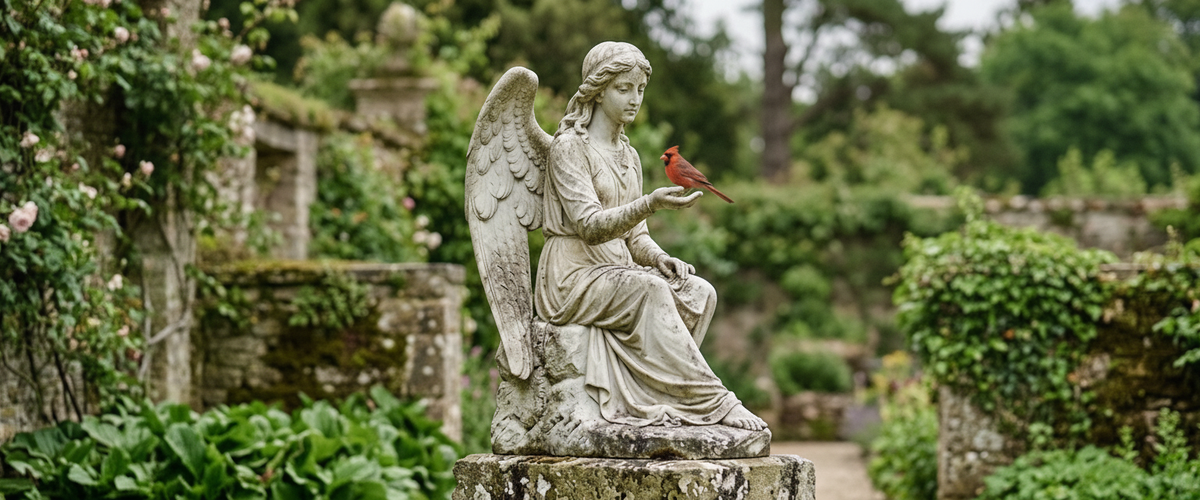

The cardinal is the one bird families ask for by name. Doves come up, hummingbirds occasionally, but the brief that keeps landing in our studio inbox is an angel cardinal garden statue: a carved figure with a single red bird perched on an open hand, a shoulder, or the corner of the plinth. It is nearly always for someone specific. The request usually arrives with a story attached, which is why the details on an angel cardinal garden statue matter more than they do on any decorative garden piece.

At a Glance
The cardinal reads as a messenger largely because it stays put. Northern cardinals are year-round residents across much of the eastern and central US, so they show up against snow when nothing else does.
Bird position changes the meaning: cupped hand reads as offering, shoulder reads as companionship, plinth reads as arrival.
Site the piece on the sight line you already use daily, not in the border that photographs best.
Judge materials on one question: will the bird on your angel cardinal garden statue still have crisp feathers in year five?
Mineral iron oxide reds outlast bright organic reds by years. Ask what pigment system is being used.
A dark evergreen hedge does more for the red than any lantern.
Keep inscriptions short and carved into the plinth face rather than applied as a plaque.
Where the Cardinal-as-Messenger Motif Came From
The symbolism is folk, not classical. Angel memorial sculpture has a long documented tradition in Victorian cemetery art, but the red bird is a North American addition, and a recent one, which makes the angel cardinal garden statue a modern hybrid rather than an inherited form. It stuck because of the bird's behavior: the northern cardinal does not migrate and holds territory through winter, per the Cornell Lab of Ornithology. A family grieving in February sees a flash of red on a bare branch. The association writes itself.
That matters commercially because the motif has no fixed iconography to copy. There is no canonical pose, which means almost every angel with cardinal memorial garden statue we produce is a variation rather than a catalog repeat. You are effectively designing the meaning, so decide what you want the piece to say before you decide how tall it should be.

Hand, Shoulder or Plinth: Three Positions, Three Readings
For wider placement ideas, How a Bronze Garden Statue Ages, Year by Year is useful companion reading before finalizing the setting and sightlines.
Three positions dominate the angel cardinal garden statue brief, and each one says something different before a single word is carved.
In the cupped hand or lap. The most legible option. A seated or kneeling angel holding the bird low reads as receiving something, and it puts the red at a height you actually see from a bench. Seated forms such as the Angel Resting on a Heart Marble Memorial Statue - 170cm are the base shape families most often ask us to adapt, with the heart motif swapped for a bird in the open palm.
The cupped-hand composition keeps the bird at seated eye level, where the red still registers from a bench.
On the shoulder. The intimate reading, a message being delivered close to the ear. It is also the hardest to carve. A bird sitting clear of the shoulder in marble needs undercutting with almost no supporting mass behind it, so the honest answer is often cast bronze, where a bird can project without a stone bridge holding it up.
On the plinth or base. The bird as visitor rather than possession, and the most durable way to build an angel cardinal garden statue. This keeps the angel's silhouette classical and puts the fragile element at knee height where a mower is the only real threat. Where you want that separation, a tall-plinth composition like the Grieving Angel on a Tall Plinth Marble Memorial at 130cm (4 ft 3 in) leaves a broad plinth face free for both the bird and the lettering.
Siting an Angel Cardinal Garden Statue: The Kitchen Window Test
Stand where you stand every morning. Sink, breakfast table, back door. That is the sight line the piece has to earn, because a memorial you have to walk out to visit gets visited less than one you glance at with coffee in hand.
We shipped an angel cardinal garden statue to a family in Napa who set theirs at the far end of the lawn, where the planting looked tidiest. They moved it twice. It ended up around 26 feet (8 m) from the breakfast room, slightly off axis so it did not read as a bullseye, with the angel turned about fifteen degrees toward the house. Same sculpture, completely different piece. Before pouring a footing, mock the position with a stack of crates at the right height and live with it for a week.

Cast Stone, Resin and Bronze Judged on One Thing
Forget the material debate in the abstract. On an angel cardinal garden statue, ask one question: will the bird still have feathers in year five?
Resin and composite: the pigment usually lives in a thin surface layer, and a small projecting bird is the first casualty of UV chalking and freeze-thaw. Light weight is also a liability; a garden piece that a leaf blower can shift is a piece that will eventually meet the flagstones.
Cast stone: weathers attractively across broad forms, but fine feather detail softens. Wingtips and beaks are where water sits and ice works. It suits a bird carved close to the body, not one held out on an open palm.
Hand-carved marble: dense, cold-tolerant, and capable of holding carved detail for decades in a temperate garden. Wing and drapery undercuts need designing with support in mind, which is a conversation to have with the carver rather than after delivery.
Bronze: the right answer for any bird sitting clear of the figure, and the most forgiving material over the long life of an angel cardinal garden statue. Cast bronze takes fine feather chasing and can be repatinated rather than replaced, which is why bronze angel and cherub statues are worth comparing against molded alternatives before you settle on a shoulder-mounted bird.
Red Fades First
Every angel cardinal garden statue has the same weak point, and it is rarely the stone. It is the color. Bright organic reds look correct on delivery and then drift pink, then gray. Mineral iron oxide reds sit duller in the studio and hold for years longer outdoors; the pigment reference database CAMEO, maintained by the Museum of Fine Arts Boston, records iron oxide reds as highly lightfast.
In bronze, you have two routes: a hot patina in the red-brown family, which ages honestly and quietly, or a cold-applied color for a truer cardinal red, which will need refreshing at intervals. Neither is wrong. What matters is that you know which one you bought. Ask any supplier, including us, to name the pigment or patina system on your angel cardinal garden statue and tell you the realistic touch-up interval.
Backdrop and Light Do More Than a Lantern
Red only reads against something dark, so set an angel cardinal garden statue where the background works for it. Yew, holly, hemlock, or a weathered Corten panel will carry a small red bird from 40 feet (12 m) away. Pale gravel, white render, and blond limestone walls swallow it whole. If your only available backdrop is light-colored, move the bird to the plinth where a shadowed recess can do the work.
A dark evergreen backdrop and low morning sun do more for the bird than any spotlight.
Skip the temptation to spotlight the bird. Uplighting a small red element flattens it and throws odd shadows through the wings. Graze the light across the angel's drapery instead and let daylight handle the cardinal. East-facing placement gives you low morning sun on the red, which happens to be when most people are looking.
Names, Dates and Short Inscriptions
On a one-off angel cardinal garden statue built as a memorial, restraint wins. A name, two dates, and one short line is usually the limit before a plinth starts reading like a headstone. Carved V-cut lettering into the plinth face outlives applied bronze plaques, which loosen at their fixings and stain the stone below. Size the letters so they can be read standing at the plinth without leaning in.
Scale changes that calculation. On a long estate walk, a figure in the register of the Standing Angel With Open Arms Marble Garden Statue - 220cm holds the far end of the axis, and the inscription becomes something you discover on approach rather than read from the house.

Before You Commission, Run This List
Photograph the spot where the angel cardinal garden statue will stand, from your daily window, morning and late afternoon.
Choose the bird position first, then the figure, then the height.
Confirm the backdrop is darker than the bird.
Ask which material carries the bird clear of the body without a support bridge.
Get the pigment or patina system named in writing, plus the maintenance interval.
Specify the footing: frost depth, drainage, and a level bearing pad under the plinth.
Agree the inscription layout on a full-size paper proof before carving starts.
Plan access for delivery. Marble and bronze at this scale need a clear route and often mechanical lifting.
Budget on a bespoke angel cardinal garden statue depends on material, finished scale, carving complexity, engineering and fixing, installation access, and finishing, so the sensible next step is a tailored quote rather than a guess. Work through our angel statues and sculptures to find a base form close to what you want, then tell us where the bird should sit. Most of the angel cardinal garden statue work we take on starts exactly there.