





































































































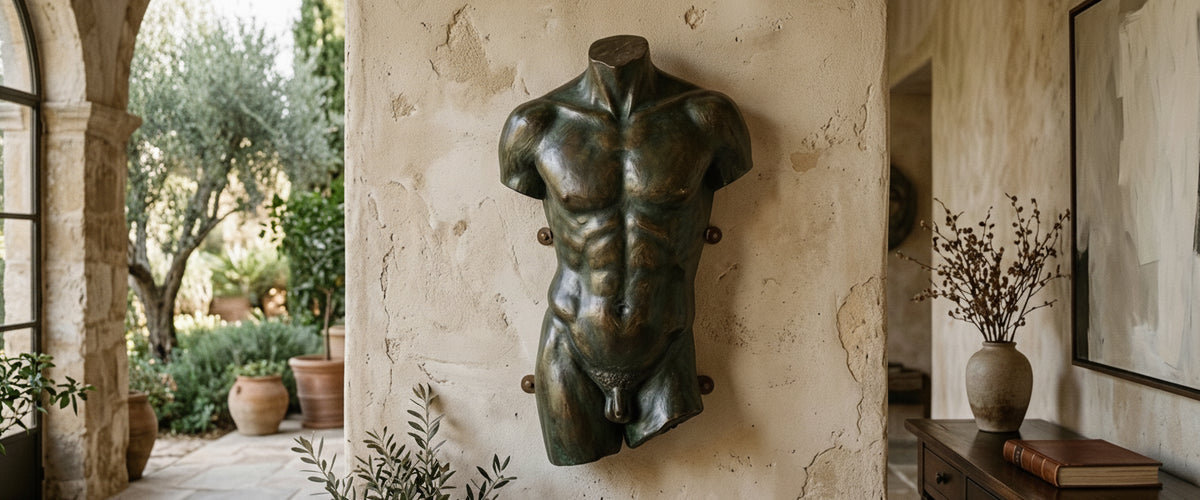

A blank wall in a double-height entrance hall is a problem most framed prints cannot solve. Paper flattens against the plaster and disappears. Bronze framed wall art does the opposite: it catches raking light, throws a soft shadow, and gives a room a physical center of gravity. That weight, both literal and visual, is exactly why buyers reach for cast metal instead of canvas when a wall has to carry a serious design brief.
Below is how we think about these pieces at Giant Sculptures, from finish and scale through to placement and bespoke commissioning.

Key Takeaways Before You Buy
- Bronze framed wall art means a relief, panel, or figural piece cast or worked in bronze, mounted to read as art on a vertical surface.
- Finish drives the mood: a warm polished bronze reads classical, an antique patina reads collected and old-world.
- Scale is the most common mistake. Small pieces get lost on big walls; go larger than instinct suggests.
- Weight matters. Real bronze needs fixings rated for the load and, often, a mount into stud or masonry rather than plaster alone.
- Budget depends on material, size, relief depth, finishing, and whether the work is bespoke. Ask for a tailored quote rather than assuming a figure.

What Bronze Framed Wall Art Means and Who It Is For
The category is broader than most buyers expect. At one end you have figural reliefs and animal heads that project several inches off the wall; at the other, circular and geometric metal panels that behave more like sculpture hung flat. What unites them is the material story. Bronze has depth of color that print and powder-coated steel cannot fake, and it ages into a surface that looks better in ten years than on day one.
This suits a specific kind of buyer. Interior designers specifying a hospitality lobby, collectors who want something that reads as an object rather than a picture, and homeowners furnishing a large modern house all land here for the same reason: they need a wall to hold its own against real architecture. If your wall is small and your ceilings are standard height, a lighter piece of metal wall art may serve you better and cost less to hang.

How to Compare Bronze Framed Wall Art Options Before Buying
Start with the honest question of what the piece is made from. A lot of "bronze" online is bronze-effect resin or a thin coating over a lightweight core. Both have their place, but they behave differently over time and under sunlight. Genuine cast bronze is an alloy of copper and tin, prized for centuries because it holds fine detail and resists corrosion; the Tate's material glossary is a clear reference if you want to understand what you are actually paying for.
Once material is settled, compare on four practical points:
- Relief depth. How far does the piece stand off the wall? Deeper relief means stronger shadow and more drama, but also more projection into the room, which matters in a hallway.
- Finish and patina. Polished, brushed, or antiqued. This is the single biggest driver of mood.
- Mounting system. Concealed cleat, threaded studs, or a visible frame. A good supplier tells you the fixing method before you buy.
- Weight per square foot. This decides your wall preparation and whether you need a professional installer.
Where you want that projection and shadow to do the heavy lifting, a figural piece such as the Classical Figural Torso Wall Sconce Bronze Sculpture - 90cm reads very differently from a flat panel: it stands off the wall, catches side light, and holds a room the way a picture cannot.

Materials, Finishes, and Scale Decisions
Bronze wall art metal finishes fall into two camps, and choosing between them is really a decision about the room's story.
Warm polished and satin bronze leans classical and confident. It works in stone lobbies, gallery walls, and rooms where you want the metal to feel deliberate and new. Antique bronze wall art takes the opposite view: a darker, mottled patina that suggests the piece has history, even when it is freshly made. Antique finishes forgive fingerprints and dust far better, which is why they suit high-traffic commercial spaces.
Where the setting needs a contemporary reflection rather than classical weight, the Orbitra Bronze Reflective Circular 3D Wall Art is closer to the right design language: it bounces light around a room and reads as sculpture and mirror at once, which suits architecture where a figural relief would feel too traditional.
On scale, the rule we repeat most often in the studio: measure the wall, then go bigger than the number in your head. A 70cm animal head that looked bold on screen can vanish on a 12-foot (3.7 m) wall. As a rough starting point, a single feature piece should fill roughly two-thirds of the visual width of the wall zone it anchors. For very large architectural walls, a bespoke commission is usually the only way to get the right proportion, because stock sizes top out before the wall does.
Where to Place Bronze Framed Wall Art for the Strongest Impact
For wider placement ideas, 3d Wall Art Decor That Actually Reads From Across the Room is useful companion reading before finalising the setting and sightlines.
Placement is where good pieces either sing or sulk. A few situations we see repeatedly:
- Entrance halls and stairwells. Raking light from a high window turns relief into a moving surface through the day. For an equestrian property, an animal relief such as the Traditional Horse Head Bronze Relief - 80cm earns a stairwell wall where a flat print would read as an afterthought.
- Above a console or fireplace. Hang so the visual center sits at roughly eye level for a standing viewer, then adjust up slightly if the piece will mostly be seen from a seated lounge.
- Feature and accent walls. Set the piece against a mid-tone or dark wall. Bronze on brilliant white can look thin; bronze on charcoal, deep green, or stone reads far richer.
- Commercial receptions. Here the piece needs to survive being looked at close-up all day. Antique patina and a concealed, tamper-resistant fixing are worth specifying.
Lighting is the quiet multiplier. A single directional spot angled across the surface at roughly 30 degrees will do more for a bronze relief than doubling its size. Flat, head-on light kills the shadow that makes the metal worth buying.
Budget, Commissioning, and Delivery
There is no single price for bronze framed wall art, and any site quoting one flat figure is usually selling you a coating rather than the metal. Real cost tracks with material weight, physical size, relief complexity, the finishing and patina work, and whether the piece is stock or bespoke. A deep figural relief with hand-applied patina takes far more foundry time than a simple flat panel, and that time is most of the cost. The practical move is to send your wall dimensions and a reference image and ask for a tailored quote.
Delivery deserves early thought because these pieces are heavy and shipped worldwide. We crate bronze wall work for freight rather than parcel post, and for larger commissions we advise buyers to confirm access, wall construction, and fixing points before the piece leaves the studio. A relief that weighs 40 to 80 pounds (18 to 36 kg) is not going onto a single plasterboard anchor, and finding that out on installation day is the expensive way to learn it.
How Giant Sculptures Helps With Bespoke Projects
Most of our interesting bronze wall work starts as a conversation about a specific wall that stock sizes will not fit. We have shipped commissioned reliefs to hospitality clients who needed a matched pair scaled to a particular archway, and the process is the same each time: reference images, a scale study against your architecture, material and patina samples, then casting and finishing.
If you want a darker, collected look, our bronze wall art range shows the antique and figural directions side by side, and the broader bronze sculptures collection is worth browsing if you are open to a freestanding piece as an alternative anchor. For anything genuinely large-scale, a bespoke commission is where bronze framed wall art stops being decoration and starts being architecture.
Send us the wall, the light, and the mood you are chasing. We will tell you honestly whether a stock piece fits or whether the wall is asking for something made for it.