





































































































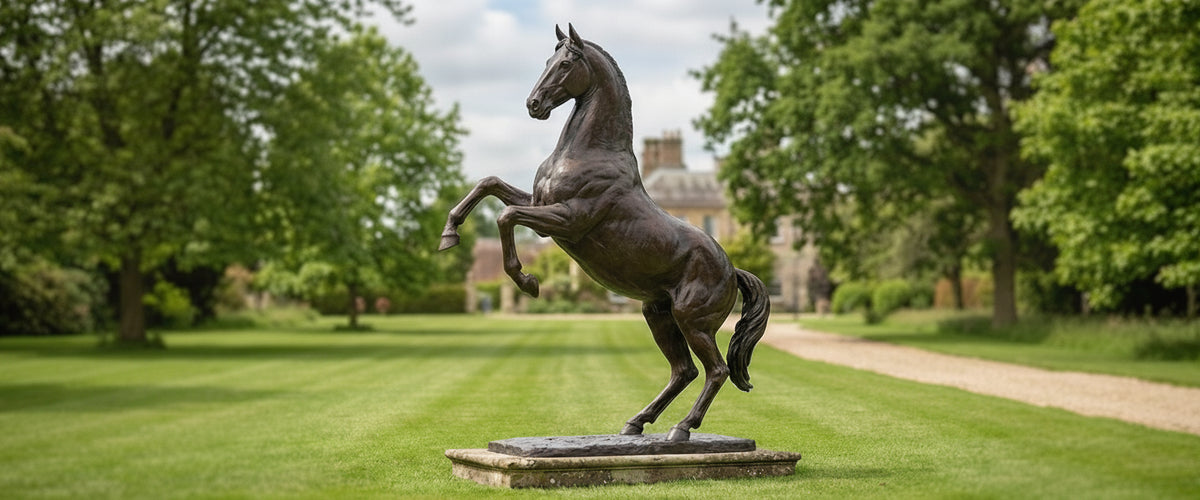

A rearing bronze horse sculpture claims about twice the ground it physically stands on, and almost nobody budgets for that. The hooves may sit inside a four-foot square, but the animal reads as a fifteen-foot event: the raised forelegs pull your eye up, the tail sweeps back, and any planting or wall within a few strides suddenly looks crowded. Pose, not size on a spec sheet, is what determines where a horse can live. Get that right and the rest of the decision (metal thickness, patina, plinth, anchoring) follows logically.

Key Takeaways
Pose decides placement. Settle on the bronze horse sculpture pose that suits your site before you lock in a height.
Rearing figures need air. Allow visual clearance on all sides, not just physical clearance for the base.
Trotting and galloping horses need a viewing run so the eye can travel with the movement. Drives, lawn edges and long approaches suit them; tight courtyards fight them.
A grazing or walking horse is the hardest pose to place badly and the best choice for a busy garden.
Racehorse proportions and heavy horse mass are two different animals. One is line and tension, the other is volume and weight.
Dynamic poses cost more in engineering because load travels through fewer contact points. Budget depends on scale, wall thickness, armature, finish and installation, so ask for a tailored quote.
The Rearing Horse: Drama You Have to Give Space To
Rearing is the pose clients fall for on a screen and then struggle to site. It is a vertical composition, so it belongs where the sky is the backdrop: the crown of a lawn, the end of a gravel sweep, a terrace edge that drops away. Put one against a wall and the silhouette dies. We shipped a rearing commission to a Napa property where the original plan was a walled entry court; the owner moved it fifty feet onto open turf after seeing the mockup, and it became the piece you see from the road.
There is a structural consequence too. A rearing horse throws most of its mass forward and up, carried by two hind legs and often the tail. In our studio the tail is frequently modeled as a hidden third point of contact into the base, or a rock or drapery form is worked into the composition. That is engineering disguised as art, and it is one of the reasons a rearing bronze horse sculpture is rarely a stock-thickness casting.

Trotting and Galloping Figures Need a Viewing Run
Movement wants distance. A trotting or galloping bronze horse sculpture reads properly when you can see it from thirty or forty feet and then walk past it, because the pose implies travel and your eye wants somewhere to send the animal. Drives, long borders, paddock fences, the approach to a clubhouse or a hotel forecourt all give that run. A small enclosed courtyard does the opposite: the horse looks like it is about to hit the wall.
Multi-figure groups amplify the effect. A composition on the scale of the Monumental Traditional Galloping Racehorses and Jockeys Bronze Sculpture - 260cm (roughly 8 ft 6 in) has to be read across its whole length, so orientation matters as much as position: set the leading horse away from the main sightline and you spend years looking at the group's back. We normally ask clients for a photo from their front gate, their kitchen window and their most-used seating spot before signing off on a direction.
The Grazing Horse Is the Quiet One
A grazing or slow-walking bronze horse sculpture behaves well almost anywhere. The head is low, the outline is horizontal, and the piece settles into planting instead of competing with it. That makes it the right answer for gardens that already have strong architecture, mature trees or a pool. Where a site is busy rather than open, a calm figure such as the Large Traditional Walking Arabian Horse Bronze Sculpture - 170cm (about 5 ft 7 in) sits comfortably at the end of a hedge run or beside a lawn edge, in a spot where a rearing figure would shout. It is also the friendliest pose for close viewing, since nothing about it depends on standing back.
Racehorse Proportions Against Heavy Horse Mass
Two horses at identical heights can feel wildly different in a space. A thoroughbred or bronze race horse sculpture is built on line: long cannon bones, deep girth, a light frame with visible tension. It reads elegant and quick, and it suits polished settings, equestrian estates, racing venues and modern architecture. A draft or heavy horse is volume. Broad chest, feathered legs, low center of gravity. It reads agricultural, grounded and calm, and it holds its own next to barns, stone walls and rougher landscape. Height alone will never tell you how a bronze horse sculpture will sit on your site; breed and build do.
Add a rider and the register changes again. Where the brief calls for narrative rather than a purely animal subject, a mounted work like the traditional racehorse and jockey at 260cm is closer to the right language, which is why that treatment works at gates, on club grounds and in commemorative settings. Seen side by side across the wider bronze horse statues range, the difference in visual weight between breeds becomes obvious quickly.

Legs, Armature and the Plinth Your Pose Forces on You
Every pose in a bronze horse sculpture dictates its own base. Four hooves down spreads load and allows a low, discreet plinth. Two hooves down concentrates it, so you need a deeper footing, a larger internal stainless armature and anchor points sized for wind loading as well as dead weight. Lost-wax casting lets a foundry vary wall thickness where stress concentrates, which is exactly why hand-finished bronze outperforms a uniform-shell cast for dynamic work; the National Sculpture Society publishes useful background on traditional casting practice for anyone new to the process.
Plinth height is an aesthetic decision as well as a structural one. Raise a galloping horse too far and the legs float; raise a rearing horse and it becomes monumental. On sloping sites we usually recommend leveling the plinth to the horizon rather than the ground, because a horse tilted two degrees looks wrong even when nobody can say why.
Patina by Pose
Dark chocolate and near-black patinas suit rearing and galloping figures, because those poses live as a silhouette against sky and a deep tone keeps the outline crisp. Warmer mid-browns, chestnuts and lightly highlighted finishes belong on standing, walking and grazing horses, where raking light travels across the barrel and shoulder and you want that modeling to show. Greened or verdigris-accented patinas can read beautifully in woodland but flatten detail on busy musculature.
Patina is chemistry, not paint, and it keeps moving outdoors. Coastal air, irrigation spray and acid rainfall all shift it. Conservation guidance from institutions such as the Getty Conservation Institute is worth reading if you want to understand why protective wax layers matter more than aggressive cleaning.
Five Winters In: What Movement-Heavy Castings Need
Static poses age slowly and predictably. Dynamic ones have more extremities, more welded seams and more places for water to sit, so a movement-heavy bronze horse sculpture carries a longer care list.
Check drainage holes annually. Raised hooves, tail tips and manes trap water; blocked weep holes are the single most common problem we see.
Re-wax high-exposure areas more often. Backs, croups and upward-facing surfaces lose protective wax fastest.
Inspect anchor bolts after freeze-thaw seasons. Movement-heavy pieces transmit more wind load into the fixings.
Rinse before winter. Salt, fertilizer and pool chemistry are more damaging than rain.
Keep irrigation heads pointed away. Repeated hard water spray leaves mineral streaks that are tedious to remove.
Photograph the patina each spring so you can spot slow change rather than react to sudden change.

Commissioning a Bespoke Bronze Horse Sculpture
If nothing in the catalog matches your breed, pose or site, a bespoke bronze horse sculpture solves it. Send us the site photos, the viewing distances, the height you have in mind and any reference imagery for the horse itself. From there we work through clay or digital maquette, agree wall thickness and armature for the pose, then set patina samples against a photo of your actual setting rather than a studio wall. Giant Sculptures builds large-scale and bespoke work for private gardens, estates, equestrian venues and civic sites, and the same conversation covers crating, freight and installation so nothing surprises you at delivery. If you are still comparing directions, the bronze animal sculptures and bronze garden statues collections are a good place to test what scale actually feels right.
For wider placement ideas, Contemporary Bronze Sculpture: How Placement Decides Whether It Reads is useful companion reading before finalising the setting and sightlines.