






































































































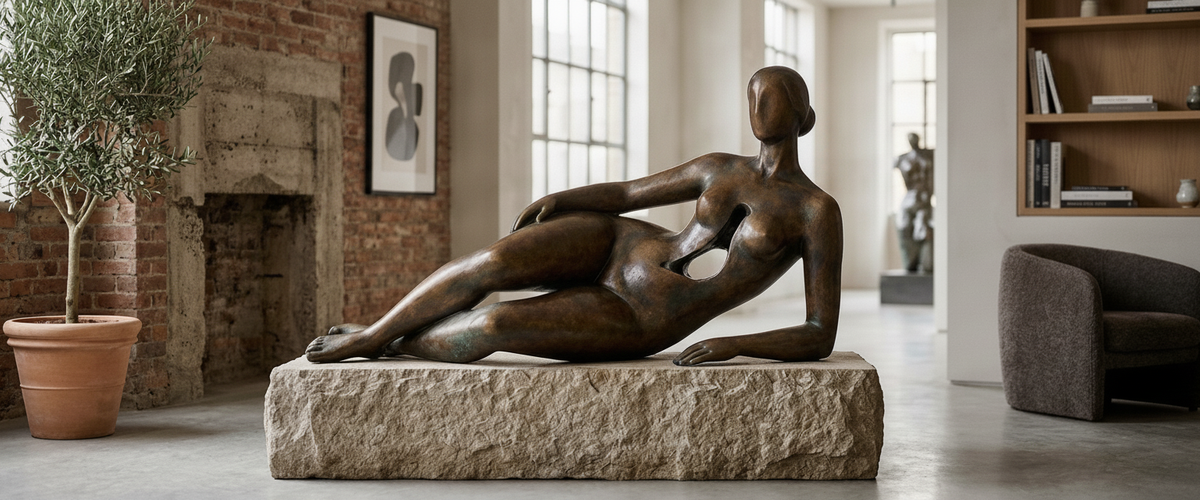

Put a life-size bronze figure at the end of a hallway and it will look back at you. Put an abstract form in the same spot and it will wait for you to walk around it. That difference settles more figurative vs abstract sculpture decisions than style ever does, and it is the one buyers think about least.
Figurative sculpture represents a recognizable body, animal or face. Abstract sculpture works with mass, line, void and surface, and may reference nothing real at all. Between the two sits a wide band of figurative abstract sculpture, where a human form is simplified, stretched or opened up but still reads as a person. Many of the bespoke pieces clients commission from our studio sit somewhere in that band.

At a glance:
Figures want a fixed viewpoint, eye-level placement and a clear approach path.
Abstracts want open floor, access from every side and light that changes through the day.
Material tips the balance: clay and bronze pull toward the body; stainless steel and Corten pull toward pure form.
Longevity: a partly abstracted figure tends to keep attention longest in a space people pass daily.
Briefing: tell your sculptor which feature must survive the abstraction before you discuss style.
Figurative vs Abstract Sculpture: A Face to Meet or a Form to Circle
A figure has a front. Even a twisting or seated pose has one angle where the head, shoulders and weight all resolve, and the sculptor built the piece around that view. Stand there and the work talks to you directly. Walk behind it and you get the back of someone, which is rarely the point.
Abstract work usually has no front. Its value comes from what shifts as you move: a curve closing into a void, a polished plane catching a window, an edge turning thin as a blade. In a figurative vs abstract sculpture decision, the first question is not which you like more. It is whether the space lets people stand still or makes them keep walking.
One piece meets you head-on; the other asks you to walk around it.
How Much Can an Abstract Human Figure Sculpture Lose?
More than most people expect. An abstract human figure sculpture can drop the face, the hands and most of the anatomy and still hold a gaze, as long as two things survive: the tilt of the head and the line of the spine. Those carry mood. Lose them and the piece slides into pure form.
A figure that swaps the face entirely for a bloom, such as the Blue Abstract Female Figure with Floral Head Sculpture - 145cm at roughly 4 ft 9 in (145 cm), is never misread as anything but a woman, because posture does the identifying. That is the trick most good abstract figure art sculpture relies on.
Push further and you get the torso alone, where scale has to carry the presence that a face would otherwise supply. The Henry Moore Foundation archive is worth an hour if you want to see how far this can go: reclining figures pierced with holes, limbs merged into something closer to hills, and still unmistakably a body at rest.

Clay and Bronze Lean Figurative, Steel Leans Abstract
Material quietly settles much of the figurative vs abstract sculpture question for you. Clay is modeled by hand, so even a heavily simplified clay abstract figure sculpture keeps thumb marks and soft transitions, the evidence of a body shaping a body. Cast that clay in bronze and the warmth carries through, which is why bronze remains the default for figures and why our bronze abstract sculptures still tend to feel organic rather than geometric.
Stainless steel is fabricated from sheet and welded, so it wants planes, crisp edges and reflection. Corten weathers into a rust skin that suits monoliths and slabs. Stone, marble included, is carved, a subtractive process that favors compact, closed forms; the work collected at The Hepworth Wakefield shows how carving and piercing can sit right on the line between figure and pure shape. If you want a figure, think twice before specifying mirror-polished steel. If you want pure abstraction, clay-modeled bronze may keep dragging it back toward anatomy.
Sightlines, Floor Space and Moving Light
Figures read best when the head sits near eye level, around 5 ft to 5 ft 6 in (1.5 to 1.7 m) for a standing viewer, so plinth height matters as much as the piece itself. Give them a clear approach: the end of a corridor, the far side of a lobby, a garden path in Napa that turns toward them. Once a piece reaches well above head height, the plinth question disappears; a wall-backed form on the scale of the White Abstract Female Torso Sculpture - 220cm, about 7 ft 3 in (220 cm), holds a lobby or double-height hall on size alone and needs only a long, uninterrupted approach.
Abstracts want space to circle, ideally at least 3 ft (about 1 m) clear on every side, and light that moves. A skylit atrium in Manhattan or a terrace in Aspen with low winter sun will give one abstract piece a dozen faces in a day. For a console or library shelf, a compact piece such as the Brown Abstract Figure on Stone-Look Base Sculpture - 54cm, about 21 in (54 cm), lets you live with the language at close range before committing to a large commission.
Open floor and moving daylight give an abstracted form a new face through the day.
Year Five in the Same Hallway
Here is the pattern we keep seeing. A fully literal bronze figure in an entry hall gets answered on day one: you know who it is and what it is doing, and within a few years the people who live with it stop seeing it. A purely geometric steel piece in the same spot often goes the same way and becomes furniture. The pieces people still stop for in year five tend to be half-abstracted figures that leave a question open: is that a hand or a fold of fabric? Ambiguity rewards a second look. Total literalness and total abstraction both get answered quickly. That, more than taste, is the real figurative vs abstract sculpture test.

Choosing Between Figurative and Abstract: Decision Criteria
Viewing distance: under 10 ft (3 m) favors detail and texture; long approaches favor bold silhouettes.
Traffic: spaces people pass daily reward partial abstraction.
Light: fixed lighting suits figures; changing daylight suits abstract surfaces.
Access: against a wall, choose a figure; free-standing in open floor, consider abstract.
Material and exposure: outdoors, prefer bronze, stainless steel, Corten or stone engineered for the site.
Briefing a Sculptor on How Far to Push
Every figurative vs abstract sculpture brief can start with a simple scale: 1 is a portrait, 5 is pure form. Name your number, then name the one thing that must survive at that number, whether the gaze, the gesture or the silhouette. Ask for a clay maquette before fabrication; abstraction that looks right in a drawing often feels cold or confused in three dimensions.
Look through our figurative sculptures and abstract sculptures side by side and save the pieces closest to your number. Budget for a bespoke commission depends on material, scale, complexity, engineering, installation and finishing, so send Giant Sculptures your site photos and references and we will prepare a tailored quote.
For wider placement ideas, 3d Abstract Wall Art Is Judged From the Doorway: Where to Hang It is useful companion reading before finalising the setting and sightlines.