





































































































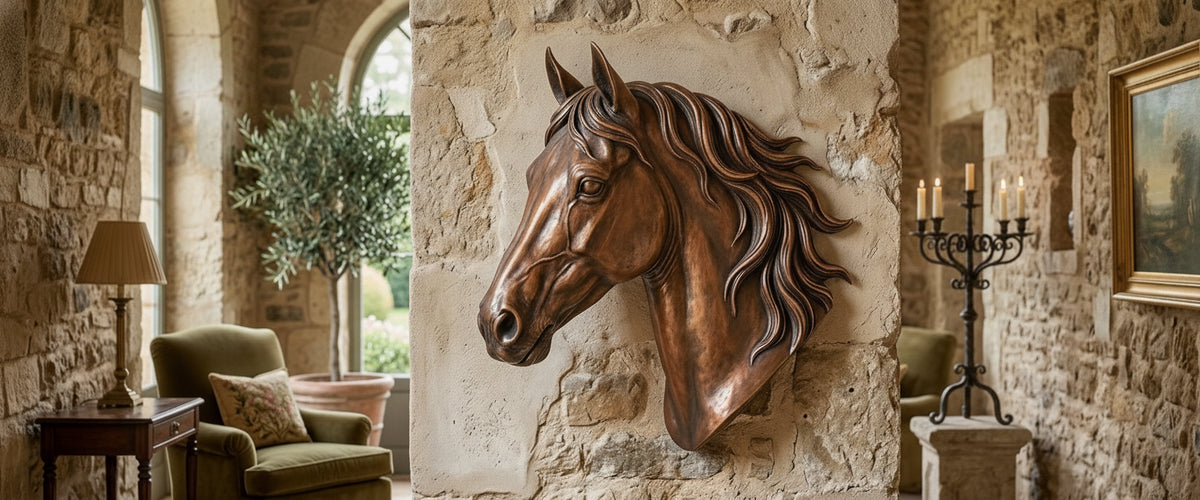

A flat print fades into a wall. A cast relief in copper bronze does the opposite; it catches raking light, throws shadow across its own surface, and reads differently at breakfast than it does at dinner. That living quality is why serious buyers keep coming back to copper bronze wall art instead of settling for framed canvas or a mass-produced metal panel. The material has real depth, and depth is what stops a large wall from looking empty.
The problem is that "bronze wall art" covers everything from a thin brushed-metal disc to a solid cast relief with genuine patina. The two are not remotely the same purchase, and the price gap reflects that. Knowing what you are actually looking at is half the battle.

Copper Bronze Wall Art at a Glance
- Best for: large blank walls, entrance halls, stairwell voids, restaurant and hotel interiors, and covered outdoor spaces.
- Core appeal: real surface relief and a warm copper-to-bronze color range that changes with the light.
- Finish options: polished, brushed, oxidized antique patina, and reflective 3D metalwork.
- Watch for: the difference between solid cast bronze and thin bronze-effect metal or coated composite.
- Scale rule of thumb: a feature piece should fill roughly two-thirds of the visual wall width.
- Budget driver: material, size, casting complexity, finishing, and fixings, not the frame.

What Copper Bronze Wall Art Means, and Who It Is For
Bronze is a copper alloy, so the copper and bronze conversation is really about ratio and finish rather than two separate metals. A high-copper surface reads warmer and redder; a traditional bronze reads browner and, once patinated, greener in the recesses. Both live under the umbrella of bronze metal wall art, and both suit buyers who want a wall piece with mass and permanence rather than something disposable.
This is the right category for you if you are furnishing a double-height space that swallows small art, styling a hospitality interior that needs to survive years of foot traffic, or replacing a print that never quite held its own. Interior designers reach for it when a room has good architecture but a dead wall. Collectors like it because a cast bronze relief behaves like sculpture, which is exactly how we treat it at Giant Sculptures.

How to Compare Copper Bronze Wall Art Options Before Buying
Start with what the piece is actually made of. True cast bronze wall art has weight you can feel and edges that hold crisp detail; bronze-effect pieces are usually thin sheet or coated composite that mimics the color without the mass. Neither is wrong, but you should know which one you are paying for, and you should ask the seller directly.
Then look at the relief. A shallow, stamped surface stays flat under most lighting. A deep cast relief, like a horse or bull head that projects several inches off the wall, creates its own shadow line and reads as a three-dimensional object. Where you want that projection to do the work of a mounted sculpture rather than a picture, a piece such as the Traditional Horse Head Bronze Relief, 80cm reads convincingly as an object from across a room rather than as flat decoration.
Finally, judge the finish honestly under the light you will actually use. A polished copper surface glows in warm evening light but can throw glare under bright downlights. A matte antique patina is far more forgiving and hides fingerprints, which matters in a busy hallway.
Quick comparison checklist
- Construction: solid cast bronze vs. sheet metal vs. coated composite.
- Relief depth: flat panel, mid relief, or high projecting relief.
- Finish: polished, brushed, or oxidized antique patina.
- Fixing system: concealed cleat, threaded studs, or surface brackets.
- Weight: confirm the hanging weight so your wall build can take it.
- Indoor or outdoor rated: ask whether the patina is sealed for exterior use.

Key Materials, Finishes, and Scale Decisions
The color you are chasing usually decides the finish. For a warm, reddish glow you want a high-copper alloy or a copper-toned patina. For a classic, gallery-quiet look, an antique bronze wall art finish with dark recesses and lighter raised edges reads timeless and settles into almost any palette. Patina is not just decoration; on bronze it is a stable surface layer, and a well-applied one protects the metal underneath. Conservation teams treat these surfaces as part of the object's history rather than a coating to be stripped, which is worth remembering before anyone "cleans" a piece too aggressively (see the Smithsonian's guidance on caring for metal objects).
Reflective circular metalwork sits at the other end of the spectrum. Where the setting needs movement and a contemporary reflection rather than heavy figurative weight, the Orbitra Bronze Reflective Circular 3D Wall Art is closer to the right design language, using bronze tone plus a 3D reflective surface to bounce light around a room. Figurative buyers, on the other hand, tend toward heads, torsos, and classical motifs.
Scale is where most buyers go wrong. People measure the piece and forget to measure the wall. On a tall stairwell, a 24-inch (61 cm) relief disappears; you want something closer to 3 feet (about 90 cm) or a grouping. For a large wall that needs a single dramatic anchor rather than a cluster, a full-height piece such as the Classical Figural Torso Wall Sconce Bronze Sculpture, 90cm carries the space on its own, whereas smaller reliefs work best grouped together. When in doubt, size up. We have never had a client tell us a bronze wall piece arrived too large; we have had several wish they had gone bigger.
Where to Place Copper Bronze Wall Art for the Strongest Visual Impact
For wider placement ideas, Wood Wall Art Decor: A Buyer's Guide to Scale, Finish, and Placement is useful companion reading before finalising the setting and sightlines.
Light is the single biggest factor. Bronze relief needs a light source coming from the side or above at an angle so the surface casts shadow into its own recesses. Flat, head-on lighting flattens the detail and wastes the material. Aim a picture light or a directional spot across the face of the piece rather than straight at it.
Entrance halls and stairwells are the natural home for a statement bronze because you approach them and pass under them, so the relief keeps revealing new angles. In dining rooms, a copper-toned surface warms the whole space once the pendant lights come on. Above a fireplace, keep the piece clear of direct heat and rising soot, and mind the sightline; the visual center should land near eye level for a standing viewer, not tucked up under the ceiling.
Copper bronze wall art also works outdoors, which sets it apart from paper or fabric wall art. On a covered terrace or a loggia, a sealed bronze relief handles the elements far better than most media. If a piece will live fully exposed to weather, ask us to confirm the patina is stabilized and sealed for exterior conditions, and expect the surface to develop character over the years rather than stay frozen.
Budget, Commissioning, and Delivery Considerations
There is no honest flat price for copper bronze wall art, and any seller quoting one number for "a bronze relief" is glossing over what drives cost. The real variables are alloy and material volume, overall size, casting and finishing complexity, the patina process, and the fixing and crating needed to ship a heavy object safely. A deep, detailed cast the size of a door reads very differently on a quote than a light reflective disc, even if both are described as bronze wall art.
For that reason we work to a commission quote rather than a fixed catalog figure on bespoke work. Tell us the wall dimensions, the ceiling height, the light conditions, and whether the location is indoor or exterior, and we can advise on scale and finish before anything is cast. If you want a matched pair, or a single piece scaled to a specific void, that is a bespoke commission and we build it to your wall rather than the other way around.
On delivery: bronze is heavy, and heavy objects need proper crating and, for larger pieces, planned installation. Confirm the hanging weight early so your contractor can specify the right fixings and, where needed, a backing batten or blocking in the wall. We would rather have that conversation before a piece leaves the studio than after it arrives.
How Giant Sculptures Can Help With Bespoke Projects
We are a bespoke sculpture supplier that ships worldwide, and wall pieces are part of that work, not an afterthought. That means we can scale an existing design up, adjust a patina toward copper or toward a darker antique bronze wall art finish, or cast a new relief from a brief. If you prefer to browse first, the Bronze Wall Art collection is the best starting point, and the wider Metal Wall Art range shows how bronze sits next to other finishes.
One recent lesson worth passing on: a client wanted a single figurative relief for a stairwell but had not accounted for how the piece would read from the landing above, looking down. We turned the composition and adjusted the projection so the relief still worked from that steep angle. Details like viewing height and approach path rarely show up in a product photo, and they are exactly the things a bespoke maker should ask about. If you have a specific wall in mind, send us the measurements and the lighting, and we will tell you honestly what will hold that space.