





































































































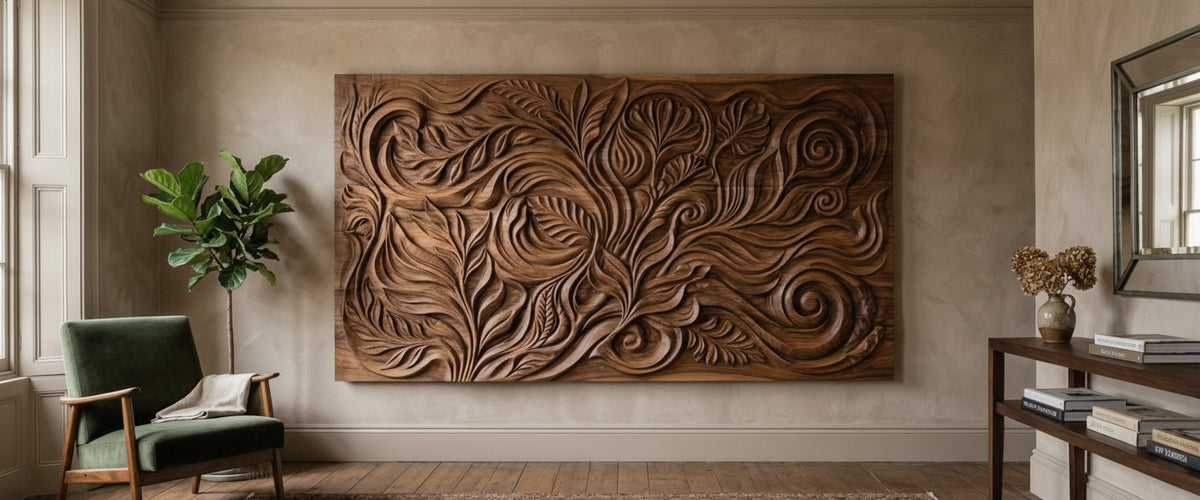

Most wood wall art decor fails for one boring reason: it is too small for the wall it hangs on. A single carved panel that looks generous in a showroom shrinks to a postage stamp above a ten-foot sofa. Before you fall for the grain or the finish, you have to be honest about the size of the space you are filling and how the piece will read from across the room. Get scale right and almost any decent timber piece looks intentional. Get it wrong and even a beautiful carving looks like an afterthought.
Looking for the full range in this category? Browse our Wood Art collection for every available finish, size, and configuration.
At Giant Sculptures we build large-format and bespoke work, so we spend a lot of time talking clients out of pieces that are simply too polite for their walls. This guide covers what wood wall art decor actually is, how to compare options, and how to hang it so it stays on the wall.

Key Takeaways
- Scale first. Aim to fill roughly two-thirds to three-quarters of the wall or the furniture width below it.
- Match the wood to the room's humidity. Solid carved panels move; engineered and sealed pieces move less.
- Hanging heavy timber is about the wall, not the hook. Find studs or use rated anchors, and spread the load.
- Reclaimed wood wall art brings texture and history but needs treatment before it comes indoors.
- Commission when nothing off the shelf fits your dimensions or when you want the wood to echo a material already in the room.

What Wood Wall Art Decor Means and Who It Is Best For
Wood wall art decor covers everything from a single hand-carved relief panel to a multi-part installation of shaped timber that reads as one composition. It sits between fine sculpture and interior finish, which is exactly why it works so well in homes that already have a lot of hard surfaces. A carved wood art wall softens a room full of glass, steel, and stone the way a rug softens a floor.
It suits a few buyers in particular. Homeowners who want warmth in high-ceilinged, open-plan spaces. Designers dressing a hospitality lobby or a spa where the material story matters. Collectors who want handmade wood wall art with a maker's mark rather than a printed panel from a catalog. If you want texture, quiet, and something that changes as the light moves across the grain through the day, timber earns its place.

How to Compare Wood Wall Art Decor Options Before Buying
Once you have three or four contenders, judge them against the same criteria rather than falling for the prettiest photo.
- Depth and relief. Flat printed timber reads as decoration. Carved or built-up relief throws shadows and reads as art. Ask how much the surface projects from the wall.
- Construction. Solid timber, laminated panel, or engineered core all behave differently over years. Solid wood is honest but moves with humidity; engineered cores stay flatter.
- Finish. Oiled finishes show grain and can be refreshed. Lacquered or sealed finishes resist moisture and handling but are harder to repair invisibly.
- Weight and fixings. A large panel can be surprisingly heavy. Confirm the weight in pounds (and kilograms) and what mounting hardware is supplied.
- Consistency across a set. If you are buying multiple panels, wood color and grain should be sequenced deliberately, not left to chance.
One more thing buyers forget: viewing distance. A piece seen from six feet needs fine detail. A piece seen across a double-height great room needs bold form that still reads from across the space. Detail that vanishes at distance is wasted.

Key Materials, Finishes, and Scale Decisions
Species drives both look and behavior. Oak and ash give strong, open grain and take a limed or oiled finish well. Walnut runs darker and richer. Reclaimed wood wall art (barn timber, old beams, salvaged flooring) brings marks, nail holes, and a patina you cannot fake, but it needs kiln treatment or careful drying before it comes indoors, or it can bring insects and movement with it. The Smithsonian's material notes on wood are a useful reminder that timber is a living material that keeps responding to its environment long after it leaves the workshop.
Finish is where wood decor either ages gracefully or looks tired in three years. A hand-rubbed oil deepens the grain and can be topped up. A hardwax or lacquer seals the surface for kitchens, bathrooms, and coastal homes where salt air and humidity are relentless. If the piece is going somewhere with big temperature swings, ask the maker how the finish handles expansion.
On scale, we push clients toward larger than they first imagine. Above a console or credenza, the art should span roughly two-thirds to three-quarters of the furniture width. On a tall feature wall, a single small panel looks lost; either go large or group pieces into one composition with tight, even gaps. If your budget or wall cannot support a single large timber piece, mixing materials is a legitimate route. A metal wall art element alongside wood can carry scale while wood carries warmth. Where a wall benefits from a single figurative accent rather than a full timber composition, a cast relief such as the Traditional Horse Head Bronze Relief - 80cm at 80cm reads with the same grain-of-material warmth a wood panel would.
Where to Place Wood Wall Art Decor for the Strongest Visual Impact
For wider placement ideas, Wall Art and Decor That Holds a Room: A Buyer's Guide to Scale, Material, and Placement is useful companion reading before finalising the setting and sightlines.
The best wall for wood is rarely the biggest empty one. It is the wall your eye lands on first when you enter, or the wall behind a piece of furniture that already anchors the room. Above a sofa, a fireplace, a bed, or a long dining console are the classic wins because the furniture gives the art a base to sit against.
Light matters more with wood than with almost any other material. Grain comes alive under raking light from the side, so a wall lit by a window at an angle, or by a directional picture light, will show far more depth than a flatly lit one. We shipped a walnut relief to one dining room that looked ordinary in overhead light and turned sculptural once the client added a single warm grazing light above it.
Timber also works as a counterweight to hard finishes. In a marble-heavy bathroom or a stainless kitchen, a sealed wood panel warms the space instantly. If your interior already leans traditional or figurative, a cast piece can bridge the gap; the Classical Figural Torso Wall Sconce Bronze Sculpture - 90cm at 90cm carries a feature wall the way a large wood panel would, and the same placement logic applies to both.
How to Hang Wood Wall Art on the Wall So It Stays There
Hanging is where good pieces get ruined. Here is the short version for how to hang wood wall art, from a light panel to a heavy carved slab.
- Weigh it and know your wall. Drywall, plaster over lath, brick, and stud framing all hold weight differently. For anything heavy, you are fixing into structure, not into the plaster face.
- Find the studs. For how to hang heavy wood art on a wall, locate the timber or metal studs and drive fixings into them where you can. If the piece does not line up with studs, use rated toggle or expansion anchors sized to the load.
- Spread the load. A French cleat is the cleanest way to hang wood panel art on a wall. A cleat runs the width of the piece, carries the weight along a whole line rather than two points, and lets you level the piece by sliding it.
- Two points minimum, three for wide panels. Two fixings stop rotation. A third stabilizes long horizontal pieces so they do not bow.
- Leave the wood room to breathe. Solid timber moves. Do not clamp it flat against a cold exterior wall with no air gap, especially in humid rooms.
If the piece weighs more than you can comfortably hold at arm's length while marking fixings, get a second person or a professional installer. We would rather quote for proper installation than replace a cracked panel.
Budget, Commissioning, and Delivery Considerations
What a wood piece costs depends on species, size, depth of carving, finish, and whether it is one of a kind. A large hand-carved hardwood relief is a different proposition from a sealed engineered panel, and a bespoke commission sits above both. Rather than quote a figure that would be meaningless without your dimensions, we price each project to the material and the labor it needs. Ask for a tailored quote with your wall measurements and a photo of the space.
On delivery, remember that large timber art travels flat and needs protection from knocks and humidity swings in transit. We crate large and bespoke work properly because a cracked corner on arrival helps nobody. If you are shipping to a coastal or high-altitude home, tell us; both affect how wood should be finished and acclimatized before hanging.
How Giant Sculptures Can Help With Bespoke Projects
When nothing off the shelf fits, we commission. That might mean scaling a design up to fill a fourteen-foot wall, matching a wood tone to existing joinery, or building a multi-panel composition sequenced so the grain flows across the set. Our background is large-format and durable work, so we think about mounting, weight, and long-term movement from the first sketch, not as an afterthought. It is the surest way to land wood wall art decor that fits the room instead of fighting it.
Start by browsing the wood wall art collection to see finishes and formats, then look across the wider wall art and wall decor range if you are weighing wood against metal or cast relief. If you already know the size and story you want, send us the brief and we will tell you honestly whether a stock piece or a commission is the better call.