




























































































Most garden sculpture fails for one of two reasons: it is too small for the space, or it will not survive its first hard winter. Contemporary metal garden sculptures solve both problems when they are specified properly, which is exactly where buyers tend to get stuck. Choosing a piece that reads well at fifty feet, holds a finish outdoors for years, and suits a modern garden takes more than picking something you like on screen.
This guide walks through the decisions that actually matter, drawn from commissions we have built and shipped from our studio to gardens across the US and beyond. Getting contemporary metal garden sculptures right starts long before you pick a form.

Key Takeaways
- Material drives longevity: bronze, stainless steel and Corten each age differently outdoors, and the right choice depends on your climate and the look you want.
- Scale is the most common mistake: a sculpture that looks large indoors often disappears in an open garden.
- Placement is a design decision: sightlines, backdrops and approach paths matter more than the sculpture in isolation.
- Budget depends on material, scale, complexity, engineering, installation and finishing, so a tailored quote is the only honest number.
- Bespoke commissions let you match a piece to a specific view, plinth or architectural line.

What Contemporary Metal Garden Sculptures Means, and Who They Suit
The phrase covers a wide range. At one end sit abstract forms in mirror-polished stainless steel that catch light and sky. At the other, you find stylized figurative and animal work with clean, modern lines rather than heavy classical detail. What ties contemporary garden art sculpture together is intent: these pieces are made to feel current, to work with modern architecture and planting, and to hold their own as a focal point rather than blend into a border. Good contemporary metal garden sculptures earn their place instead of decorating it.
They suit homeowners with a considered garden, landscape designers building a scheme around a single anchor piece, and commercial venues (hotels, wineries, corporate campuses) that want a signature at the entrance. Where a garden calls for a modern animal form that reads as sculpture rather than ornament, a stylized piece such as the Large Contemporary Wild Boar Bronze Sculpture - 150cm feels current because of how the form is simplified, not because of any surface trickery. That distinction matters when you are buying something you expect to keep for decades.

Materials, Finishes and Scale Decisions
Three metals do most of the heavy lifting in contemporary metal garden sculptures, and they behave very differently once they are outside.
Bronze
Bronze is the long-game material. Cast well, it lasts for centuries, and its patina can be controlled at the studio to give you anything from deep brown-black to green verdigris. Outdoors, the surface continues to move over the years, which most owners come to value. A waxed bronze in a Napa garden will look subtly different from the same piece in coastal Maine, and that is part of the appeal. If you want a piece that feels rooted and warm rather than flashy, bronze is usually the answer.
Stainless Steel
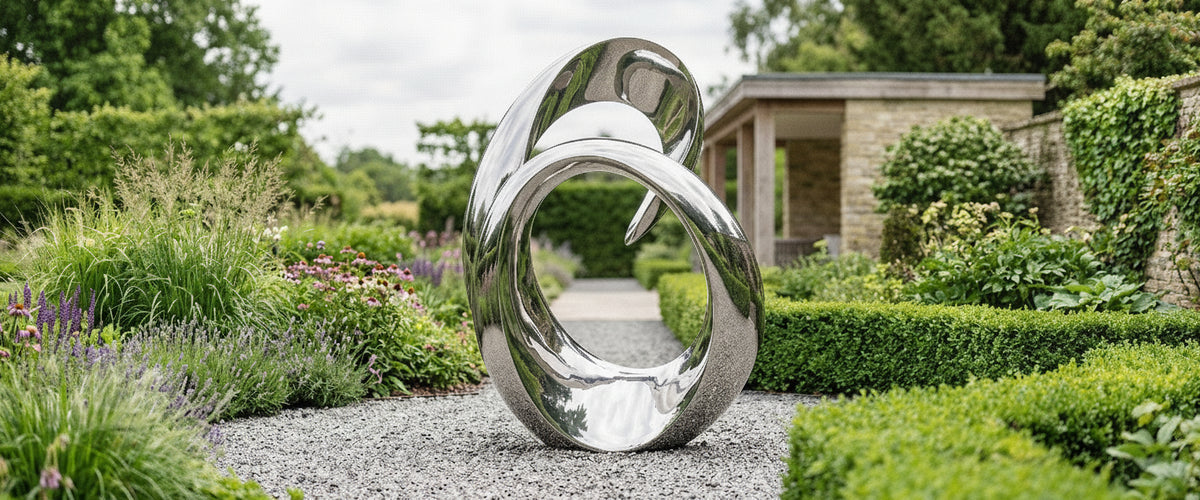
Stainless steel is where contemporary gardens get their drama. Polished to a mirror, it reflects planting and sky and changes through the day. Brushed or satin finishes read quieter and hide fingerprints and water spotting better. For coastal and poolside sites, specify marine-grade 316 stainless rather than 304; the added molybdenum gives far better resistance to salt and chlorine, a point the Nickel Institute covers in its guidance on grade selection for corrosive environments. We push clients near the ocean toward 316 every time, since stainless is a favorite for contemporary metal garden sculptures on exposed sites.
Corten (Weathering Steel)
Corten develops a stable rust-orange surface that seals itself against further corrosion. It has become a signature of contemporary landscape design because it pairs well with grasses, gravel and concrete. Be aware that during its first year or two the surface can leach runoff that stains pale paving and stone, so plan the base accordingly.
Getting Scale Right
Scale is where most garden sculpture purchases go wrong. A piece that feels commanding in a showroom can look lost on an open lawn. Our rule of thumb: measure the viewing distance, then size up. A sculpture seen mainly from a terrace 40 feet (12 m) away needs real height to register, often 6 to 8 feet (1.8 to 2.4 m) or more. For a big lawn read from a distance, something conceived at that scale carries where a smaller piece would vanish; the Large Contemporary Dual Dragon Bronze Sculpture - 250cm at 250 cm holds its ground precisely because it was built to be seen across open space. If you are unsure, cut a cardboard silhouette to size and stand it in position for a few days. It is the cheapest test you will ever run, and it saves grief on the biggest contemporary metal garden sculptures.

Where to Place Contemporary Metal Garden Sculptures for Impact
For wider placement ideas, Contemporary Abstract Metal Sculpture: A Buyer's Guide to Form, Scale, and Placement is useful companion reading before finalising the setting and sightlines.
A sculpture is only as strong as what sits behind it. The most effective placements we have shipped share a few habits, and they apply to almost all contemporary metal garden sculptures.
Give it a backdrop. A mirror-polished piece needs a darker foil (a yew hedge, a stone wall) to read clearly. Set the same piece against a bright sky and it can wash out. Corten and bronze, being darker, do the opposite: they want light behind or beside them.
Work with the approach. Think about how people move through the space. Placing a modern metal garden sculpture at the end of a sightline (the far point of a path, the turn of a driveway, the axis from a picture window) gives it a job to do. One California client set a leaping form so it caught the last hour of sun through a row of olive trees; the shadow it threw became half the pleasure. Where a poolside or waterside setting wants a piece that echoes the movement of water, an upward, animated form like the Contemporary Upright Dolphin Bronze Sculpture - 170cm sits more naturally than a static upright.
Consider water. Metal and water are natural partners. A reflective piece beside a still pool doubles its presence, and a genuine water feature adds sound and movement. If that appeals, our garden fountains and water features collection shows how metal reads alongside moving water.
Respect negative space. Contemporary work often needs room to breathe. Crowding a clean abstract form with fussy planting fights the piece. Gravel, lawn or a simple stone plinth lets the silhouette do the talking, and that restraint is what makes contemporary metal garden sculptures land.
Budget, Commissioning and Delivery
There is no honest single price for contemporary metal garden sculptures, and anyone quoting one without seeing your project is guessing. Cost is driven by material, scale, the complexity of the form, structural engineering for wind and weight, finishing, and installation. A polished stainless abstract that needs internal armature and a concealed mount is a different proposition from a smaller cast bronze. The sensible move is to request a tailored quote once you know roughly what you want and where it is going.
A few practical points buyers often miss:
- Weight and foundations. Large metal pieces can run into hundreds or thousands of pounds (hundreds of kilograms). Many need a concrete footing or engineered pad. Factor this into the site plan early.
- Access. We have had crews carry work through houses, over walls, and by crane into courtyards. Tell us about gates, steps and overhead cables before delivery day, not on it.
- Lead times. Cast and fabricated work takes time. Bespoke commissions take longer still. Plan around your landscaping schedule.
- Crating and shipping. International freight for large sculpture needs proper crating and, often, specialist handling at both ends. Build this into the budget rather than treating it as an afterthought.
If you want something specific to your garden rather than a standard model, this is where a bespoke commission earns its keep. We can adjust scale, pose, patina and mounting to suit a particular view or an architect's material palette. A figurative piece is often the easiest to tune this way, its gesture reworked to answer the line of a building; a form such as the Large Contemporary Violinist Bronze Sculpture - 220cm can be adjusted in stance and finish to sit in a courtyard or a concert-hall forecourt. This is how the best contemporary metal garden sculptures end up feeling inevitable in their setting.
How Giant Sculptures Helps with Bespoke Projects
We are a bespoke sculpture supplier working at large scale, which means most of what we ship is chosen or built for a specific place. Our team advises on material for your climate, works up the engineering so the piece stands safely for the long term, and handles crating and delivery worldwide. For buyers weighing up contemporary metal garden sculptures, the full metal sculptures collection is a good place to gauge scale, finish and form before a conversation.
The habit worth keeping through all of this: decide the site first, then the material, then the piece. Gardens that get modern metal garden art right almost always started with the view, not the object. Get those three in order and a contemporary metal garden sculpture will anchor your outdoor space for decades rather than one season.