

































































































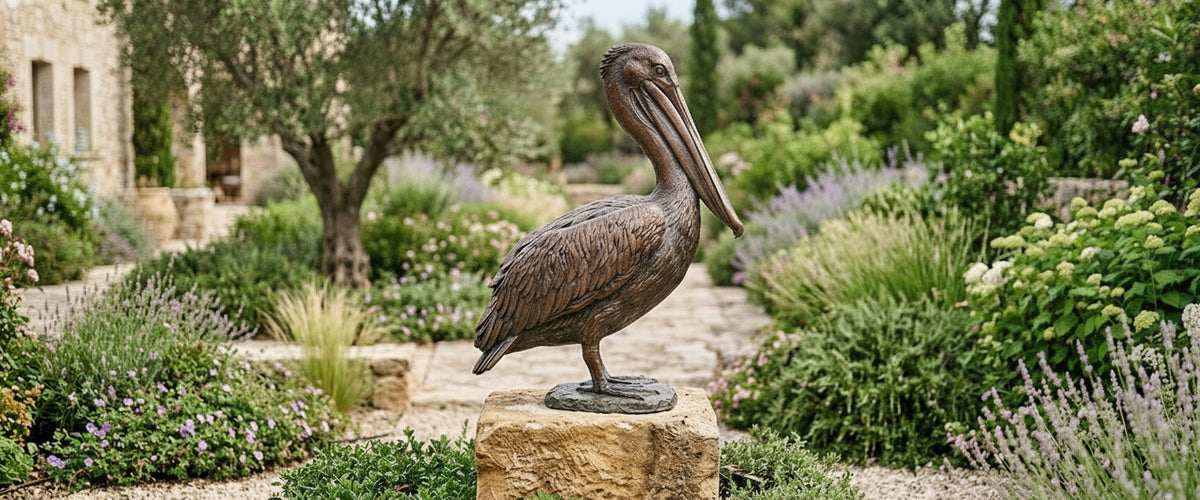

A pelican is one of the few birds that looks equally at home perched still or caught mid-flight, which is exactly why a bronze pelican sculpture carries a room or a garden the way a heron or an egret rarely does. The bird has weight and personality. That heavy bill, the folded pouch, the broad wingspan; cast in bronze, those features read as coastal and confident rather than fussy. Get the pose and the scale right and you have a piece that anchors a space for decades.
Looking for the full range in this category? Browse our Bronze Sculptures collection for every available finish, size, and configuration.
Below is a practical guide for buyers who want more than a garden ornament. If you are furnishing a waterfront property in Florida, a Napa terrace, or the lobby of a coastal resort, the decisions that matter when choosing a bronze pelican sculpture are pose, finish, scale, and siting.
A perched pelican reads calm and settled beside water.

Key Takeaways for a Bronze Pelican Sculpture
Pose drives everything: a perched pelican reads calm and settled; a pelican in flight brings movement and needs headroom.
Bronze is the durable choice: a properly cast and patinated bronze pelican sculpture can live outdoors for generations with light care.
Scale is a placement decision, not a taste decision: measure the sightline before you fall for a size.
Finish sets the mood: a traditional brown patina feels naturalistic; polished or verdigris tones feel contemporary.
Budget depends on material, scale, complexity, engineering, and installation. Ask for a tailored quote rather than guessing from a photo.
What a Bronze Pelican Sculpture Means and Who It Suits
The pelican has long carried symbolic weight. In medieval Christian art it appeared as an emblem of self-sacrifice and care, a motif that survives in heraldry and church carving today. For most buyers now, though, the appeal of a bronze pelican sculpture is simpler: it signals water, coast, and a certain unhurried elegance without tipping into nautical cliche.
This bird suits three buyers particularly well. Coastal and lakefront homeowners who want a piece that belongs near water. Landscape designers looking for a focal point with a clear reading from a distance. And commercial clients (resorts, marinas, restaurants, corporate campuses near the coast) who need something durable and memorable that photographs well and survives weather.
It is a bird with personality, so it rewards a confident placement. Tuck a pelican sculpture behind planting and it disappears. Give it a clear stage and it earns its keep.

Materials, Finishes, and Scale Decisions
Bronze is the material we recommend for a pelican sculpture that lives outdoors, and the reason is longevity. A quality casting develops a stable surface and, with basic care, handles salt air, sun, and frost far better than resin or painted composite. The Metropolitan Museum of Art holds outdoor bronzes that have weathered more than a century; that is the timeline this metal is built for, and it is why serious collectors keep returning to it.
Finish is where the bird gains its character. A few common directions:
Traditional brown patina: warm, naturalistic, and forgiving in a garden setting. It reads like the bird itself.
Verdigris and blue-green tones: the classic weathered look, strong against stone or gray render, and a nod to coastal weathering.
Polished or highlighted bronze: a contemporary treatment where the raised surfaces catch light. This suits modern architecture and hard landscaping.
Patina is not paint. It is a chemically induced surface applied hot in the foundry, then sealed with wax or lacquer. That distinction matters when you later care for a bronze pelican sculpture, because you maintain the wax layer rather than repaint the bird.
Scale is the decision buyers most often get wrong. A close-up spot such as a low wall, a dock post, or a poolside plinth calls for something like the Life-Size Traditional Pelican Bronze Sculpture - 80cm (roughly 31 inches), which reads well when people pass within touching distance. Where the setting wants a genuine focal point over a courtyard or lawn, the Life-Size Contemporary Pelican Bronze Sculpture - 150cm (about 5 feet) is closer to the right proportion. For a bird in flight, remember the wingspan pushes the footprint well beyond the height figure, so a large flight piece needs real air around it.
A flight piece needs open sky behind it so the wings read clearly.

Where to Place a Pelican for the Strongest Impact
For wider placement ideas, Bronze Tabletop Sculptures: How Scale and Placement Decide the Whole Effect is useful companion reading before finalizing the setting and sightlines.
The best siting for a bronze pelican sculpture usually involves water or the suggestion of it. That does not mean it must sit in a pond. It means the eye reads the pelican against an open, reflective, or horizontal surface.
Strong placements we see work again and again:
Poolside and terrace edges, where a perched bird mirrors in the water at dawn and dusk.
Dock and jetty posts on lake and coastal properties, a natural home for a single life-size figure.
Lawn focal points viewed from the house, where a flight piece against sky and greenery gives real drama.
Entrance and arrival zones for resorts and restaurants, where a pair reads as a signature.
Pairs deserve a word. For a wide frontage or a large water feature, a two-bird arrangement such as the Large Contemporary Dual Pelican Bronze Sculpture - 250cm (roughly 8 feet) creates a conversation between the birds that a single piece cannot. We shipped a paired arrangement to a Gulf Coast property where the client wanted the birds angled toward each other across the top of an infinity pool; the mirrored reflection effectively doubled the piece.
For a bronze pelican sculpture in flight, headroom is everything. Something on the scale of the Large Traditional Pelican in Flight Bronze Sculpture - 300cm (close to 10 feet) needs open sky behind it and no overhanging tree line, or the wings lose their read. Place it where the outline lands against blank sky, gray render, or dark water and the movement carries from across the garden.
Buyer Mistakes to Avoid
A few recurring errors are worth naming before you buy a bronze pelican sculpture:
Buying to the height number alone. A wingspan or an outstretched neck changes the visual footprint. Always check the widest dimension against your site.
Under-scaling for a big space. A life-size bird on a broad lawn looks lost. In open landscape, size up.
Ignoring the base and fixing. A tall or flight piece needs proper anchoring, especially in exposed coastal wind. Ask how the piece bolts down before it arrives.
Choosing a busy background. Dense planting behind a detailed bronze kills the silhouette. Give it contrast.
Assuming all bronze is equal. Wall thickness, casting quality, and patina sealing separate a bronze pelican sculpture that lasts from one that pits within a few seasons.
Budget, Commissioning, and Delivery
There is no single price for a bronze pelican sculpture, and any figure quoted from a thumbnail would be a guess. Cost is driven by the material weight, the scale, the complexity of the pose (a flight piece with extended wings involves far more engineering than a compact perched form), the finish, and the logistics of crating and installing a heavy object. A large flight sculpture can weigh several hundred pounds (over 130 kg) once cast and mounted, which affects both freight and the groundwork on site. The honest answer is to request a tailored quote against your actual piece and location.
If nothing in the standard range fits your setting, a bespoke commission is worth considering. Clients commission a bronze pelican sculpture rather than buy off the shelf for a few reasons: a specific pose (wings half-raised, or a bird preening); a scale that suits an unusual sightline; a matched pair with deliberate angling; or a patina tuned to existing stonework and architecture. As a bespoke sculpture supplier, Giant Sculptures works from reference images and site details to develop a piece before any casting begins, so you approve the form and finish rather than hoping the photograph matches.
Delivery of large bronze is a project in itself. Expect crated freight, and plan access for the piece to reach its final position; a 300cm flight sculpture will not fit through a standard garden gate. We map the route from truck to plinth before dispatch, because a piece that cannot reach its spot is a problem best solved on paper.
How Giant Sculptures Helps With Bespoke Pelican Projects
Our focus is large-scale, durable, and bespoke work, which is exactly the territory where a bronze pelican sculpture pays off. We can advise on pose against your sightline, recommend a patina that suits your stone or render, and engineer the fixing for coastal exposure. Browse the bronze animal sculptures collection to see the range of poses and finishes, or the wider bronze garden statues collection if you are building a coherent scheme across a garden.
Whether you want a single life-size bird on a dock post or a paired flight arrangement over water, the aim of a bronze pelican sculpture is the same: a bronze that still looks right in thirty years. Send us your site photos and dimensions, and we will help you choose a piece that earns its place.