





































































































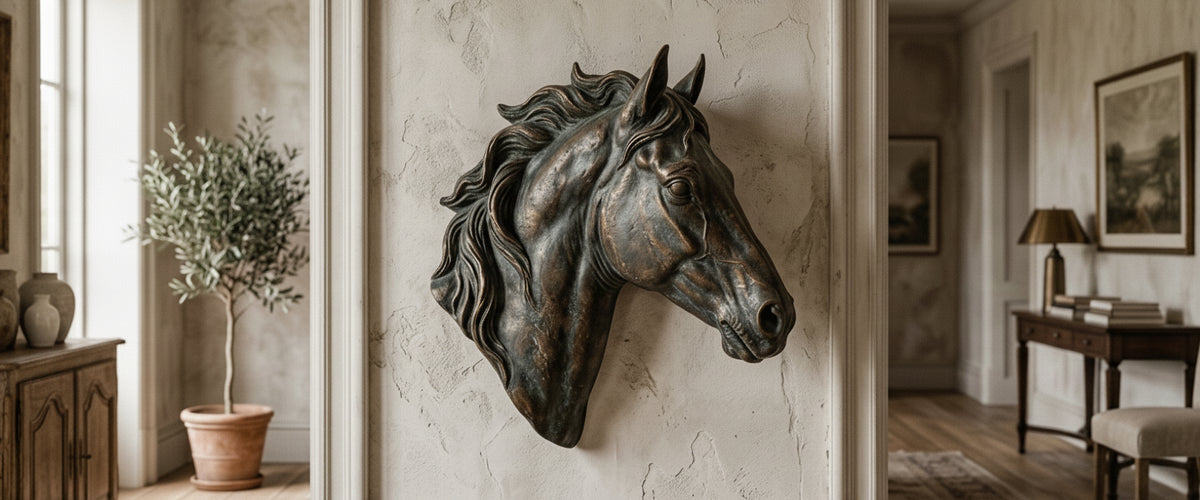

A relief piece lives or dies by its shadow. Hang a beautifully cast bronze torso in flat, even light and it flattens to a plaque. Move it three feet, angle a light source across it, and the same piece throws depth you can read from the far side of the room. That gap between flat and alive is what most people get wrong with 3D wall art decor, and it has almost nothing to do with the object and everything to do with placement.
We ship large relief and dimensional wall work all over the US, from Napa tasting rooms to double-height entryways in Texas, and the same few decisions keep deciding whether a piece of 3D wall art decor looks intentional or apologetic. This is the reasoning we walk clients through before anything gets drilled into a wall.

Key Takeaways
- Scale first. A wall piece needs to occupy roughly two-thirds of the visual field it sits in, or it reads as an afterthought.
- Raking light makes dimensional wall pieces work. Side light creates the shadow that gives relief its depth; flat frontal light kills it.
- Indoor and outdoor are different problems. Material, fixings, and contrast all change once weather and long sightlines enter the picture.
- Height is a sightline decision, not a rule. The old "center at 57 inches" gallery convention breaks in tall rooms and on approach walls.
- Bespoke solves fit. If your wall or setting is unusual, a commission sized to the space beats forcing a stock piece to work.

What 3D Wall Art Decor Actually Looks Like in Different Rooms
The 3D wall art decor category is broader than people expect. At the light end you have 3d butterfly wall art and cut-metal clusters that sit close to the surface and cast fine, scattered shadows. In the middle sit relief panels: horse heads, bull heads, floral roundels, classical figures pressed out from a backing plate. At the sculptural end you get near-freestanding forms that happen to mount to a wall. Where a wall piece needs to behave like a half-round sculpture rather than a flat panel, something like the Classical Figural Torso Wall Sconce Bronze Sculpture - 90cm projects far enough off the surface to read that way.
Each depth wants a different room. Butterfly clusters and terracotta roundels suit a stairwell wall or a powder room where people pass close and reward small detail. A deep bronze relief wants distance and a plain field around it. In a living room with a tall chimney breast, a single strong piece of 3D wall art decor over the mantel does more than a scattered arrangement ever will. A projecting animal head such as the Traditional Horse Head Bronze Relief - 80cm needs that kind of breathing room; crowd it with picture frames and the projection reads as clutter rather than depth.
Outdoors the logic shifts again. A relief on a garden wall in Aspen or a courtyard in Santa Barbara has to compete with sky, foliage, and moving light all day, so it needs both mass and a material that ages with intent.

Scale, Sightlines, and Pedestal Height
The single most common fix we make to 3D wall art decor is size. People measure their wall, pick something that fits the wall, and end up with a piece that fits nothing. What matters is the visual field: the zone your eye takes in when you enter the room and look at that wall. A 24-inch (61 cm) roundel on a 14-foot (4.3 m) feature wall disappears. The same roundel on a tight hallway wall commands it.
As a working rule, a wall piece should fill around two-thirds of the empty field it anchors. Over furniture, size it against the furniture, not the wall: aim for roughly two-thirds to three-quarters the width of the console, sofa, or headboard below it.
Sightlines change the height rule. The gallery habit of centering work at eye level (about 57 to 60 inches / 145 to 152 cm to center) assumes a viewer standing a few feet back on a flat floor. That breaks the moment you have a staircase approach, a mezzanine looking down, or a double-height entry. On an approach where people see the piece from below, lift it and let the projection catch light from above. When a piece will be viewed from a landing, hang it so the strongest modeling faces the descending eye line.

Indoor Versus Outdoor: When Each Wins
Indoors, dimensional wall decor is about intimacy and controlled light. You can use finer detail, softer materials, and pieces that reward a close read. This is where 3d printed wall art and lighter metal work earn their place; short viewing distances make delicate cutwork legible, and there is no weather to fight. Indoor 3D wall art decor can lean on subtlety in a way outdoor work never can.
Outdoors, the brief is durability and read-from-distance mass. Bronze develops a natural patina and, when properly cared for, lasts for generations; conservators note that a stable protective patina is what shields the metal beneath, which is why outdoor bronze is waxed and maintained rather than left bare. Corten steel and stainless behave differently again: Corten rusts to a sealed russet skin, stainless throws light and stays bright. For a shaded north wall in the Pacific Northwest, a reflective stainless piece pulls in what light there is. On a sun-baked Texas courtyard wall, matte bronze or Corten reads better because it will not glare.
If you want to see the spread of finishes and formats side by side, our 3D wall art collection and the wider metal wall art range show how the same subject reads across materials.
Light, Backdrop, and Contrast
Depth is shadow. That is the whole game. A relief with no raking light is a picture of a relief. Position a piece of 3D wall art decor so a light source, a window early or late in the day or a fitted wall light, rakes across the surface at a shallow angle. The low angle stretches shadows into the recesses and pulls the high points forward.
Backdrop contrast decides whether the silhouette reads at all. A dark bronze on a charcoal wall vanishes; the same bronze on a warm plaster or pale limestone wall gains a crisp edge. Where the piece is lighter cut-metal or terracotta openwork, a mid-tone wall behind it lets the negative space do its job. A round floral piece like the Blossom Halo terracotta roundel depends on that tonal gap to keep its pierced pattern legible. As a general steer: pale piece, deeper wall; dark piece, lighter wall.
One studio note from a job we shipped to a Napa winery: the client had specced downlights directly above a bronze bull relief. Straight-down light killed the modeling, so the horns and muzzle went flat. We moved the source to a wall-grazing fitting eighteen inches off the surface and the whole face came back. Nothing about the sculpture changed; the light did all of it. That single move is often what separates working 3D wall art decor from a dead one.
Common Placement Mistakes and How to Avoid Them
For wider placement ideas, How Big 3D Metal Wall Panels Actually Read at Home is useful companion reading before finalizing the setting and sightlines.
- Hanging too small for the field. The most frequent error. Size to the visual zone, not the wall dimension.
- Flat frontal lighting. Kills depth on every relief. Rake it from the side or above at a shallow angle.
- Ignoring projection depth. A piece that stands 6 inches (15 cm) off the wall behaves like sculpture. Do not hang it where a shoulder or elbow will clip it in a corridor.
- Matching wall color to the piece. Low contrast erases the silhouette. Push the tonal gap.
- Under-speccing fixings. A heavy bronze relief needs into-stud or masonry fixing, not drywall anchors. Weigh the piece and match the hardware.
- Forgetting the approach. Think about where people first see your 3D wall art decor, not just where they stand up close.
How to Hang Dimensional Wall Art, Step by Step
- Confirm the finished weight and how the piece is meant to hang (cleat, keyhole, or through-bolt).
- Find your fixing substrate. Studs, masonry, or backer board decide the hardware, not preference.
- Mark your center height by sightline, then check it from the doorway before you drill.
- Level a French cleat or bracket; for heavy relief, spread load across two fixings minimum.
- Set spacers if the piece needs air behind it to cast a clean edge shadow.
- Lift with two people for anything over about 30 pounds (14 kg), and never trust a single drywall anchor.
Commissioning a Piece Sized to Your Space
When a wall is genuinely unusual, tall, curved, viewed from an odd angle, or exposed to hard weather, a stock piece will always be a compromise. That is where bespoke 3D wall art decor pays off. As a supplier of large-scale and bespoke sculpture, Giant Sculptures works from the wall and the sightline backward: we set the projection depth, the finish, and the fixing method to the actual setting rather than asking the room to accommodate an object.
Because scale, material, engineering, and finishing all move the cost, there is no honest flat price for this work. The sensible route is to send us the wall dimensions, the viewing distances, and a couple of photos, and ask for a tailored quote. That beats buying twice. Well-placed 3D wall art decor almost always comes down to matching the piece to the space rather than the reverse, which is why serious buyers treat decor 3d wall art as a fit problem before a taste one.
If you are still narrowing subject and material for your 3D wall art decor, browse the full wall art and wall decor collection to see how relief depth, finish, and scale interact before you commit.