


























































































Most bronze busts are ruined by the thing underneath them. Buyers spend weeks comparing faces, patinas and modeling, then drop the finished head onto whatever console table happened to be free. Walk into almost any bronze bust sculpture sale and you will see the same gap in the listings: gorgeous studio photography of the head, no mention of the base it was designed to sit on. The plinth is half the sculpture. Judge it first.

Quick Answer: What to Check in Any Bronze Bust Sculpture Sale
Set the chin, not the eyes. Aim for the chin at roughly 60 to 64 inches (152 to 163 cm) off the floor so the gaze reads as level.
Match plinth footprint to shoulder width, not to the widest point of the hair or headdress.
Find the truncation line. A mid-chest cut needs a shorter plinth than a neck-only cut.
Ask for the base weight. Cast bronze and bronze-powder resin behave very differently on a slim pedestal.
Confirm sightlines. A bust holds one strong view and two supporting ones. Corners kill all three.
Budget by material, scale and finishing, then request a tailored quote rather than guessing from a thumbnail in a bronze bust sculpture sale listing.
Chin Height, Not Eye Height
The setting rule almost nobody applies: position the chin, and the eyes take care of themselves. Sculpted heads are often modeled with a slight downward tilt to the gaze, because historically they were meant to be seen from below. Set the eyes at your own eye level and the figure ends up staring at the carpet. Push the chin to around 60 to 64 inches (152 to 163 cm) and the look lands squarely on an average standing viewer.
Heads in a bronze bust sculpture sale are almost always quoted as one overall height, so do the arithmetic before you buy rather than after delivery. Take the overall bust height, subtract the distance from the base of the sculpture to the chin, and the remainder is the plinth height you need. A compact head such as Traditional Cowboy Guitarist Bronze Bust, 70cm stands roughly 28 inches, so almost half the finished height has to come from the pedestal underneath it. A floor-standing bust close to 5 feet tall has already solved that problem: a low block, or no base at all, is the right answer.
Chin at 60 to 64 inches: the measurement that decides plinth height.

Marble, Slate or Blackened Steel Under a Bronze Head
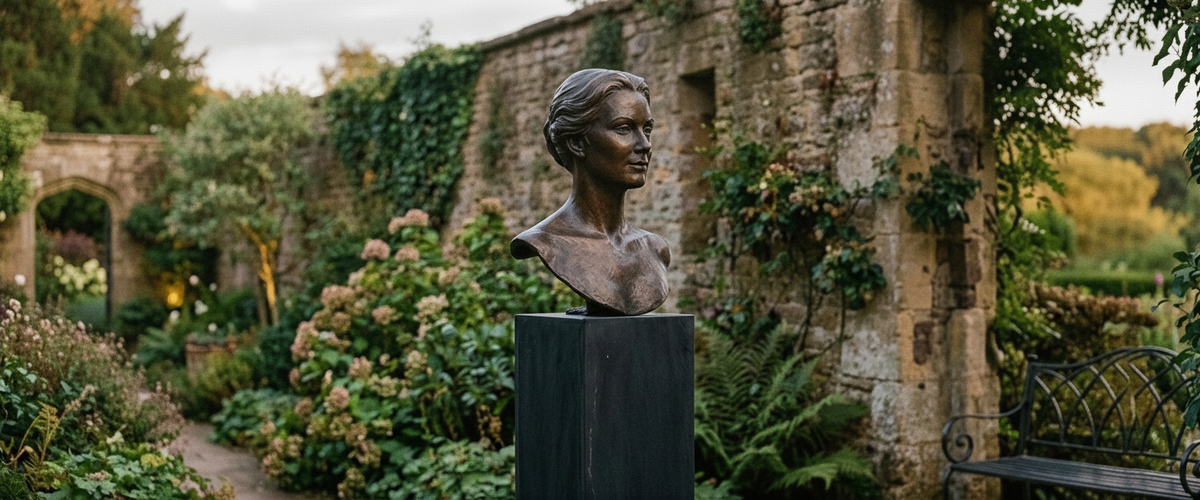
Base material changes how a patina reads more than people expect, because it changes what the bronze is reflecting back. White or pale gray marble bounces light up into the underside of the jaw and lifts a mid-brown patina toward warm bronze-gold. Honed black slate does the opposite: it absorbs, and a chocolate or near-black patina turns dense and matte, with the highlights doing all the storytelling. Blackened or waxed steel sits between the two and suits contemporary modeling, especially elongated or abstracted heads where you want the silhouette to read hard-edged.
Green and blue-green patinas are the fussy ones. Put a verdigris head on cool gray granite and it goes flat and slightly sickly; put it on warm travertine or a dark hardwood plinth and it reads as intentional. Any honest bronze bust sculpture sale should state the base material as plainly as it states the patina, because the two are read together. Patina is a chemically produced surface layer, not paint, and the way it responds to light is part of what you are paying for. Conservation guidance from the Getty Conservation Institute is a useful primer if you want to understand how those surfaces age.
Plinth Footprint Versus Shoulder Width
Here is the proportion that stops a bust looking perched: the top face of the plinth should be at least as wide as the shoulders, and ideally a fraction wider. Not as wide as the hair, not as wide as a hat brim, not as wide as an outstretched wing. Shoulders. When the head visibly overhangs its support, the eye reads instability even when the fixing is completely sound.
Depth matters as much as width, and it is the dimension a bronze bust sculpture sale listing almost never publishes. A square-topped pedestal on a shallow console leaves the back of the shoulders hanging in air, which is the single most common problem we correct on site. Tapered plinths, wider at the base than the top, are the safe default for portrait work. For animal heads with real projection the calculation shifts again: a forward-thrown form such as Large Traditional Eagle Head Bronze Bust, 150cm needs a base that reads as a solid anchor rather than a stand, because the beak carries the visual weight well ahead of the footprint.
Where the Truncation Line Falls
Truncation is the cut where the sculpture ends: mid-chest, below the collarbone, at the neck, or straight through the base of the skull. It quietly determines the height you need underneath. A mid-chest bust carries its own mass and sits comfortably on a lower plinth. A neck-only cut looks severed and floating unless it is lifted high and given air around it.
Contemporary sculptors often use a deliberately abrupt truncation as part of the composition, which is why a piece like Life-Size Contemporary Orangutan Bronze Bust, 180cm, close to 6 feet, works set directly on stone paving with no pedestal at all. We shipped a similar animal head to a Napa tasting room where the client had specified a 30-inch pedestal by email. On site we set it straight onto the poured concrete instead. Standing on the floor, it read as presence rather than ornament.

What a Sale Listing Is Hiding When It Photographs the Bust Alone
A bronze bust sculpture for sale that appears only on a seamless white background, cropped tight, is telling you something by omission. Sometimes the base is a plain painted MDF block that will not survive close inspection. Sometimes the mounting is a single threaded rod with no back plate. Sometimes the piece is simply not designed to stand alone and the seller does not want to explain that.
Ask three direct questions of any seller running a bronze bust sculpture sale before you commit: what is the base made from, how is the sculpture fixed to it, and what does the whole assembly weigh? Sellers who cast their own work answer instantly. The rest hedge.
Cast Bronze, Cold-Cast or Bronze-Powder Resin
Weight gives it away, and the base is where you feel it. A solid or thick-walled foundry bronze head, produced by lost-wax casting, the method the Metropolitan Museum of Art traces back through ancient Greek bronze work, demands an engineered plinth with a proper load path to the floor. Cold-cast or bronze-powder resin is a thin shell of bronze dust in a resin binder over a hollow core. It looks convincing in photographs and it is far lighter, which is exactly why it often ships on a slender base that a genuine cast piece would tip over.
Neither is dishonest as long as it is declared, and a well-run bronze bust sculpture sale declares it in the specification rather than the small print. The problems start when it is not. Outdoors, real cast bronze develops patina and can be waxed and maintained for generations; resin surfaces are more vulnerable to UV and to the freeze-thaw cycles you get in Aspen or upstate New York. If the piece is going into a garden, insist on cast bronze and check our bronze garden statues for what full-weather construction actually looks like.
Corner, Console or Center of the Room
A bust holds a single dominant sightline. Give it the wrong one and it disappears. Corners are the classic mistake: two walls immediately behind the head kill the silhouette and force every viewer into a three-quarter approach. A console against a long wall works far better, provided you leave at least a head's width of clear space on either side.
A pedestal set clear of the wall lets the gaze carry down the room.
The strongest placement is a free-standing pedestal roughly 3 feet (about 1 m) off any wall, positioned so the gaze runs down the length of the room or out through a window. In a Texas entry hall we set a portrait bust facing the front door rather than side-on to it, and visitors met the gaze before they took in the room. Outdoors, aim the gaze along an axis: down a lawn, toward a pool, into a planted view. The full range of bronze busts and heads and the wider bust and torso sculptures are worth comparing side by side if you are still deciding between portrait and animal subjects.

Pre-Purchase Checklist
Measure floor to chin at your intended spot, then work backward to plinth height.
Compare plinth top width against shoulder width, including depth front to back.
Identify the truncation line and adjust height accordingly.
Confirm casting method in writing: foundry bronze, cold-cast, or bronze-powder resin.
Request total assembly weight and check your floor or console can take it.
Test the primary sightline by taping a cardboard box at the finished height for a day.
For outdoor placement, confirm drainage at the base and a fixing detail that will not trap water.
Line up the answers from every piece you shortlist before you start comparing prices.
Commissioning Rather Than Buying Off the Shelf
Where a bronze bust sculpture sale rarely delivers is proportion to a specific room. If your ceiling is 14 feet, a standard portrait head will look undersized no matter how good the modeling is. Giant Sculptures works as a bespoke supplier for exactly this reason: scaling a head up, adjusting the truncation, or building a plinth in matching stone so the whole assembly reads as one object. Commission cost depends on scale, material, casting complexity, engineering and finishing, so the sensible route is a tailored quote once the setting is measured. Bring us floor-to-ceiling dimensions, the intended sightline and a photograph of the wall behind. That is usually enough to start.
For wider placement ideas, How to Read a Cast Bronze Sculpture Before You Buy is useful companion reading before finalising the setting and sightlines.