







































































































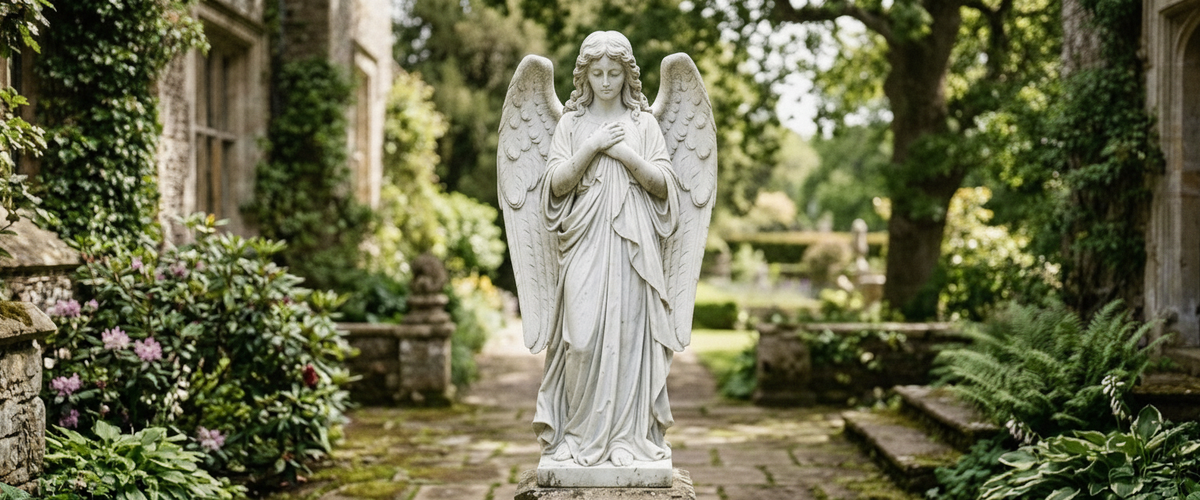

The face goes first. Wings and drapery hold up well outdoors, and even fingers last longer than most people expect. The soft modeling around an angel's eyes and mouth does not. That is where weather and worn molds do their damage. If you are comparing angel statues for sale, judge the expression most carefully. Most listings photograph it least honestly.
Key takeaways
On any angel statue for sale, judge the eyelids, lip edges and nose bridge before the wings or the pose.
Carved marble and cast bronze hold facial detail for decades. Concrete and low-density cast stone soften fastest.
A face sized for a terrace can read as a blank oval from 40 feet (about 12 m) away.
If no catalog angel has the right expression, commission the face rather than settle.

Why Weather and Tired Molds Blur the Face First
The face is the shallowest relief on the whole figure. An eyelid crease may be only a few millimeters deep, so any loss of surface reads at once as a change of mood. Porous concrete and cast stone take in water, which freezes and expands and lifts the crisp edges away grain by grain. Acid rain works more slowly on marble. Over many decades it rounds the lips into a soft, sugary blur.
The second culprit shows up before the statue leaves the factory. Production molds wear with every pour. Early casts from a fresh rubber mold carry sharp lids and a defined groove above the lip. The hundredth cast from the same mold looks sleepy and vague. The pattern is familiar: a cast-stone angel spends two winters outdoors, the eyelids merge into the cheeks, and the figure looks drowsy rather than serene. In most such cases the face was already soft on the day it shipped. Freeze-thaw simply finished the job. That is why so many budget angel statues for sale look tired after a couple of seasons.
Downcast, Uplifted or Reading: What the Gaze Has Meant
Gaze carries centuries of meaning in garden and funerary sculpture. The downcast angel, with head bowed and eyes lowered, became the mourning figure of Victorian cemeteries on both sides of the Atlantic. The Association for Gravestone Studies records how widely these motifs spread through American burial grounds. An uplifted face, often paired with a raised arm, signaled hope and consolation. The reading angel holds a book or tablet and traditionally plays the recorder of deeds. It is the quieter, more contemplative choice.
In a private garden, the choice is about mood rather than doctrine. When you sort through angel statues for sale, decide the mood first and let the gaze follow. A downcast angel at the end of a shaded walk invites people to slow down. An uplifted face works on an axis or at the top of steps, where the eye follows the gaze upward. A reading figure suits a bench or a memorial corner, and our headstones and memorials collection includes figures made for that role.

Eyelids, Lips and the Nose Bridge: What to Check on Angel Statues for Sale
Most listings of angel statues for sale show a three-quarter view from a flattering distance. Ask for a straight-on close-up of the face in side light, then check three things.
Eyelids. The upper lid should cast a visible shadow line. If the eye reads as a smooth bulge, the mold or the carving was soft.
Lips. Look for a clean edge where lip meets skin, and for defined corners. Mushy corners make every angel look faintly sulky.
Nose bridge. The step from brow to nose should be crisp and symmetrical. A flattened bridge is the classic sign of a tired mold or a hurried finishing pass.
Low side light shows whether the eyelids and lip edges are truly crisp.
In our studio, carvers check faces under a single lamp held low to one side, because flat overhead light flatters everything. Ask any supplier of angel statues for sale, including us, for that same photo.
Which Material Holds a Face After Ten Winters?
Material decides how long an angel statue for sale keeps its expression once it is outdoors. Concrete is heavy and porous. In freeze-thaw climates like Colorado or upstate New York, expect facial detail to soften within a handful of winters. Cast stone varies widely with mix density. A dense mix does noticeably better, and a poor one behaves like concrete. Resin takes crisp detail from the mold and weighs little, but UV exposure can chalk and fade the surface, and gilding suffers first. That is why a gilded resin figure such as the Gold Angel with Celestial Spheres is better placed in a covered loggia, an atrium or a double-height hall than out on an open lawn.
Carved marble keeps a face for generations with sensible care. Erosion is measured in decades, not winters, and our marble sculptures are carved, not cast, so there is no mold to wear. Bronze is the most forgiving material of all. A cast bronze face keeps its edges almost indefinitely, and only the patina shifts with age. For exposed coastal gardens or hard winters, bronze angel and cherub statues are the safest long-term choice. The National Sculpture Society is a good starting point for understanding how figurative bronze is still modeled and cast today.

A Face That Works at Arm's Length Can Vanish Across a Lawn
Sculptors have always adjusted features for viewing distance, yet few listings of angel statues for sale mention it. A face carved for a niche beside a front door can be subtle. Put the same face 50 feet (about 15 m) down a lawn and it needs deeper eye sockets, a stronger brow shadow and a slightly firmer mouth to read at all. For a large garden in Napa or the Hamptons, a full-height carved figure such as the Winged Flower Angel, at 200cm (about 6 ft 7 in), gives the features enough scale to carry across the grass. A smaller figure works better near seating, where people stop and look closely.
At lawn distance, height and stronger features keep the expression legible.
For a long sightline, or a courtyard seen from upper windows, think about posture as well as features. When the viewer is too far away to see an eyelid, a composition built around a gesture, like the Angelic Embrace at 260cm (roughly 8 ft 6 in), tells its story in silhouette rather than through the face alone.
Buyer Checklist Before You Commit
Run through this list with every angel statue for sale on your shortlist, ours included.
Ask for a side-lit close-up of the actual face, not a render or a stock image.
Confirm the material. For cast pieces, ask whether the casting comes from a fresh mold.
Stand where the viewer will stand and measure the distance, then size the figure to it.
Match material to climate: bronze or marble for hard winters, resin under cover.
Agree on the base and fixing method with your landscape designer or contractor before delivery.
Ask about aftercare. Marble benefits from gentle washing, and bronze from periodic waxing.

When No Catalog Angel Has the Right Expression: Commissioning the Face
Sometimes the pose is right and the face is wrong. You might want a particular tenderness, or a memorial angel whose features echo a family resemblance. Many angel statues for sale online cannot be altered, but a commission can. At Giant Sculptures we start from your reference images and model the face in clay at working scale. We then send photographs for your approval before any marble is cut or any bronze is poured. Changes at the clay stage take days. Stone, once removed, cannot be put back.
Budget depends on several factors: material, scale, carving complexity, engineering, installation and finishing. A tailored quote is the honest route. Browse our full range of angel statues for sale first. If the right expression is not there, ask us to make it.
For wider placement ideas, Resin Angel Statues for the Garden: Where They Fail and Where They Work is useful companion reading before finalizing the setting and sightlines.