






































































































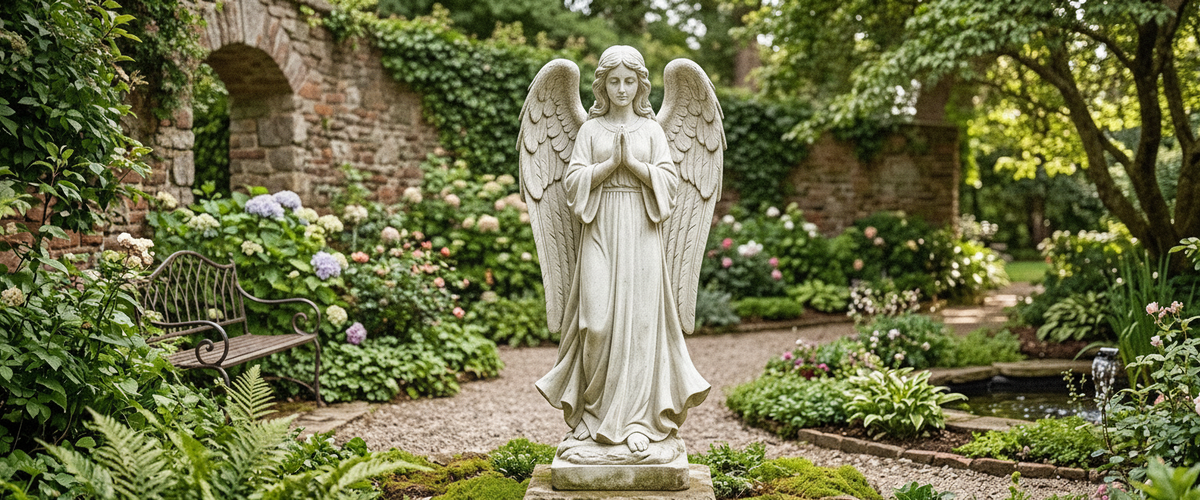

Most garden resin angel statues that reach us with a "can you replace this?" note did not topple in a storm. They lost a wingtip first, then a finger, then the finish went chalky across the shoulders. If you are comparing resin angel statues for garden use, that order of failure is worth knowing before you buy. It tells you where to look on a cast, how to keep one standing, and where a lightweight figure genuinely earns its place.
At a glance
Wings fail first on garden resin angel statues: thin feather sections and hidden bonded joins take the most sun and wind stress.
Hollow casts need ballast, especially on terraces and open lawns.
Painted faux marble and faux bronze finishes usually weather faster than the resin beneath them.
Crisp faces and hands are the quickest test of mold quality.
Resin suits roof terraces, rentals and short ownership horizons. Marble and bronze suit permanent gardens.

Why Wings Are Where Resin Gives Way
Wings are the thinnest part of almost every angel figure. On garden resin angel statues they are often molded separately and bonded at the shoulder blades, and the seam is then filled and painted so you never see it. Outdoors, the resin expands on warm afternoons and contracts at night, and that joint flexes at a slightly different rate from the body. Ultraviolet light also breaks down polymer surfaces over time. The EPA's UV index scale gives a fair sense of how punishing summer sun gets in Arizona, Texas or inland California, and feather tips go brittle there before anything else does.
One client in Scottsdale sent us photographs of two resin angels flanking a pool gate. After two summers, both had hairline cracks circling the wing roots, invisible from the terrace and obvious at arm's length. When you shop for resin angel statues for the garden, look for wings that are thick where they meet the back, feather edges that are rounded rather than knife-thin, and a seller who can tell you how the wings are attached.
Wing roots are where most garden resin angel statues crack first.
Hollow Hems, Wind and the Case for Ballast
Most resin garden angel statues are hollow and open underneath. A draped robe with a flared hem behaves like a small sail: wind gets under the edge and the figure rocks, then walks, then falls. A 4-foot (about 1.2 m) resin angel can weigh less than a bag of patio sand. Fill the base cavity with dry sand or a lean concrete mix, cap the opening, and fix the figure to a plinth with a threaded rod or an exterior-rated adhesive. On coastal plots or high terraces, read the National Weather Service wind guidance and anchor as though the worst gust of the year will arrive in the first week.
Sand ballast and a threaded rod keep garden resin angel statues standing through winter gusts.

Faux Marble Chalks, Faux Bronze Flakes
On garden resin angel statues, the finish is usually the weaker layer. Faux marble is often a white gel coat with painted veining, and in hard sun it chalks into a powdery bloom you can wipe off with a fingertip. Faux bronze is typically metallic paint or cold-cast powder over resin. In steady drizzle (a Pacific Northwest garden, or a shaded corner of a Hamptons lawn), water creeps under any chip and lifts the coating in flakes. Real bronze darkens and builds patina; painted bronze peels. Ask whether the color runs through the cast or sits on top of it.
Soft Faces and Blurred Hands: Reading a Cast Before You Buy
Detail tells you how hard a mold has been worked. Fresh silicone molds give crisp eyelids, separated fingers and clean feather ridges. Tired molds give soft noses, mitten hands and hair that reads as a lump. Those blurred areas often hide thin walls and trapped air bubbles, which become the first entry points for frost. Carved stone is the fairest benchmark: on a hand-carved figure such as the Kneeling Prayer Angel in marble, the clasped fingers are cut as separate forms with real shadow between them. Hold every garden resin angel statue on your shortlist to that standard, even if stone is not on your list.
How to Judge Resin Angel Statues for Garden Placement
For wider placement ideas, Give Him a Hedge and a Heading: Placing a Male Angel Garden Statue is useful companion reading before finalizing the setting and sightlines for resin garden angel statues.
Before committing to resin angel statues for a garden, score each candidate against a few practical criteria:
Wall thickness: tap the robe. A dull knock is good; a hollow ring with visible flex is not.
Wing construction: one-piece or reinforced joins beat glued-on wings.
Finish type: through-colored resin outlasts painted effects.
UV protection: ask whether the resin or topcoat is UV-stabilized.
Base design: an open, fillable base you can ballast and anchor.
Detail sharpness: crisp hands and faces signal a fresh mold and sounder casting.

Care Checklist for a Garden Resin Angel Statue
Each spring, inspect wing roots, hem edges and the base for hairline cracks.
Seal any crack at the wing root with clear exterior-grade sealant before water gets in.
Wash with mild soap and a soft brush. Never use a pressure washer on the painted finishes of garden resin angel statues.
Recoat with a UV-protective clear coat every year or two in sunny climates.
Check ballast and anchoring after every major storm.
Where winters freeze, move the figure into a garage or shed. If it must stay out, lift it off wet ground and use a breathable cover, never plastic sheeting.
Where a Lightweight Resin Angel Makes Sense
Weight is resin's honest advantage. Many roof terraces in Manhattan or Chicago have load limits that rule out a solid marble figure without a structural engineer's sign-off, and a well-ballasted resin angel can sit there without that conversation. Renters benefit too, since a resin piece moves with you at the end of a lease. We also see resin used as a stand-in: one New York client kept a resin angel on her terrace for a season to settle height and sightlines before commissioning a carved piece for her country garden. For short horizons and tricky structures, resin angel statues for the garden are a sensible tool.

When to Step Up to Marble or Bronze
For a permanent garden, a memorial or a piece you expect to hand down, resin is the wrong material. Carved marble weathers slowly and gracefully, and at scale it holds a lawn the way resin cannot. At the end of a long Napa-style vista, a 200 cm figure such as the Harvest Grace Angel carries real presence where a garden resin angel statue of the same height would read as light and hollow. Scale works the other way too: for a memorial corner or a quiet bed beneath a tree, a small carved figure like the Praying Child Angel memorial at 80 cm suits the setting better than a tall winged figure. Bronze offers fine wing detail without the brittleness, which is why our bronze angel and cherub statues suit exposed sites.
If garden resin angel statues no longer fit the plan, browse the wider angel statues collection for poses and scale, or ask Giant Sculptures about a bespoke commission. Budget depends on material, scale, complexity, engineering, installation and finishing, so we recommend requesting a tailored quote.