































































































Most interiors that chase art deco style end up looking like a cocktail bar in a period drama. Gilt sunburst mirror, fluted bar cart, zebra-print stool, three chevron cushions on a velvet sofa. The reference is right and the result is wrong, because deco was never a set of props. It was a way of drawing: disciplined, geometric, machine-confident. Get the line right in one commanding piece and the rest of the room can stay quiet.

At a Glance: Art Deco Style Without the Pastiche
The line matters more than the motif. Stepped setbacks, fluting and repeating arcs are the grammar; sunbursts are just vocabulary.
Material carries the message. Bronze reads collected, chrome reads jazz-age, marble reads architectural, lacquer reads high-drama.
One large piece outperforms a room of period furniture. Scale does the work that repetition cannot.
Raking light is the whole trick. Deco relief needs a sharply angled, off-axis light source to show its steps and grooves.
Bespoke beats reproduction. A commissioned deco-inspired form can be proportioned to your wall, your ceiling height and your sightline.
The Deco Line: Stepped Forms, Fluting and Repeating Arcs
Strip away the glamour and art deco style is essentially three moves repeated with conviction. Setbacks, where a form climbs in stacked tiers like a 1930s skyline. Fluting, where parallel grooves turn a flat plane into a rhythm you can read from across a room. And arcs that repeat in scaled sequence, often fanning from a single origin point. The Miami Design Preservation League has spent decades documenting how that stepped massing shows up at architectural scale in South Beach, and the same logic scales down neatly into sculpture.
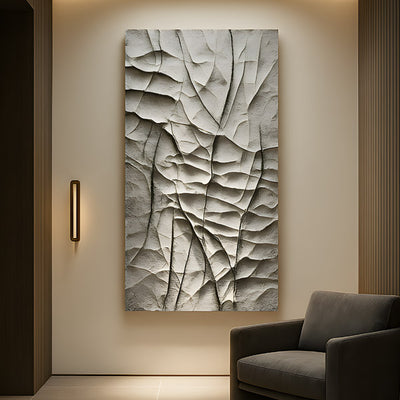
Stepped setbacks and parallel fluting read clearly from across the room when the light strikes the surface at a sharp angle from one side.
Streamline moderne, deco's later cousin, softened those angles into aerodynamic curves and horizontal speed lines. Worth knowing the difference before you buy: a hard stepped ziggurat and a smooth streamlined torso can both be called deco, but they behave differently in a room. The stepped piece adds structure to a soft, upholstered space. The streamlined piece calms down a room already full of hard edges.

Bronze, Chrome, Marble and Lacquer: What Each Material Signals
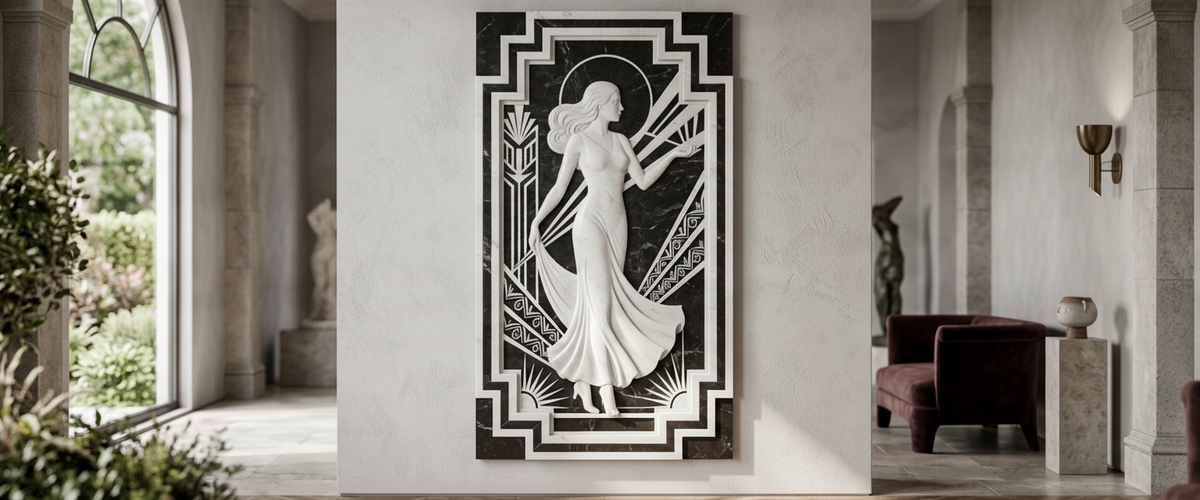
Material choice is the loudest decision you will make. Cast bronze gives deco figures their authority; the original 1920s chryselephantine dancers were bronze-led, and a dark or gently gilded patina still reads as collected rather than bought. Polished stainless steel or chrome-finished metal is the jazz-age register, mirror-bright and reflective, which suits a modern penthouse better than a traditional drawing room. Marble brings the architectural weight, especially in two-tone compositions where the contrast between pale and dark stone does the drawing for you, which is how a panel like the Art Deco Figure Two-Tone Marble Relief Wall Art - 180cm holds its geometry without any gilding to prop it up.
Lacquer is the outlier. Deep black or oxblood lacquered surfaces were central to French deco cabinetmaking, but lacquer is delicate and unforgiving in daylight-heavy rooms. For a sculptural piece you want to keep for thirty years, we steer buyers toward metal or stone. If a piece will ever live near a pool, a terrace door or a coastal window, the conservation guidance on cleaning and handling metals from the Canadian Conservation Institute is worth reading before anyone approaches it with a household spray.
One Deco Statement Piece Beats a Room Full of Period Furniture
Here is where most projects go wrong. Search for art deco style furniture for living room schemes and you will find a hundred matching sets; buy six pieces from one of them and the space reads like a showroom floor. Deco was designed for grand volumes: lobbies, ocean liners, cinema foyers. Dropped into a 12 by 18 foot (3.7 by 5.5 m) living room in six separate objects, it crowds itself.
The better move is one dominant deco form and restrained furniture around it. Where a long living-room wall needs architecture rather than decoration, a stone relief standing 180 cm (5 ft 11 in) does more work than a full suite of period furniture ever will. Put that on the long wall and your sofa can be plain linen, your coffee table plain stone. The piece supplies the period, the furniture supplies the comfort. Buyers browsing our living room art selection tend to land on this logic quickly once they see how much visual weight a single large work absorbs.

Mantel, Console or Entry Axis: Where a Deco Form Takes Raking Light
Deco relief lives or dies on shadow. Flat frontal lighting flattens fluting into a grey smear; a light source set close to the wall and off to one side turns every groove into a crisp line of dark. Three placements consistently work:
Above the mantel. A stepped or fanned form sits naturally over a fireplace, which already gives you a symmetrical architectural frame.
The console vignette. A bronze figure on a console in an entry hall, lit from a ceiling fixture set forward of the piece, not directly above it.
The entry axis. The view you get the second the front door opens. This is the single highest-value position in most homes and the one people waste on a mirror.
A console vignette on the entry axis: the fixture sits forward of the piece so the shadow falls across the form rather than behind it.
We shipped a large deco-inspired relief to a client who had planned it for a hallway, then moved it to the double-height stair wall after seeing how the afternoon light crossed it. Same piece, completely different result. If you are choosing between walls, track the light for a day before you drill anything. Our broader wall art and wall decor range includes pieces that reward that kind of patience, and wrought iron and metal wall decor gives you a harder-edged alternative when marble feels too soft for the room.
The Pastiche Trap: Gilt, Sunbursts and Other Shortcuts
Gold leaf everywhere. Sunburst clocks. Flapper silhouettes in black acrylic. These are the shortcuts that turn art deco style into a costume. The tell is usually finish quality: thin gilt over resin, printed mirror edging, or a motif applied to a shape that has no geometric logic behind it. Real deco design has structure underneath the ornament, which is why a well-made stepped bronze looks expensive even in matte black with no gilding at all.
If you want metallic warmth, use it sparingly and in one place. A gilded highlight on a single edge of a bronze reads as intent. A fully gilded figure reads as a prop.
Commissioning Art Deco Style Work That Looks Made This Decade
A bespoke commission solves the proportion problem that reproduction furniture never can. At Giant Sculptures we start with the wall or plinth dimensions, the viewing distance and the ceiling height, then set the piece's height and depth of relief to suit. Deep relief needs more projection to cast usable shadow; a shallow wall in a narrow corridor needs the opposite. If you want a starting point for that conversation, the proportions of the two-tone marble figure relief are a useful benchmark for height, border depth and how much stone contrast a single wall can carry.
The other thing worth specifying early is the edit. Ask for the geometry and drop the period figuration, or keep the figure and simplify the border. Contemporary deco-inspired work succeeds when it borrows the structure and leaves the costume behind. Budget depends on material, scale, complexity, engineering, installation and finishing, so the honest answer is always a tailored quote rather than a headline figure.

Buyer's Checklist for an Art Deco Style Piece
Measure the wall or plinth, then the viewing distance. Under-scaling is the most common regret.
Identify your light source and its angle before you commit to a relief depth.
Pick one material register and stay in it: bronze, stainless, stone or metalwork.
Check fixings and wall build-up. Marble and bronze reliefs need structural backing, not plasterboard anchors.
Ask what the finish will look like in five years. Patina should be specified, not accidental.
For outdoor or poolside placement, confirm the piece is rated for it and review our outdoor wall art options rather than adapting an interior work.
Request a scale mock-up or elevation drawing before production begins on any bespoke commission.
Buy one piece with real geometry behind it, light it properly, and let the rest of the room breathe. That is art deco style working as design rather than as theme.
For wider placement ideas, Wall Sculptures for the Living Room: How to Choose a Piece That Actually Holds the Wall is useful companion reading before finalising the setting and sightlines.