






































































































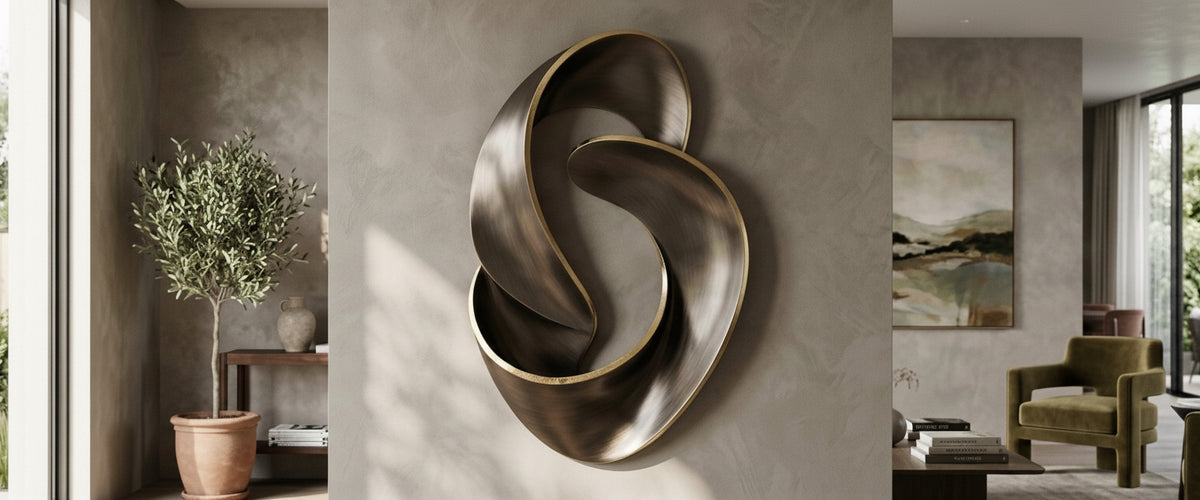

Wall sculptures living room walls have earned because they carry depth that a flat print never can. They cast shadows that shift through the day, catch raking light from a window, and give an otherwise plain surface a physical presence. That is the whole point of choosing a sculpted piece over a canvas, and it is also where most buyers get the decision wrong. When people shop for wall sculptures for the living room, they pick something too small, hang it too high, or ignore how the material reads against the wall behind it.
We ship wall pieces into homes from California ranch conversions to high-ceilinged NYC apartments, and the same questions come up every time. So this is the practical version for anyone weighing up wall sculptures living room ideas: what to compare, what to spend attention on, and where a piece will earn its place.

Key Takeaways for Choosing Wall Sculptures for the Living Room
Scale beats everything. A piece that reads well on the studio floor often disappears on a 12-foot (3.7 m) wall. Measure the wall, not the sculpture.
Material sets the mood. Metal reads crisp and contemporary; wood softens a room; paper craft and layered forms bring texture without weight.
Light is half the artwork. Relief and 3D pieces need directional light to throw shadow. Flat frontal light kills the effect.
Weight and fixing matter. Larger metal work needs proper anchoring into studs or masonry, not drywall plugs.
Bespoke is on the table. If nothing fits your wall, a commission solves scale, color, and finish in one move.

What This Category Actually Means, and Who It Suits
The category of wall sculptures living room buyers reach for runs wider than people expect. At one end you have single sculptural objects mounted to sit proud of the wall. At the other you have modular, multi-panel arrangements that spread across a large expanse and behave almost like architecture. In between sits everything from abstract metal forms to layered wood grids and dimensional paper craft.
Who is this for? Anyone with a wall that feels underused. Homeowners with double-height rooms who need something with vertical reach. Designers finishing a scheme who want a focal point above a low console or fireplace. Collectors who want texture and shadow rather than another framed work. If your space already has a strong art wall, a sculpture usually earns its place better as a solo statement than crowded among frames.
How to Compare Wall Sculptures for the Living Room Before You Buy
Start with the wall, not the piece. Photograph it straight on, measure the width and height of the clear area, and note what sits below (a sofa, a media unit, a fireplace). A good rule from gallery hanging practice is to keep the visual center of the work around eye level, roughly 57 to 60 inches (145 to 152 cm) from the floor, then adjust up for pieces hung above furniture.
Next, when you compare wall sculptures living room options, weigh these four things against each other:
Depth: How far does the piece stand off the wall? Deeper relief throws more shadow but needs clearance and light to justify it.
Palette: Does the finish sit with your wall color or fight it? A gold-edged abstract sings on a deep charcoal or plaster wall and vanishes on cream.
Repeat versus one-off: Modular grids let you scale coverage; a single sculptural form makes a sharper statement.
Read from distance: Living rooms are viewed from across the room, not up close. Fine detail gets lost; strong silhouette wins.
Where the wall calls for a single-statement approach that reads instantly from across the room, a piece like Eclat Sphere Red Abstract Metal Wall Art lets its form and color do the heavy lifting, which is exactly what a solo piece needs on a large wall.
Materials, Finishes, and Scale Decisions
Material is where the room's mood gets decided, and it separates good wall sculptures for the living room from forgettable ones. Here is how the main options behave in a living space.
Metal
Metal wall art gives you crisp edges, reflective highlights, and a contemporary edge. Brushed and polished finishes catch light and change as you move past them. Gold and bronze tones warm a cool room; raw and rustic finishes add grit. Where a scheme needs pulling together without shouting, a flowing metal form with a gold edge such as Astrid Azure Flow Gold Abstract Wall Art is closer to the right design language than a hard geometric block. If you want the full range, our metal wall art collection is the place to compare finishes side by side.
Wood
Wood softens hard-edged interiors and adds warmth that metal cannot, which is why so many wall sculptures living room schemes lean on it. When you want texture and rhythm across a wider span rather than a single focal object, a modular wood grid like Artiora Red Edge & Wood Block Modular Grid 3D Wall Art spreads coverage while keeping a coherent read. Wood does move with humidity, so keep it off walls that back onto bathrooms or run hot from a fireplace flue. The Forest Products Laboratory has good technical background on how wood responds to indoor moisture changes if you want to understand the science before committing.
Layered and dimensional forms
Paper craft and layered floral pieces bring softness and shadow at lower weight, which makes them easy to hang and easy to live with. They suit calmer, tonal rooms where you want dimension without a hard metallic edge. Consider how the layers will read under your existing light before choosing color.
Scale
This is the one people underestimate. A 24-inch (61 cm) piece that looked generous in a photo will float uncomfortably on a 10-foot (3 m) feature wall. As a starting point, aim for the sculpture to fill roughly two-thirds of the available wall width above a sofa or console. When in doubt, go larger; small wall sculptures living room buyers pick for big walls read as an afterthought.
Where to Place Wall Sculptures in the Living Room for the Strongest Impact
For wider placement ideas, Wall Art For Living Room: When Scale Earns Its Keep is useful companion reading before finalizing the setting and sightlines.
Placement decides whether wall sculptures for the living room look intentional or accidental. A few positions consistently work:
Above the sofa: The classic anchor. Keep the bottom edge roughly 8 to 10 inches (20 to 25 cm) above the sofa back so it relates to the furniture without crowding it.
Above a fireplace or media unit: A strong center line. Center the piece on the architecture, not the room, or it will look off-balance.
On a tall empty wall: Double-height rooms cry out for a vertical or oversized piece. This is where a commission usually pays off.
Facing a window: A reflective metal piece opposite natural light will animate through the day.
Light is the part people forget. A relief or 3D piece needs directional light coming across its surface to throw shadow; a wall washer or an angled spot does far more for a sculptural work than a ceiling downlight aimed straight at it. If you can, add a dimmable directional fitting when you install. The lighting guidance from the Illuminating Engineering Society is a solid reference for getting the angle and intensity right on displayed artwork.
Budget, Commissioning, and Delivery
There is no honest single figure for wall sculptures living room projects, because the cost is driven by material, scale, complexity, finishing, and how far it has to travel. A modest layered wall piece and a large fabricated metal commission sit worlds apart. Rather than guess, tell us the wall size, the material direction, and the room, and we will put together a tailored quote.
A few things worth budgeting for beyond the piece itself:
Fixing and installation. Heavier metal work needs mounting into studs or masonry with proper fixings. For anything substantial, use a professional installer.
Crating and shipping. We ship worldwide, and dimensional work is crated to protect edges and finish. Larger pieces travel freight rather than parcel.
Lead time. Stocked designs move quickly; bespoke and made-to-order pieces need production time. Ask early if you have a completion date.
How Giant Sculptures Helps with Bespoke Living Room Projects
When nothing off the shelf fits the wall, we commission. Giant Sculptures is a bespoke sculpture supplier, and wall work is one of the areas where a made-to-order approach solves the most problems at once. We can scale a form to a specific wall, match a finish to your scheme, and engineer the mounting so it hangs safely and sits flush.
One example from the studio: a client with a wide, pale double-height wall in a Napa home kept buying wall sculptures for the living room that looked lost the moment they went up. The fix was not another product; it was a single oversized metal form scaled to the wall, in a finish pulled from the room's bronze fittings. It reads as part of the architecture now, which is what a large wall wants.
If you want to browse before you commission, the living room art collection is a good starting point for scale and mood, and it will point you toward what a bespoke version of wall sculptures living room work could do on your own wall. Send us your measurements and a photo of the space, and we will tell you honestly whether a stock piece works or a commission is the smarter route.