





































































































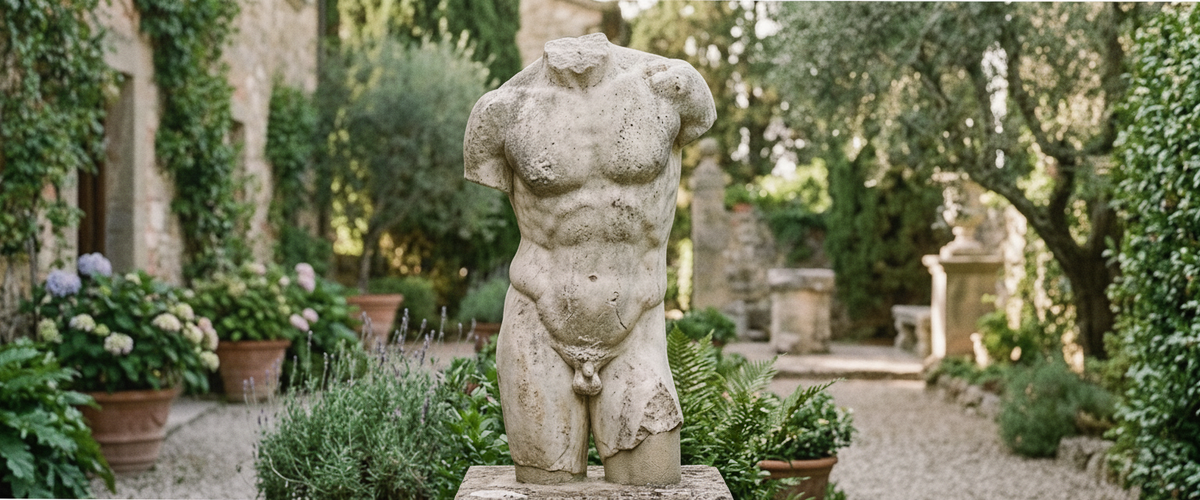

Remove the head, the arms and both legs below the thigh, and a figure gets more interesting, not less. That is the strange arithmetic behind the classical sculpture torso. A complete statue tells you who it is, what it holds and where it is looking. A torso tells you almost nothing, so the viewer stays longer, filling in the missing parts themselves. We see it in the studio every time a fragment goes out on the floor next to a finished figure: people walk past the whole one and stop at the broken one.

At a Glance
The appeal is withheld information. No face, no gesture, no narrative. Just anatomy and surface.
Break edges make or break the piece. Honest, irregular fracture reads as age; a neat sawn stump reads as furniture.
Height is everything. A classical sculpture torso wants to meet your chest, not your knees.
Material sets the mood. Marble for cool restraint, bronze for outdoor life and warmth, cast stone for weight without the cost of solid marble.
Scale changes the job. Around 24 inches (60 cm) it is an object on a console. At life size it becomes architecture.
Fragments flatter tight settings such as alcoves, stair returns and planted borders where a full figure would crowd the space.
A Fragment Holds a Room Because It Refuses to Tell You the Whole Story
Antiquity gave us the taste for this by accident. Most surviving Greek and Roman marbles reached us damaged, and for centuries collectors had them restored with new arms and heads, until nineteenth-century taste turned against the practice and museums began stripping those additions back off. Both conditions, restored and left as found, sit side by side in the Getty's collection of Greek and Roman antiquities. Rodin then made the partial figure a deliberate choice rather than an accident of survival, exhibiting torsos as finished works.
That history matters commercially. A classical sculpture torso is not read as a damaged statue by anyone who knows the form. It is read as a distilled one. Buyers who find a full-length nude too declarative in a dining room or hotel lobby will happily live with a fragment in the same spot, because the piece stops short of confronting anyone.
Marble fragment set so the neck break meets the viewer's chest, keeping the ribcage twist legible.
Reading Ribcage, Obliques and the Moment the Carve Stops
Judge a classical sculpture torso on three surfaces: the sternum and lower ribs, the external obliques above the hip, and the iliac furrow angling down toward the groin. A well-carved classical male torso sculpture shows the ribcage rotating slightly against the pelvis, so even without legs you can tell which hip carried the weight. That twist is the difference between a body and a mannequin.
Then look at where the carve stops. On good work the anatomy keeps developing right up to the edge of the break, as though the sculptor modeled the whole figure and then removed it. On weak work the detail fades out an inch before the fracture, because the maker knew nobody would see the rest. Run your eye along the shoulder stumps in particular. Deltoid mass should still be present and directional.
Female torsos ask a different question. Drapery. A carved chiton falling across one hip gives the fragment its own composition, which is why so many surviving Hellenistic examples still work as standalone pieces. Where a setting needs that softer language at full height instead, cloth can carry the movement in place of anatomy, as it does on Life-Size Classical Robed Lady on Horse Bronze Sculpture - 120cm.

Honest Break Edges Versus a Faked Ruin
This is where most reproductions give themselves away. A genuine fracture in marble follows the crystal structure: irregular, granular, and rougher at the core than at the skin. A faked ruin tends to be sawn flat, then chipped decoratively around the rim, which produces a shallow border of damage and a suspiciously smooth center.
Ask three things before you buy a classical sculpture torso. How was the break formed, is there weathering inside the break as well as on the exterior, and do tool marks in the recesses match the period the piece imitates? Real weathering pools in the hollows and lightens on the high points, because rain and hands do different work. When we produce fragmentary commissions, break geometry is designed at the model stage rather than improvised at the end, and patination is carried into the fracture so it does not glow paler than the rest of the body.
Eye Line and Plinth Height
A classical sculpture torso set too low turns into a garden ornament. The break at the neck should sit near your own chest or slightly above, which usually means a plinth doing real work rather than a low pedestal. Get this wrong and viewers look down onto the shoulders, flattening the ribcage and killing the twist.
Two practical notes from installations we have shipped. First, the plinth needs a top face close to the footprint of the piece; overhang reads as a display stand. Second, in a stair return, aim the front plane of the body at the descending viewer rather than square to the wall, because that is the sightline people actually use.
Marble, Cast Stone, Bronze and Resin
Marble. The classic. Translucent skin, cool interiors, best under shelter or indoors. Marble is calcite based and slowly loses surface definition to acid rain, so exposed sites in coastal or urban air deserve a covered position. Browse examples in Marble Busts and Torsos.
Bronze. The outdoor answer. A patinated bronze classical sculpture torso takes weather, salt air and freeze cycles that would erode stone, and regular waxing keeps the color stable for decades.
Cast stone. Convincing weight and a chalky matte surface that ages fast in a good way. Sensible for larger garden fragments where solid marble becomes a rigging problem.
Resin and composite. Light, cheap to ship, fine for interior styling and film or retail sets. UV will eventually dull it outdoors, so treat it as a short-horizon option rather than an heirloom.
Patinated bronze handles full exposure, and planting crops the figure so the missing limbs stop reading as loss.
Male and Female Torsos at Scale
Around 24 inches (60 cm) a classical sculpture torso behaves like a bronze or marble object: it sits on a console, a library shelf or a reception desk, and it competes with lamps and books. Push to roughly 4 feet (120 cm) and it starts to hold a corner alone. At life size it becomes part of the architecture, and the room has to be planned around it.
Scale also changes anatomy tolerances. Small errors in the oblique or the line of the linea alba are invisible at 24 inches and glaring at life size, which is why full-scale work such as Life-Size Classical Nude Male Figure and Horse Bronze Sculpture - 170cm is modeled from a full armature rather than enlarged from a maquette. Ask any supplier how a large piece was scaled up. The answer tells you a lot.
Alcoves, Stair Returns and Planted Borders
Incomplete figures suit settings that also crop the view. A wall alcove finishes the composition for you. A stair return gives changing sightlines as you climb. In planting, a classical sculpture torso half-swallowed by grasses or box reads as something excavated, and the missing limbs stop feeling like loss.
Outdoors, remember drainage and mounting. Water sitting in an open neck break will freeze, so hollow bronze fragments need weep points and stone pieces need a slight fall on the top surface. In a large garden where a fragment would disappear against long views, a monumental figure like Monumental Classical Female Figure and Lion Bronze Sculpture - 320cm holds distance better; keep the fragment for the courtyard or terrace where people pass within a few feet. More options sit in Garden Statues.

Commissioning Checklist
Confirm the exact break points at model stage, not after casting or carving.
Specify whether patination or weathering continues inside the fracture.
Set plinth height against the viewer's chest, then check the sightline from the main approach.
Match material to exposure: sheltered for marble, open weather for bronze.
Plan drainage, fixings and lifting points before delivery, especially above ground level.
Ask how the anatomy was developed at the scale you have chosen.
Budget depends on material, scale, complexity, engineering, installation and finish, so request a tailored quote rather than working from a guess.
Giant Sculptures produces bespoke fragmentary and complete classical work in bronze, marble, cast stone and engineered metalwork, shipping to private homes, hotels and public schemes worldwide. If you are weighing a classical sculpture torso against a full figure, send us the space, the sightlines and the exposure, and we will tell you honestly which one the setting wants. Start with Bust and Torso Sculptures or the wider Classic Sculptures range.
For wider placement ideas, Buying a Classical Marble Sculpture? Check the Fingers First is useful companion reading before finalising the setting and sightlines.