






































































































Almost every bronze wolf sculpture inquiry that reaches our studio arrives with a reference image, and it is nearly always the same one: the she-wolf in Rome, ribs showing, head cranked sharply off the line of her spine, twins beneath her. That single cast has quietly dictated how sculptors pose wolves for centuries. That is worth knowing before you choose a piece for a ranch gateway, a hotel lobby or an entrance court, because stance, not size, is what decides how the animal behaves in your space.

At a Glance
Stance sets the mood. Stalking reads as threat and movement, howling reads as landmark, standing alert reads as guardian.
Head studies buy you interior placement. A wolf head on a plinth works where a full body would crowd the room.
Dark brown or near-black patina beats green on a heavily modeled coat, because verdigris flattens fur texture.
Pairs and pack groups need sight lines, not just floor area. Plan the angles before the plinths.
Budget follows material, scale, complexity, engineering, finishing and installation. Ask for a tailored quote rather than working from a ballpark.
Why the Capitoline Wolf Bronze Sculpture Still Sets the Pose
The Capitoline wolf bronze sculpture is the ancestor of most wolves cast since. Long read as Etruscan, its dating has been argued over for decades, and technical study of the casting has moved much of that argument toward a medieval origin, with the suckling twins added in the fifteenth century. The Capitoline Museums hold the original. What matters commercially is the pose: a low, level body with the head turned sharply off-axis, which gives you a sculpture that changes character as you walk past it.
That turned head is the trick worth stealing. A wolf facing straight down its own spine looks taxidermied. Casts that stay close to the Roman lineage, twins and all, tend to go to collectors and institutions who want the Romulus and Remus reference read instantly rather than a naturalistic animal.

Stalking, Howling or Standing: Three Stances, Three Different Buildings
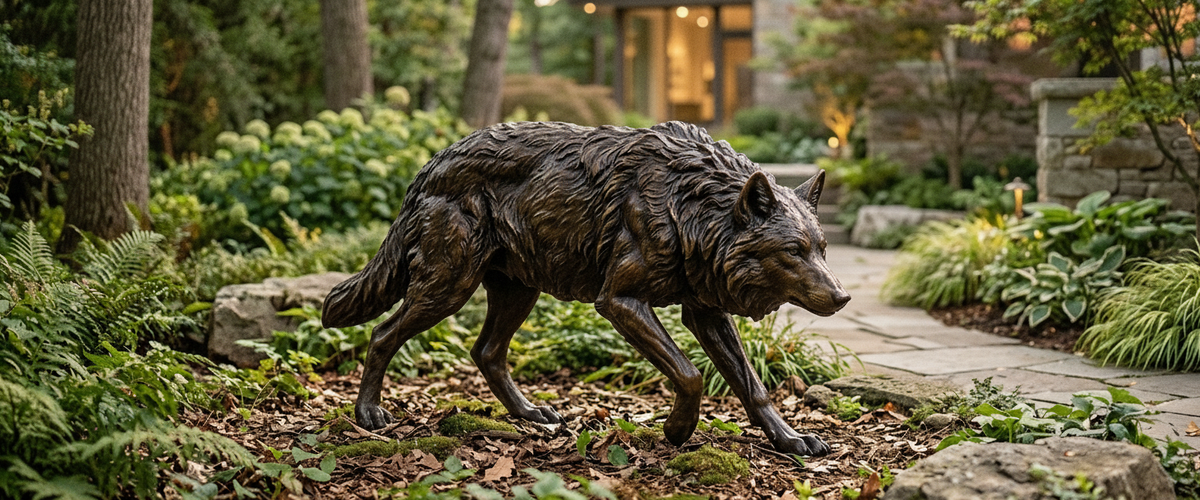
A stalking wolf carries tension. Shoulders dropped, head low, one forepaw lifted, and the whole mass leaning into a direction. It needs open ground in front of it or the energy dies against a wall. Where the approach is long and the animal is first read from thirty or forty feet out, something in the register of the Life-Size Traditional Stalking Wolf Bronze Sculpture at 120cm, close to 4 ft, is the scale that holds a lawn approach or gravel drive without needing a plinth to be noticed.
Read from the drive, the dropped shoulder and lifted forepaw are what carry the movement.
Howling is the vertical option. The muzzle lifts, the throat line stretches, and you gain height without gaining footprint, which is why a piece on the scale of the Life-Size Howling Wolf Bronze Sculpture - 220cm (about 7 ft 2 in) reads as a landmark rather than an ornament. Set one on a rise or against a tree line and it does the work of a much larger abstract piece.
Standing alert is the guardian stance, and it is the one people under-order. It is calm, symmetrical enough to pair, and it survives close viewing at a doorway where a snarling animal becomes tiring after a month. If the piece will sit within ten feet of people every day, standing wins.
Full Body, Head Study or Pack Group
A full body needs air on at least three sides. Push it into a corner and you lose the silhouette, which is the whole point of a quadruped in bronze.
A bronze wolf head sculpture solves the interior problem. Cropped at the neck and mounted on stone or a steel column, it becomes a portrait rather than an animal, and it holds a reception desk, a library niche or a stair landing without dominating circulation. Buyers browsing our bronze busts and heads often arrive wanting a full wolf and leave with a head study once they measure the room honestly.
Pack groups are the most demanding and the most rewarding. A grouping like the Monumental Three Wolf Bronze Sculpture - 220cm only works when the animals read as a unit from the main approach and then break apart into individuals as you move. We set a group like this for a ranch entrance outside Bozeman, and the lesson from that install was blunt: we rotated the lead animal about fifteen degrees on site because from the road the original angle made the pack look like it was leaving rather than watching.

Fur Texture Against Patina: Why Dark Wax Beats Verdigris
Wolves are the hardest animal to patinate well, because everything good about the modeling lives in the coat. A deeply worked pelt, with tool marks running along the guard hairs and knife-cut depth at the ruff, needs a patina that separates high points from hollows. Dark brown to near-black chemical patina, finished with a hot wax, does exactly that: the wax sits in the recesses and the raised fur catches light.
Dark wax settles into the hollows of the ruff so the guard hairs stay legible in raking light.
Green verdigris finishes do the opposite. They read as one uniform botanical color and flatten the coat into a mass, which is why a green wolf so often looks like a dog. Save verdigris for smooth classical drapery.
Ongoing care is simple and non-negotiable outdoors. Wash with clean water and a soft brush, dry it, and re-wax on a regular cycle; conservation guidance from the American Institute for Conservation covers the principle well. Exposed coastal sites need attention more often than dry inland gardens.
Placement: Gateways, Lodge Entrances and Lobby Plinths
For wider placement ideas, Buying a Bronze Figurative Sculpture: How Scale and Placement Decide the Whole Room is useful companion reading before finalising the setting and sightlines.
Wolves are directional animals, so placement is about where the head points. At an estate gateway, set a pair slightly toed inward toward the drive rather than square to the road; square-on reads as municipal, angled reads as watchful. At a lodge or clubhouse entrance, keep the piece off the door line so arriving guests pass it in profile.
Indoors, plinth height decides everything. Aim to bring the animal's head into the range of adult eye level and no higher, or you lose the face and gain a view of the belly. Bases matter structurally too: a stalking pose concentrates load on fewer contact points than a standing one, so tell us the substrate early and we will engineer the fixing and internal armature to suit. Anything crossing a paved terrace, roof deck or suspended slab needs that conversation before casting, not after.
Modern and Faceted: When Stripping the Realism Sharpens the Animal
A modern bronze wolf sculpture works when the geometry keeps the anatomy honest. Faceted planes across the skull, a wedge-cut muzzle, legs reduced to tapered blades. Done well, the abstraction reads as the animal at a hundred feet and as pure sculpture at ten.
If your research has taken you through searches like bronze wolf sculpture Basel or bronze wolf sculpture Kunstbetrieb, you have landed on the contemporary fabrication side of the subject. Kunstbetrieb, the art fabrication workshop near Basel, is the kind of operation contemporary artists use for casting and precision metalwork, and work of that type is usually specified for gallery and exhibition conditions rather than decades in open weather. The useful takeaway for buyers is the question set: ask any supplier about casting method, wall thickness, weld and chasing quality, internal support and how the patina was applied.

Checklist Before You Commission
Decide the primary viewing distance and angle first, then choose the stance.
Measure clear space on all sides, not just the footprint.
Confirm lost-wax casting, wall thickness and internal armature specification.
Choose patina against your background color: dark bronze on pale stone, warmer brown against dark timber or evergreen.
Agree the base, fixing detail and substrate load before production starts.
Plan access for delivery: crate size, crane or gantry needs, and final positioning.
Set a wash and re-wax schedule in year one so the finish never falls behind.
Wolves reward buyers who commit to a stance and then build the setting around it. Browse the bronze wolf statues collection to see the range of poses at scale, look through bronze garden statues for how patina behaves in planted settings, and talk to Giant Sculptures about a bespoke commission if the pose, size or grouping you need does not yet exist. Scale, engineering and finish are all specified to the site, and that is where a bronze wolf sculpture stops being a purchase and starts being a fixture.