





































































































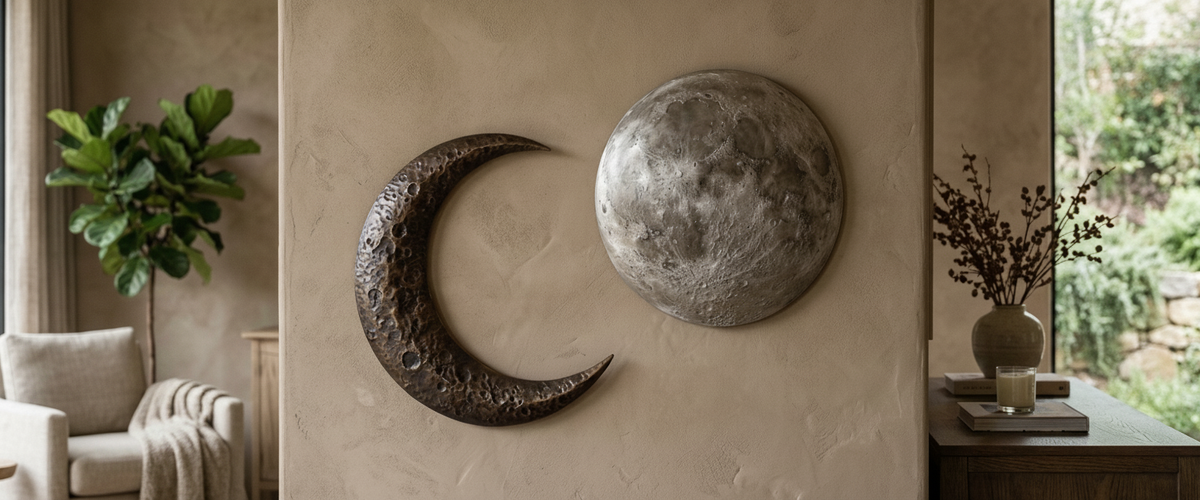

A single moon disc bolted dead center on a garden wall looks decisive for about a week. Then the eye learns it in half a second, parks, and moves on. That is the quiet failure mode of the outdoor moon wall sculpture: the shape is so resolved, so symmetrical, that it gives the viewer nothing left to do. The pieces that keep working year after year almost always come as a pair or a short sequence, with a deliberate gap between them and a wall chosen for what it does to a curved edge.

Quick Answer: What Makes an Outdoor Moon Wall Sculpture Work
Pair or sequence over solo disc. A crescent beside a gibbous form gives the eye somewhere to travel.
Gap discipline. Space phases at roughly a third to a half of the largest disc's width, and keep those gaps consistent.
Backdrop first. Smooth render flatters a crisp silhouette; brick and timber fight it unless the relief is deep.
Compose for where people sit, not where they enter.
Mount off the wall on spacers with isolating washers so damp masonry never feeds a rust streak.
Grazing light or no light. Flat frontal floodlighting kills crater texture instantly.
One Full Disc Stalls the Eye, a Crescent Pair Keeps It Moving
A full circle is a closed shape. It resolves. A crescent is an interrupted shape, and interruption is what buys you a second look. Put a deep crescent alongside a fuller disc and you create an implied direction, a sense that something is happening rather than hanging. We have watched this play out on courtyard commissions where the client started out wanting one large moon on a long stucco wall. Mocked up in cardboard on site, the single disc looked like signage. Two forms at different phases, offset vertically by about a foot (30 cm), read immediately as sculpture. That is the compositional test for any outdoor moon wall sculpture: does the eye have somewhere to go once it arrives?
A crescent set beside a fuller phase gives the eye a route across the wall instead of a full stop.
Scale drives the decision too. A wall over about 20 ft (6 m) long swallows a lone 3 ft (0.9 m) disc. Either go big enough that the single form commands the plane, or break the idea into parts and let the spacing carry the composition. It helps to measure against something already built at that scale: a panel on the order of the Six Galloping Horses Marble Relief Wall Panel - 180cm is roughly the footprint a single moon needs before it stops looking like an accessory on a long garden wall. Big single forms work; they just need to be genuinely big, and that means engineering, mounting hardware and a wall survey rather than a hook.

Spacing the Phases So They Read as a Sequence, Not Clutter
The gap does more work than the discs. Too tight and the group reads as one lumpy mass; too loose and the pieces lose their relationship and become separate ornaments on the same wall. A workable starting rule: set the gap between forms at roughly a third to a half of the widest disc, then hold that measurement across the whole run. Inconsistent gaps are what make a moon group look accidental, and spacing is the one decision an outdoor moon wall sculpture cannot recover from once the holes are drilled.
Vertical placement matters as much. Staggering the heights slightly, the way the moon climbs across the sky, gives the sequence motion. Perfectly level centers give you a row, and a row reads institutional. Keep the stagger small and rhythmic rather than random.
Render, Brick and Timber: What Each Backdrop Does to a Moon's Edge
Smooth painted render or stucco is the friendliest backdrop for an outdoor moon wall sculpture. The silhouette stays clean, the shadow gap reads sharply, and a brushed stainless or darkly patinated bronze moon separates from the surface without any help. Pale render also bounces light back up into the underside of a relief, which flatters cratered texture.
Brick is busier. The coursing lines cut across a curve, so the piece needs either strong tonal contrast or real depth to hold its own. This is where a heavier relief tradition pays off. Against coursed brick, deep modeling of the kind carried by the Galloping Herd Bronze Relief Wall Art - 120cm holds its edge because the form casts its own shadows regardless of what is happening behind it, and a moon on the same wall needs the same relief depth to survive. Timber cladding is trickiest of all: warm, directional grain competes with a circle, and seasonal movement in the boards means fixings must go into structure, not cladding.
Tonal contrast is the other lever, and pale stone behaves differently outdoors than most buyers expect. Set against a dark wall, the crisp white ground of a marble panel like the Bamboo Grove and Rockery Marble Relief Wall Panel - 100cm does the separating work on its own; against pale render the same stone dissolves and the piece has to earn its reading through depth instead. A moon obeys exactly the same rule, which is why finish and backdrop have to be chosen together rather than one after the other.

Sightline First: Compose for the Patio Seat, Not the Garden Gate
Most people design wall pieces from the approach path, because that is where they stand while planning. Then they spend every evening looking at the piece from a dining chair 12 ft (3.7 m) away and 18 inches (46 cm) lower. Sit where you will actually sit. Hold a cutout at that angle. From a seated position, an outdoor moon wall sculpture hung at the height that looked right standing will often float too high and lose its connection to the terrace.
On one poolside commission the whole sequence dropped by nearly 10 inches (25 cm) after the client tested it from a lounger. Nobody would have noticed the original height was wrong; they just would not have looked at it much.
Mounting an Outdoor Moon Hanging Wall Sculpture Off a Damp Wall
Garden walls hold water. Mount any outdoor moon hanging wall sculpture flush against damp masonry and you trap moisture behind it, which stains the wall, accelerates corrosion at the fixing points and makes the piece impossible to clean behind. Stand it off on stainless spacers. The air gap dries, and the shadow line you gain makes the form appear to hover, which is worth as much visually as it is technically.
Spacers create the drying gap and the shadow line at the same time.
Two details separate a clean installation from a streaky one. First, isolate dissimilar metals at every fixing with nylon or neoprene washers so galvanic action does not start quietly under the bracket. Second, if you are using weathering steel, plan for runoff; the early oxide stage releases stain-carrying water, and the American Institute of Steel Construction's guidance on weathering steel is blunt about designing so that runoff never lands on light stone or render. A drip detail or a gravel strip at the base solves it.
Grazing Light or Nothing at All
After dusk, a flat floodlight aimed straight at an outdoor moon wall sculpture erases everything the sculptor built into the surface. Craters, hammer marks, cast texture: gone. Light from a shallow angle instead, ideally from a small fixture mounted above or to one side, so the beam skims the face and every raised rim throws its own shadow. Keep the source shielded and aimed at the sculpture rather than the sky; DarkSky International's lighting principles are a sensible reference for warm color temperature and controlled spill, and they happen to produce better sculpture lighting as a side effect.
A shallow beam angle lets every raised rim cast its own shadow after dark.

Adding a Third Moon Later Without Wrecking the Rhythm
Buyers often start with two and want a third a year on. Extending an outdoor moon wall sculpture group works if you planned the interval. Keep the established gap, continue the vertical stagger in the same direction, and match the phase logic rather than repeating a shape you already have. What breaks a group is adding a piece in a different material or finish age; a fresh mirror-polished disc next to two weathered ones looks like a repair. If a phased build is likely, tell us at the commission stage and we will record the alloy, finish specification and patina recipe so a later addition matches.
Checklist Before You Commit
Cardboard mockups taped to the wall, viewed from the seating position at the time of day you use the space.
Wall construction confirmed: solid masonry, cavity, or cladding over frame, and fixings specified accordingly.
Spacer depth chosen for both drying and shadow gap.
Metal isolation washers at every contact point.
Runoff path checked against any pale paving or stone below.
Lighting angle decided before the fixings go in, not after.
Finish and material recorded for future additions.
Access agreed for cleaning the wall behind the piece.
Commissioning a Bespoke Moon Group
Most outdoor moon wall sculpture commissions we take on are bespoke for a reason: wall lengths, seating angles and phase counts are never standard. Budget depends on material, scale, relief depth, engineering, mounting hardware, finishing and installation, so the sensible route is a tailored quote once the wall and sightlines are known. Browse Outdoor Wall Art & Decor to see how weight and depth read on exterior walls, and 3D Wall Art for the relief depth that makes outdoor wall hanging sculptures survive textured backdrops. Then talk to Giant Sculptures about proportions before anyone drills a hole.
For wider placement ideas, Choose Garden Wall Art From the Patio Chair, Not the Ladder is useful companion reading before finalising the setting and sightlines.