





































































































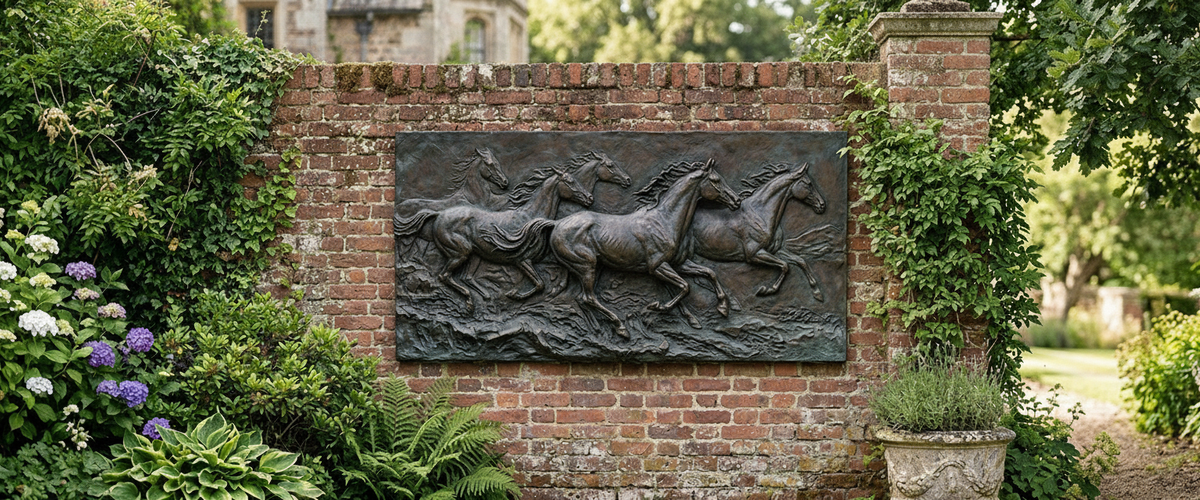

Most garden wall art fails long before it weathers. It fails the afternoon it goes up, when the owner walks back to the patio, sits down, and realizes the piece they measured on a ladder from eighteen inches away reads as a smudge from thirty feet (9 m). The panel is fine. The wall is fine. The relationship between them was never checked.
We spend more time asking about walls than about subjects. A render finish, an old brick boundary and a timber fence are three completely different engineering problems, and each one narrows the field of suitable garden wall art before anyone talks about horses, figures or foliage.

Key Takeaways Before You Shop
The wall decides the fixing, and the fixing decides the weight. Render over blockwork, solid brick and fence posts each carry very different loads.
Relief depth beats size once planting matures. Shallow etching disappears behind a July border.
Orientation is a design input. A north-facing wall never gets the raking light that makes deep relief read.
Judge scale from the seating position you actually use, not from the ladder.
Material aging is a choice, not a defect. Corten stains, bronze patinates, cedar silvers, powder coat holds color.
Budget follows material, scale, relief complexity, engineering and installation. Ask for a tailored quote rather than assuming a piece scales linearly with width.
Three Walls, Three Completely Different Plans
A smooth rendered wall looks like the easiest surface in the garden and is often the trickiest. Render hides what is underneath. We have had a client in Marin County send photos of what looked like solid masonry; it turned out to be a single skin of blockwork over an old garage, and the resin anchors had to land in specific cores rather than wherever the composition wanted them. On render, we design the fixing pattern first and the panel layout second.
Old brick boundaries are usually the most generous hosts for heavy garden wall art. Solid brickwork takes stainless steel anchors well, and the color of aged brick flatters bronze better than almost anything. Against that kind of texture, a deep-cast panel such as the Galloping Herd Bronze Relief Wall Art - 120cm at roughly 4 ft (120 cm) wide has an easier job than a flat plaque, because the undercuts throw real shadow onto a surface that already carries some grain of its own.
Timber fences are the honest constraint. A fence panel is a wind sail, not a structural wall. Either the piece hangs from the posts, or it hangs from a freestanding frame set behind the fence line. Lightweight aluminum or cedar panels usually make more sense here than stone. If you are set on marble or bronze on a boundary like this, build a pier. We would rather quote for the pier than watch a panel take a fence down in a spring gale.
Relief Depth Versus a July Border
Gardens photograph in April and get lived in during July. That gap catches people out. A perennial border that reads as neat mounds in spring can push 3 to 4 ft (0.9 to 1.2 m) of growth by midsummer, and most of that height arrives in a few weeks once the soil warms. Check the mature heights of anything planted near the wall; the Missouri Botanical Garden plant finder lists them species by species. Anything shallower than about an inch of relief loses its bottom third to grasses and salvias and never comes back until the fall cutback.
Two fixes. Mount higher than instinct suggests, so the composition sits clear of peak growth. Or choose deeper carving, where the figures still hold their edges when foreground planting starts to crowd. Where a long wall sits behind a deep border, something like the Walking Herd Four Horses Marble Relief Wall Art - 200cm at about 6 ft 7 in (200 cm) answers both problems at once: the length gives you horizontal reach above the planting, and the modeling is deep enough to survive foreground clutter. Browse the wider 3D wall art range if you want to compare relief depths side by side.

What Low Winter Sun Does That Midday Summer Light Cannot
Relief sculpture is lit sculpture. Low winter sun crosses a wall at a shallow angle and rakes every undercut, which is why a panel can look magnificent in February and oddly flat in June, when overhead light drops straight down and kills the shadows. On a south-facing wall in Texas or Arizona, midday sun flattens even good carving for hours at a stretch.
Practical response: on a bright, high-sun elevation, choose stronger modeling and darker patina so the piece works on tonal contrast rather than shadow alone. On a shaded north-facing wall, go the other way. A pale marble panel like the Bamboo Grove and Rockery Marble Relief Wall Panel - 100cm keeps its drawing in soft light, where a dark bronze of the same size would sink into the masonry behind it. And if you can, add a low-level grazing light set close to the wall. It reproduces winter sun on demand.
Corten, Powder-Coated Aluminum and Cedar After Five Wet Winters
Materials age in public. That is the point of outdoor work, and it is where buyers get surprised.
Corten (weathering steel): forms a stable oxide layer and then settles down, but the run-off in its first two winters will stain pale stone and concrete below it. Detail a drip gap or accept the streak as part of the look. Guidance from the American Institute of Steel Construction is clear that weathering steel needs proper wet and dry cycles; keep it out of permanently damp, sheltered corners.
Powder-coated aluminum: holds color and stays light, which makes it the sane choice for fence-mounted work. Expect gradual gloss loss on high-UV elevations, and specify a marine-grade coating system near coastal air.
Cedar: silvers to a soft gray within a couple of wet seasons and needs its end grain kept off standing water. Left untreated it ages gracefully; oiled, it needs a schedule you will actually keep. See our wood wall art for the warmer, quieter end of the range.
Bronze and marble: the long-life options. Bronze patina shifts and can be waxed annually; marble reliefs want a wall that sheds water rather than dumps it down the face.
Judging Scale for Garden Wall Art
Here is the test we give every client. Cut cardboard to the exact panel size, tape it to the wall, then go and sit in the chair you sit in every evening. Not the ladder. Not the kitchen window. The chair.
Seen from 20 to 30 ft (6 to 9 m), a panel under 3 ft (90 cm) wide reads as decoration. Past about 6 ft (1.8 m), it starts to read as architecture. Courtyards under 15 ft (4.5 m) across reward vertical or roundel compositions, because you meet them close up and head-on at the end of a short axis; long garden walls reward horizontal ones that travel with the eye rather than stopping it.
Garden Wall Art for Indoor and Outdoor Decoration
Plenty of our relief work crosses the threshold. Garden wall art for indoor and outdoor decoration makes most sense when a room and a terrace share a sightline: a marble panel in a pool house echoing one on the garden wall outside, or a bronze relief in an entrance hall that repeats at a smaller scale on the rear elevation. Indoors you can drop the relief depth, because you control the lighting. Outdoors you cannot, so specify up.

What We Ask Before Quoting
Wall build-up: solid brick, block and render, stone, timber frame or freestanding pier? Any cavity or insulation behind?
Orientation: which way does the wall face, and what shades it in summer?
Viewing distance and eye level: where do people stand, sit and approach from?
Planting plan: mature heights of anything within 6 ft (1.8 m) of the wall.
Exposure: coastal salt, hard frost, sprinkler overspray, run-off from above.
Access: can a lift or hoist reach the wall, or is it a hand-carry through a side gate?
Material and finish intent: do you want the piece to change over time, or hold its day-one appearance?
Answer those seven and a commission becomes straightforward. Giant Sculptures works with designers, landscape architects and private clients on bespoke relief panels and large-scale outdoor pieces, sizing and engineering each one to the wall it will live on. Start with the outdoor wall art and decor collection to fix a direction, or send us wall photos and a rough seating plan and we will quote against the real conditions rather than a guess.
For wider placement ideas, Sandstone Art Wins in Gray Light: A Placement Guide for Walls and Gardens is useful companion reading before finalising the setting and sightlines.